
What this suggests
Whether the team has the energy for change, or is already under strain.
A free, anonymous employee engagement survey for one team: nine statements on how people feel about their work and the company, with the culture gaps behind them.
New to these tools? Start with team personality, about two minutes each.
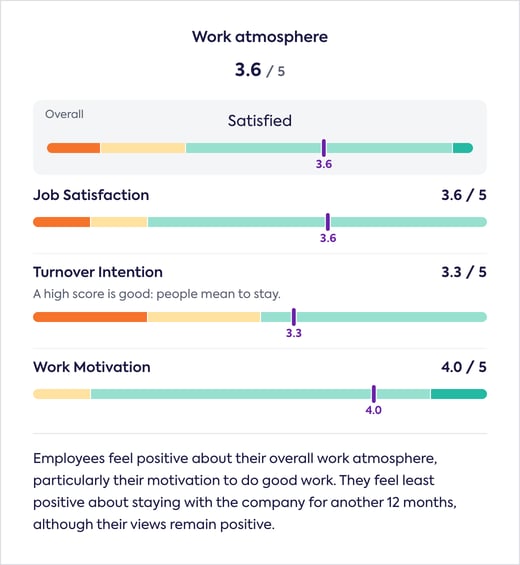
3 of 5 work atmosphere statements shown.
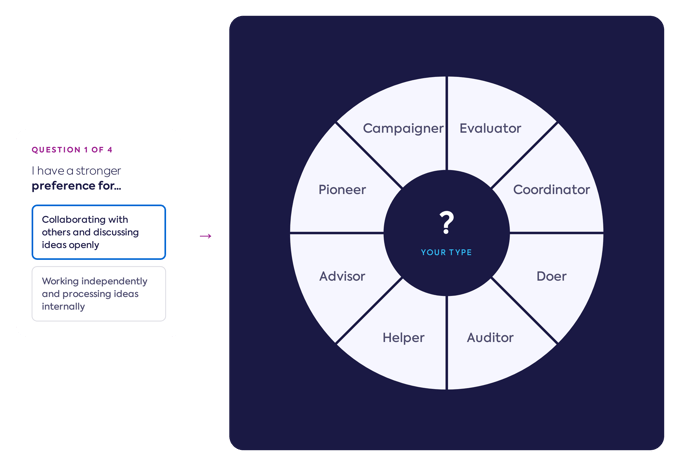
The types of work that naturally motivate each person and the team as a whole.
Team personality
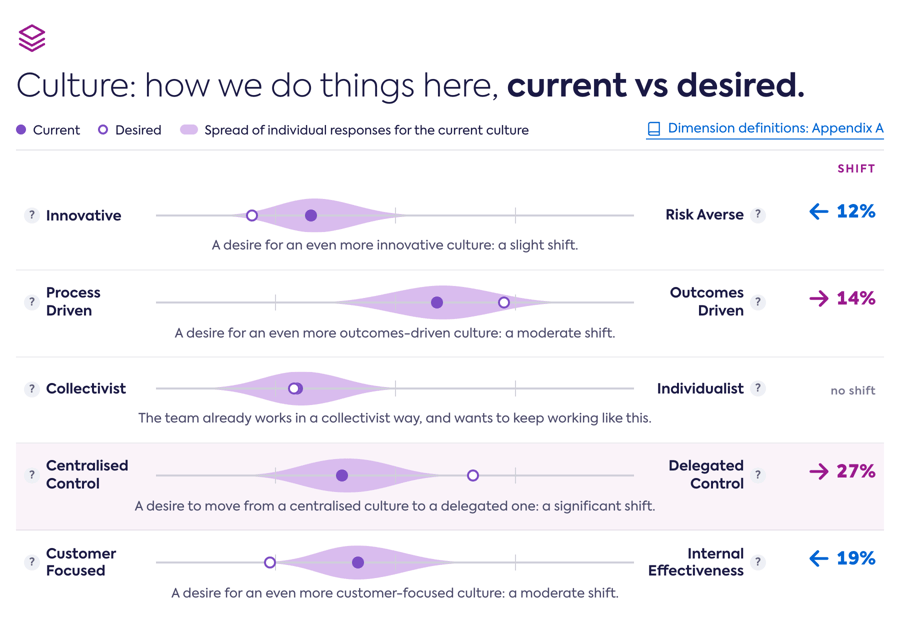
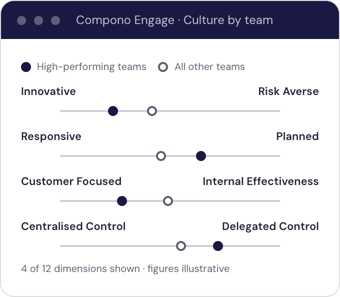
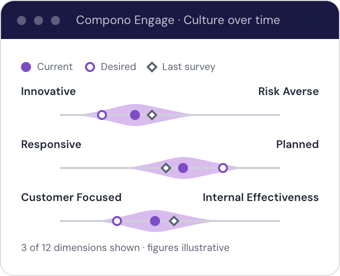
How we do things around here: the work environment we have today versus the one we want to achieve our goals.
Team culture
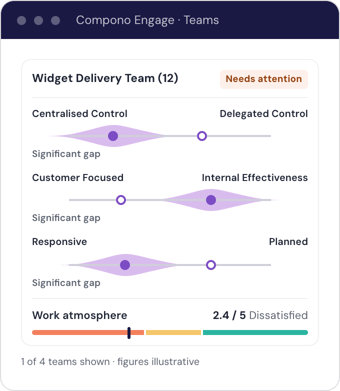
Workplace atmosphere (climate) reflects how people feel about their current work environment and the way things get done.
Team culture
How people feel shapes their behaviour and performance, ultimately influencing organisational outcomes.
Start with either report and add the other when you're ready.
Most engagement surveys stop at the score, so you know how people feel but not why. This one reads how your team feels about its work and the company beside how it works now and how it should.
So you know where to start, before good people quietly check out.

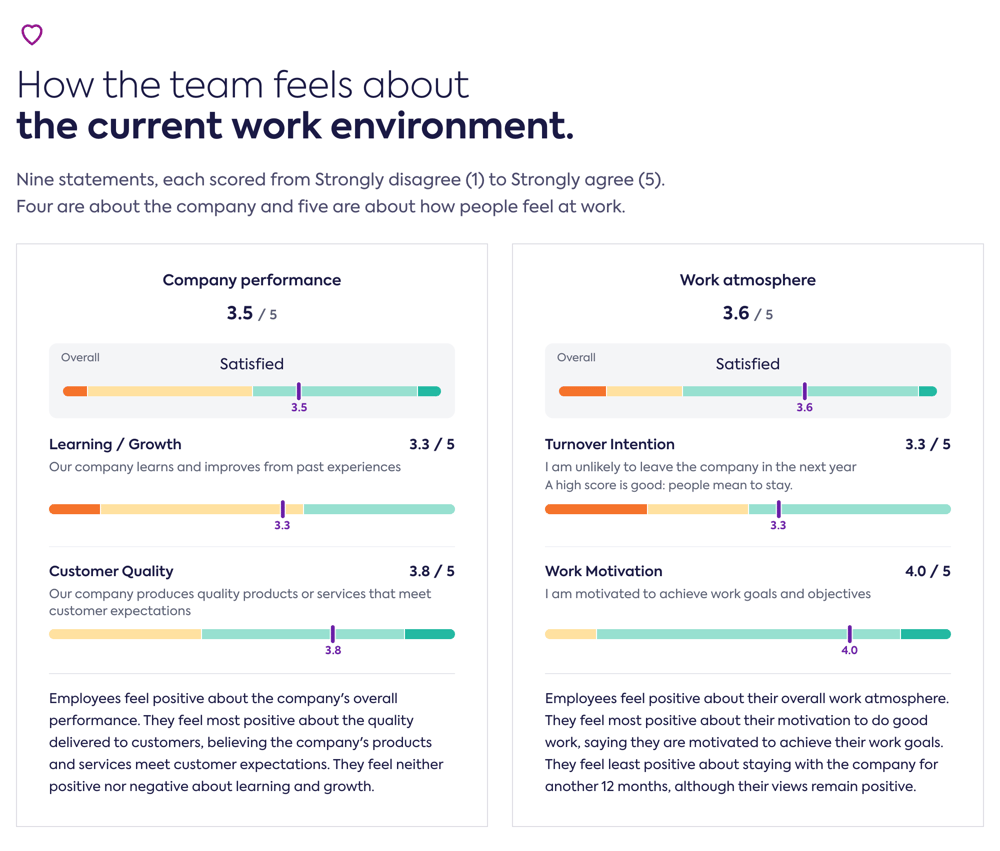
Company performance and work atmosphere, side by side, each rated from Very dissatisfied to Very satisfied.
Whether the team has the energy for change, or is already under strain.
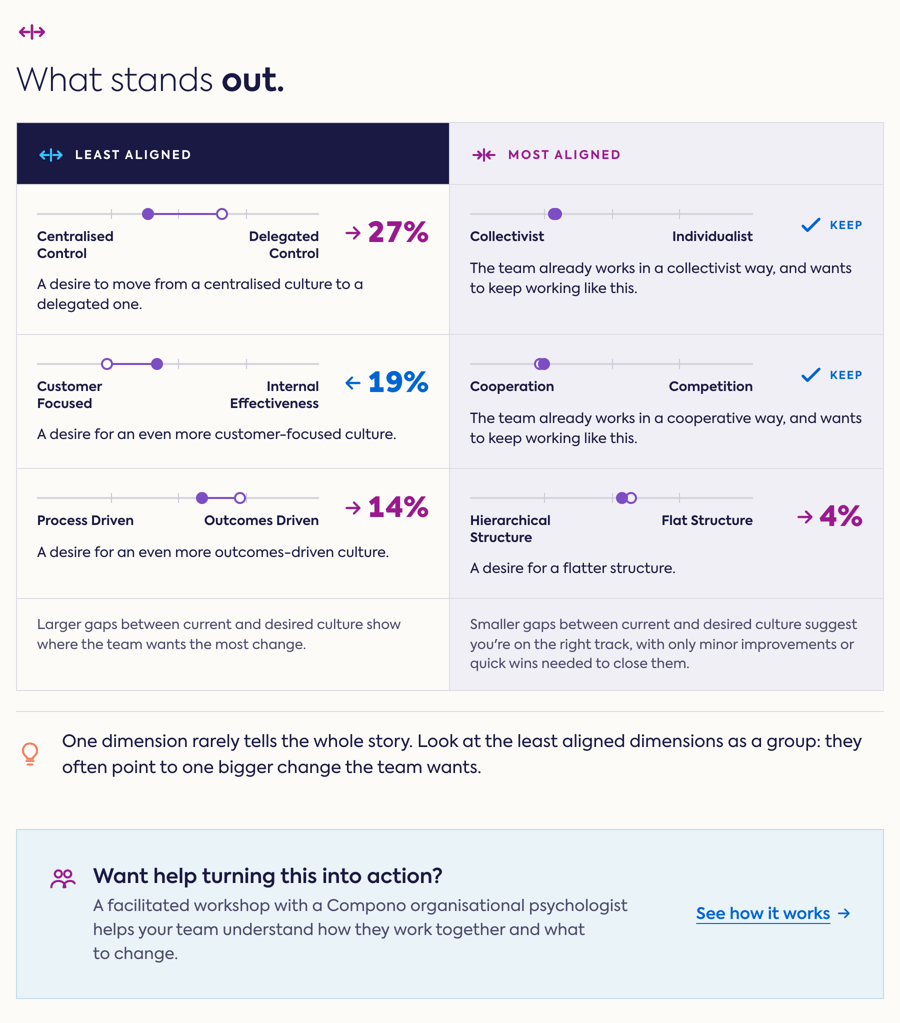
Where current and desired culture sit furthest apart: what sits behind the score.
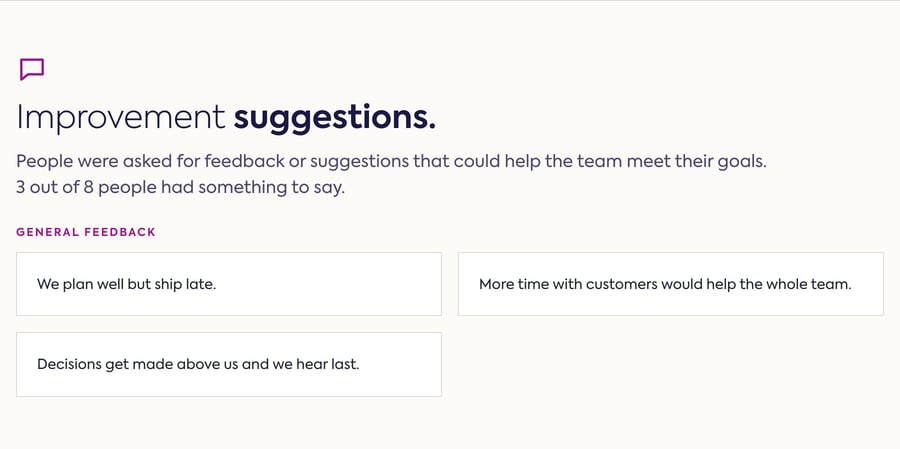
What people wrote, as written, without names.
How the company is performing and how people feel at work, side by side, each with the report's reading.
The same survey shows your culture: 12 dimensions, current against desired, and where the team is least and most aligned.
The report opens with the biggest desired shifts and two scores out of 5.
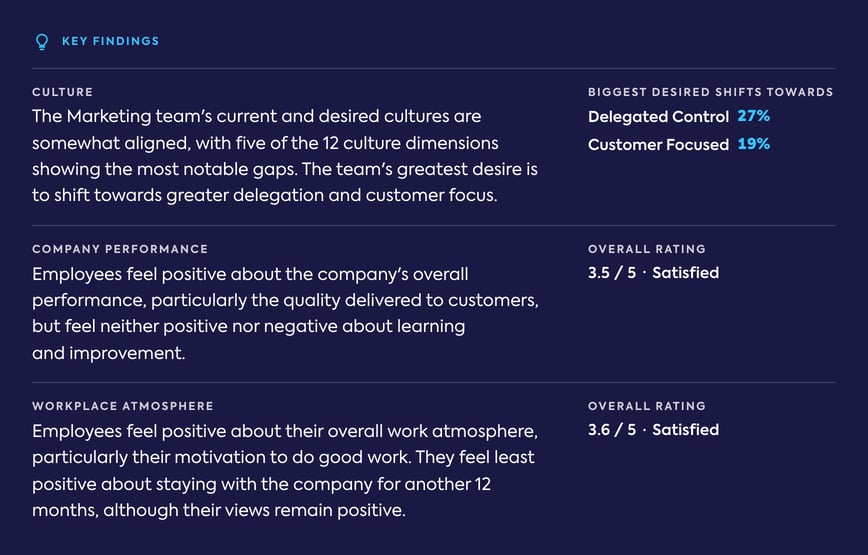
The culture behind the score: the team's biggest desired shifts, beside where it's on the right track.
Every comment grouped by topic, without a name.
This is a preview. Get started with your own team.
Get startedWeigh every candidate's fit with the culture your team asked for.
Put people where the way the team works suits them.
Build habits that make the shift happen, even when it doesn't come naturally.
Your email and first name. The team name is optional.
You go first, then share one link with your team.
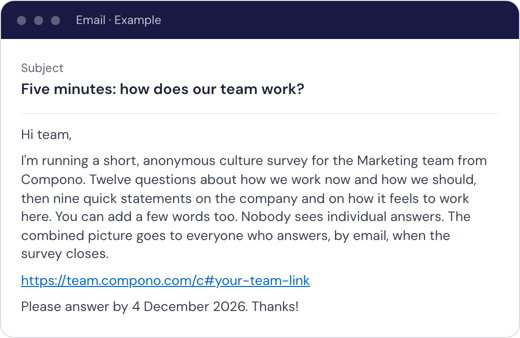
A ready-made message goes with it, to copy or open in your email app.
Everyone who answered gets it by email when the survey closes, if three people have answered.
Example

No name or email sits with anyone's answers.
Each person gives a first name and email before sending, stored apart from the answers.
Below five answers, no count shows under any statement.
The combined scores and the suggestions people wrote, never a person's line.
Names and emails are used to send the report and follow up, never shown in it.

The free engagement survey covers one team, at one point in time. Compono Engage shows how people feel over time, with culture beside it.
We can show you engagement and culture across every team and subculture, with practical insight right across the business.
Free, for one team
In the Compono platform
Compono Engage
How every team feels about its work and the company, by group and over time, with the culture gaps that matter most.
Compono Hire
Every candidate's culture fit checked, so new hires suit the culture the team asked for.
Compono Develop
A learning management system (LMS) that builds the capability each person needs for their role.
Compono Assist: ask anything about a report in plain words.
Compono Engage
See it with your own team before you talk to anyone. Nine statements and the twelve dimensions behind them, about five minutes a person.

No. Keep the tools you have. This is a different lens: it reads how your team feels beside how it works now and how it should work.
Run it with your team first and bring your results to the conversation. After a demo, it's an easy way to show the rest of your team what the platform reads.
Nine statements, each scored from Strongly disagree (1) to Strongly agree (5). On the company: our company is performing well financially; runs effectively and efficiently; learns and improves from past experiences; produces quality products or services that meet customer expectations. On work: I am engaged in my job; I am satisfied with the tasks and responsibilities of my job; I am unlikely to leave the company in the next year; I am motivated to achieve work goals and objectives; my work environment is positive and supportive.
There's nothing to download or set up. The survey is ready to run: send one link, and your team answers the nine statements above with the 12 culture dimensions beside them.
Not quite. It's one short survey for one team at one point in time, about five minutes a person. Running it across every team and over time is what Compono Engage does.
It is a team survey with an engagement part. The nine statements come with the twelve culture dimensions, because a score tells you where the team stands and the culture tells you what sits behind it. About five minutes a person, one report.
Each half, the company and the work, is averaged into one score out of 5 and rated the platform's way: 1.0 to 1.8 Very dissatisfied, 1.9 to 2.6 Dissatisfied, 2.7 to 3.4 Neutral, 3.5 to 4.2 Satisfied, 4.3 to 5.0 Very satisfied. Neutral is not fine: people are often still deciding.
No. The twelve culture dimensions and the nine statements are the survey; only the improvement suggestions can be skipped. The report reads the scores beside the largest culture gap, and it cannot do that from the scores alone.
No. The score is this team's own, read against this team's own culture gaps. The Compono platform reads engagement by location, by function and over time, and does not benchmark against other organisations either.
No answer has a name or email on it. Each person's name and email are kept apart from their answers, and scores show only combined. Below five answers no count shows under any statement.
So each person answers once, gets the report when the survey closes, and so we can help or follow up. It is stored apart from the answers and never appears in the report.
You see how many have answered while it's open. It closes when you close it, or 14 days after you start. Then everyone who answered gets the report by email, if three people have answered. From five answers it also shows the spread on each line.
A low score with large culture gaps means the team may be under strain: change is probably needed, and pace, communication and trust matter as much as the change itself. A low score with small gaps needs a closer look in person, because people may have stopped expecting change.
Yes, up to 200 people. Past 20, the report says it's several cultures in one survey, where a gap in one group can hide behind calm in another. Finding hotspots by team and division is the Compono platform's job.
Add the survey to it from your dashboard. If that team has already run the culture survey, it has run this one: they are the same survey. One email, one team at a time. Once this team's reports have ended you can start a new team, which takes the old one off your dashboard, so keep the PDF.