


 Mathan Allington


How to turn a job description into a hiring scorecard
 Mathan Allington
To turn a job description into a hiring scorecard to remove bias, standardise interviews, and make better recruitment decisions.
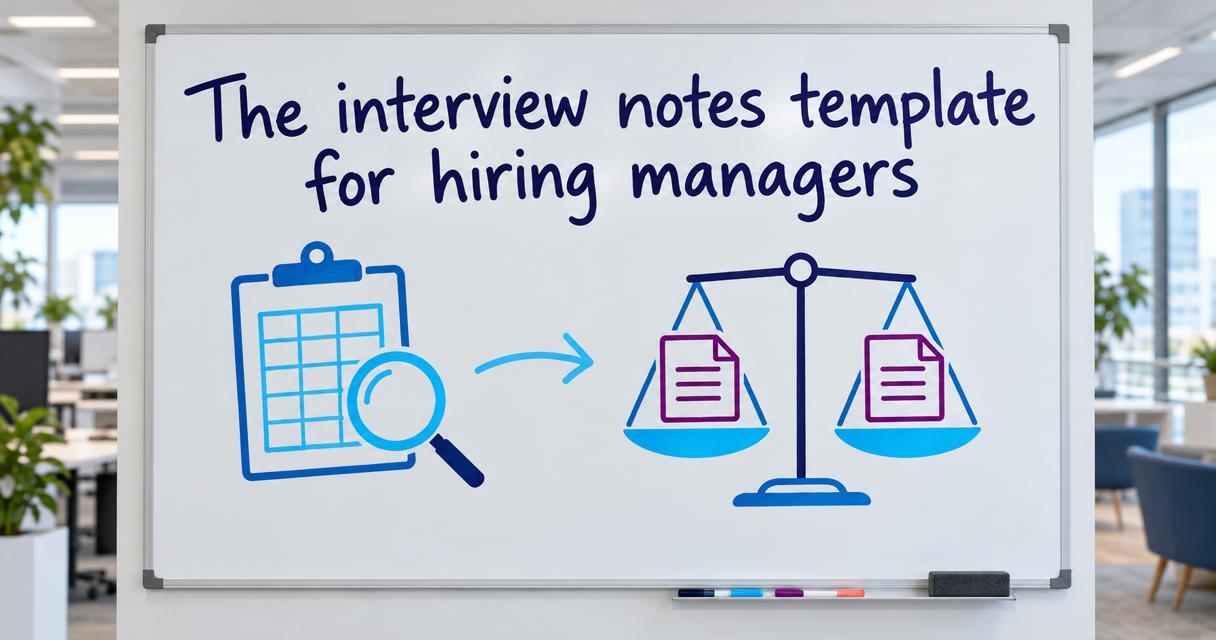
An interview notes template for hiring managers is a structured document used to record a candidate's exact responses and observable behaviours, ensuring your hiring decisions are objective, legally defensible, and grounded in real evidence.
Last reviewed October 2026
Key takeaways
- Only 31.2 percent of interviews have a scorecard attached, leaving most hiring decisions vulnerable to bias and legal risk.
- A reliable notes template captures candidate evidence, follow-up questions, competency ratings, and a specific rationale for the hiring recommendation.
- Federal and state anti-discrimination laws require businesses to prove they made hiring decisions fairly and on merit.
- Structured interview notes improve predictive accuracy, achieving a mean operational validity of 0.42 for predicting long-term job performance.
Many hiring managers walk into an interview room armed with nothing more than a printout of the candidate's resume and a blank notepad. They ask a few standard questions, have a conversational chat, and then make a decision based on whether they liked the person. This unstructured approach relies entirely on memory and gut feeling, which is exactly how process risk and people insight risk enter the business.
The lack of written evidence is a widespread issue across modern teams. According to a study of 5.2 million candidate interviews by Metaview, only 31.2% had at least one scorecard attached. Even worse, the same study found that among 296,555 candidates who advanced to a later interview round, 41.9% moved forward without a submitted scorecard behind them.
When you advance candidates without documenting the evidence, you lose the ability to compare them objectively against the rest of the talent pool. This is one of the fastest ways to introduce bias into your recruitment process, forcing you to constantly learn how to avoid common hiring mistakes after the damage is already done.
Interview notes are not just memory aids for the hiring panel. They are formal business records. If an unsuccessful candidate challenges your hiring decision, your written records are the primary evidence you have to demonstrate that the process was fair, equitable, and based entirely on the requirements of the role.
In Australia, the Fair Work Ombudsman and the Australian Human Rights Commission (AHRC) enforce strict federal and state anti-discrimination Acts. These include the Age Discrimination Act 2004, the Disability Discrimination Act 1992, the Racial Discrimination Act 1975, and the Sex Discrimination Act 1984. To comply with these laws, you must ensure your managers know exactly what to ask and what they are legally prohibited from asking, which is why providing a bias-free hiring guide alongside your template is highly recommended.
Your notes must prove that the candidate was evaluated on their skills and behaviours. Writing down that someone "was not a good culture fit" without defining the specific behaviours that led to that conclusion is a legal risk. The U.S. Office of Personnel Management recommends that interview ratings be defensible and supported directly by the interviewer's notes, ensuring that every claim traces back to an observable fact.
A good template standardises the information you collect. It gives the interviewer a clear path to follow, ensuring they gather enough data to make an informed recommendation at the end of the meeting.
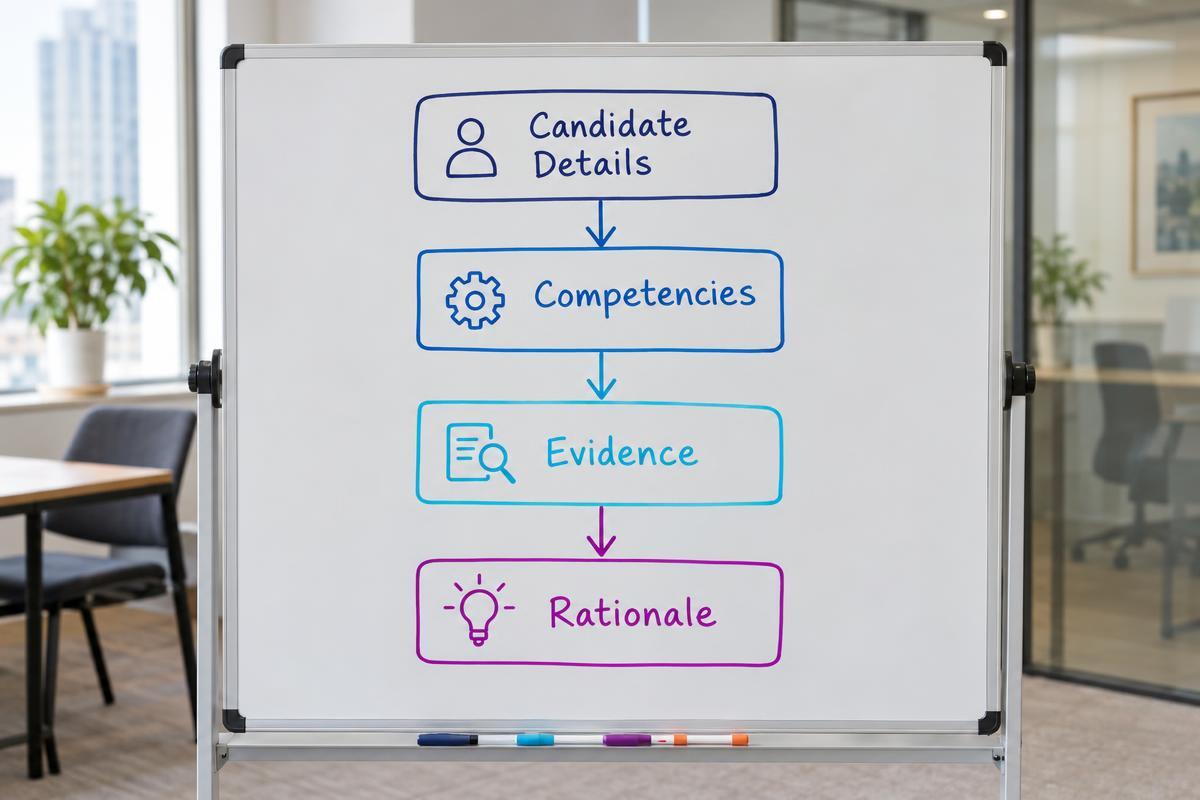
As analysis from Metaview shows, a structured notes template should capture the candidate's evidence, follow-up questions, competency rating, and the specific rationale for the recommendation. A standard template format looks like this:
| Section | Purpose and Content |
|---|---|
| Candidate details | The date, time, interviewer names, and the exact role title. |
| Core competencies | The predefined skills and behaviours required for the role, mapped to specific interview questions. |
| Candidate evidence | Verbatim notes and observable behaviours demonstrating how the candidate has handled relevant situations in the past. |
| Follow-up questions | The specific probing questions asked to clarify the candidate's initial answers. |
| Scoring and rationale | The final competency rating and a plain-language explanation of why that score was awarded. |
It is important to understand how this physical document fits into your wider process. Our glossary explains the theory behind what a structured interview is, while your template is the practical tool you take into the room to execute that theory. Similarly, you use this template in tandem with your interview scoring rubric. The rubric tells you what number to assign, while the notes template captures the vital context and evidence behind that number.
The primary goal of any interview is to predict how well a person will perform in the role. Unstructured conversations are notoriously poor predictors of performance because they allow interviewers to drift off-topic and focus on irrelevant shared interests.
By contrast, structured interviews had a mean operational validity of 0.42 for predicting job performance in a 2022 meta-analysis, supporting notes organised around consistent competencies and questions published by the Journal of Applied Psychology. When interviewers use a consistent template, they are forced to ask the same questions in the same order, creating a level playing field for every candidate.
The U.S. Office of Personnel Management says detailed notes on observable behaviours and verbal responses are "important" and should document and support the employment decision. Taking detailed notes shifts the interviewer's mindset from passive listening to active evidence gathering. Instead of simply engaging in conversation, they are continuously evaluating whether the candidate's answers meet the specific criteria outlined in the template.
Even the best interview notes template for hiring managers is useless if people refuse to fill it out. The reality of modern recruitment is that asking managers to manually complete long forms after an interview rarely yields high-quality data.
Data from Metaview shows that interview scorecard submission was 50.3% when generated from interview conversations, versus 28.6% when interviewers started with a blank form, based on a sample of 120,000 scorecards. Furthermore, generated scorecards contained an average of 7.85 completed fields, compared with 2.61 for manually completed scorecards in a separate sample of 80,000. People need a framework to succeed.
You cannot rely on disparate Word documents or spreadsheets to manage this process. To ensure compliance and drive consistency, you need an applicant tracking system that bakes structured, defensible interviewing directly into the platform. Compono Hire is an ATS that manages process risk while delivering deep people insight, ensuring that your interview records are centralised and secure.
When you standardise your evaluation tools, you can scale your culture without losing quality. We saw this when The Coffee Club started Compono to establish one hiring standard across more than 400 outlets. By adopting a structured approach to assessing fit and capability, they achieved 8 percent lower turnover, contributing to our platform's 4.8 out of 5 rating on Capterra. Consistent tools build consistent teams.
Compono Hire provides the tools you need to assess candidates fairly, score them consistently, and capture the evidence that justifies your hiring decisions while keeping your process compliant.
You should never record personal opinions, assumptions, or physical descriptions of the candidate. Avoid any commentary related to a person's age, race, gender, marital status, religion, or physical ability. Keep your notes focused entirely on observable behaviours, factual statements made by the candidate, and evidence related to the core competencies of the role.
Yes. Under privacy legislation in Australia and many other jurisdictions, candidates generally have the right to request access to the personal information you hold about them, which includes interview notes and scorecards. This is why it is critical that your notes remain objective, professional, and directly related to the requirements of the job.
Most legal and HR professionals recommend retaining interview notes for at least 12 to 24 months, even for unsuccessful candidates. This timeframe generally covers the period during which a candidate might lodge an unfair treatment or discrimination claim under federal or state laws. Check your local legislation and company policy to establish a firm retention schedule.
An interview notes template is the document where the interviewer writes down the candidate's exact responses and observable behaviours during the meeting. A scoring rubric is the grading scale used to assign a numerical value to those responses. The notes provide the context and the evidence, while the rubric provides the final score.
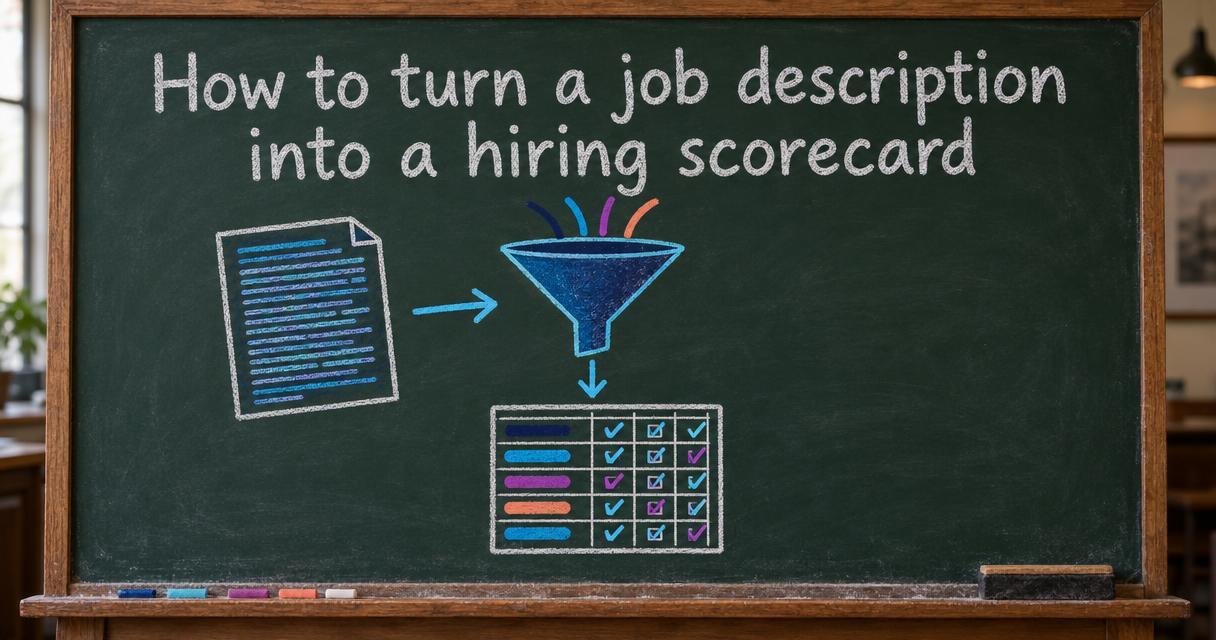
To turn a job description into a hiring scorecard to remove bias, standardise interviews, and make better recruitment decisions.

Stop relying on gut feeling when you hire. How to build an interview scoring rubric template that removes bias and finds top performers.

How behavioural science in hiring actually works, and why structured interviews and work-sample tests predict performance better than CVs.
 Compono