

.webp)

 Compono


How to turn a job description into a hiring scorecard
 Mathan Allington
To turn a job description into a hiring scorecard to remove bias, standardise interviews, and make better recruitment decisions.

An interview scoring rubric template is a structured evaluation tool that grades candidates against specific, predefined criteria rather than a hiring manager's gut feeling.
Key takeaways
- A reliable rubric focuses on three to six core capabilities tied directly to the role's required outcomes.
- Using a standard rating scale with clear behavioural anchors ensures different interviewers score the same answers consistently.
- Structured scorecards force independent scoring before group debriefs, actively reducing groupthink and hiring bias.
- Effective templates capture specific evidence and observable actions, rather than just an interviewer's subjective impressions.
Most hiring managers walk into an interview with a printed CV and a vague idea of what a good fit looks like. They ask a few standard questions, have a pleasant chat, and hire the person they got along with best. This is exactly how bias infects your hiring process.
When you rely on unstructured conversations, you are testing for likability. You are measuring how well a candidate performs in an interview setting, which rarely correlates with how well they will perform in the actual job.
To make evidence-based hiring decisions, you need a system that standardises how you evaluate talent. You need a structured framework that forces every interviewer to measure candidates against the exact same criteria.
A rubric removes the guesswork from recruitment. It provides a clear, objective framework for assessing whether a candidate possesses the skills and behaviours required to succeed.
According to industry research, a strong template usually includes candidate details, interviewer name, interview stage, criteria, rating scale, evidence fields, strengths/concerns, and a recommendation. This structure ensures that no matter who conducts the interview, the output is consistent and comparable.
The goal is to create a document that anyone on your hiring panel can pick up and use to evaluate a candidate objectively. If two different interviewers speak to the same candidate and use the same rubric, their final scores should be nearly identical.

The biggest mistake companies make when building a rubric is trying to measure too many things. If you list twenty different skills, your interviewers will suffer from cognitive overload. They will default back to their gut feeling.
Instead, an interview scorecard should focus on a small set of job-specific competencies – typically 3 to 6 core capabilities – rather than a long wish list. These capabilities must be directly tied to the reality of the job.
To identify these core capabilities, look past the generic job description. For role design, some experts recommend starting with the top five to seven outcomes the candidate should achieve in their first year and building the rubric from those outcomes.
If a marketing manager needs to launch a new product line within six months, one of your core capabilities should be "cross-functional project management". If a sales representative needs to revive a dead territory, you should measure "resilience and objection handling".
A rating scale of 1 to 5 is useless if the interviewers disagree on what a "4" looks like. Without clear definitions, one manager's "excellent" is another manager's "average".
You solve this by using behavioural anchors. These are specific descriptions of what a candidate must say or do to earn a specific score on your scale.
Let's look at a practical example for the competency of "Conflict Resolution":
A score of 1 means the candidate avoided the conflict or blamed others. A score of 3 means they addressed the issue directly and found a workable compromise. A score of 5 means they de-escalated a highly volatile situation, repaired the working relationship, and implemented a system to prevent future issues.
By defining the exact behaviours you expect to see, you remove the subjectivity from the scoring process.
Human memory is flawed. If you interview four candidates in a single day, their answers will start to blur together. You will remember the person who made you laugh, and you will forget the person who gave a highly competent but quiet answer.
To combat this, your interview scoring rubric template must require interviewers to record actual evidence. Interview rubrics should be built around observable actions and include bias and legal checks to avoid overly subjective criteria.
If an interviewer scores a candidate a 2 out of 5 for communication skills, they cannot simply write "poor communicator". They must write down exactly what the candidate did – for example, "rambled for four minutes without answering the prompt" or "failed to explain the technical concept in simple terms".
This reliance on evidence protects your organisation. It ensures your hiring decisions are defensible and rooted in facts.
The rubric proves its worth during the post-interview debrief. This is where the hiring panel meets to discuss the candidates and make a final decision.
Without a structured scorecard, the most senior person in the room usually speaks first. They say they liked the candidate, and the rest of the panel falls in line. This is classic groupthink.
Structured scorecards are designed to support independent scoring before the hiring debrief, reducing the influence of groupthink. Every interviewer must complete their rubric and submit their scores before they are allowed to discuss the candidate with anyone else.
When you sit down for the debrief, you look at the data. If one interviewer scored a candidate a 5 for leadership and another scored them a 2, you have a specific discrepancy to discuss. You compare the evidence notes, figure out why the scores differ, and make a highly informed hiring decision.
A well-designed rubric will vastly improve your hiring process. But it still relies on human observation, which means it is still vulnerable to human error. Candidates can rehearse their answers. They can fake enthusiasm. They can present a polished version of themselves that disappears the moment they sign the employment contract.
To truly understand how a candidate will perform, you need to look beneath the surface. You need to understand their natural work preferences and behavioural drivers.
This is where using a scoring key for fairer, smarter hiring decisions becomes incredibly powerful. By integrating psychometric assessments into your recruitment process, you gain objective data about a candidate's work personality.
You can see if they naturally gravitate towards detail-oriented tasks or if they prefer big-picture strategy. You can measure their natural resilience, their communication style, and their preferred working environment. When you combine this objective behavioural data with a structured interview rubric, you build a comprehensive profile of the candidate.
You stop guessing. You start knowing.
Key insights
- An effective rubric limits evaluation to 3–6 core capabilities derived directly from the role's expected outcomes.
- Behavioural anchors prevent interviewers from applying their own subjective definitions to a 1–5 rating scale.
- Forcing interviewers to record observable evidence prevents decisions based on vague "gut feelings".
- Independent scoring prior to the panel debrief is the most effective way to eliminate groupthink.
- Combining a structured rubric with psychometric data provides the most accurate prediction of a candidate's future performance.
Stop relying on unstructured conversations and start making evidence-based hiring decisions. Compono helps you build structured, objective recruitment processes that identify the right fit for your team based on real behavioural data.
Related reading
It is a structured evaluation document used by hiring managers to grade job candidates. It lists the specific skills, competencies, and behaviours required for the role, alongside a standardised rating scale. This ensures all candidates are evaluated objectively against the same criteria.
Behavioural anchors provide specific examples of what a poor, average, and excellent answer looks like for a given competency. They remove subjectivity from the rating scale, ensuring that all interviewers score candidates consistently based on observable actions.How many core competencies should we measure?
You should aim to measure between three and six core capabilities during an interview. Attempting to measure more than six leads to cognitive overload for the interviewer and dilutes the focus of the assessment.
A rubric reduces bias by forcing interviewers to focus on predefined, job-relevant criteria rather than personal affinity or likability. By requiring interviewers to submit independent scores with written evidence before discussing the candidate, it also eliminates groupthink.
No. While the basic structure of the template can remain the same, the specific core capabilities and behavioural anchors must be tailored to the exact requirements and expected outcomes of each individual role.
Psychometric testing provides a layer of objective behavioural data that an interview alone cannot reveal. When you understand how candidates are assessed using psychometrics, you can use that data alongside your rubric to make highly accurate, evidence-based hiring decisions.
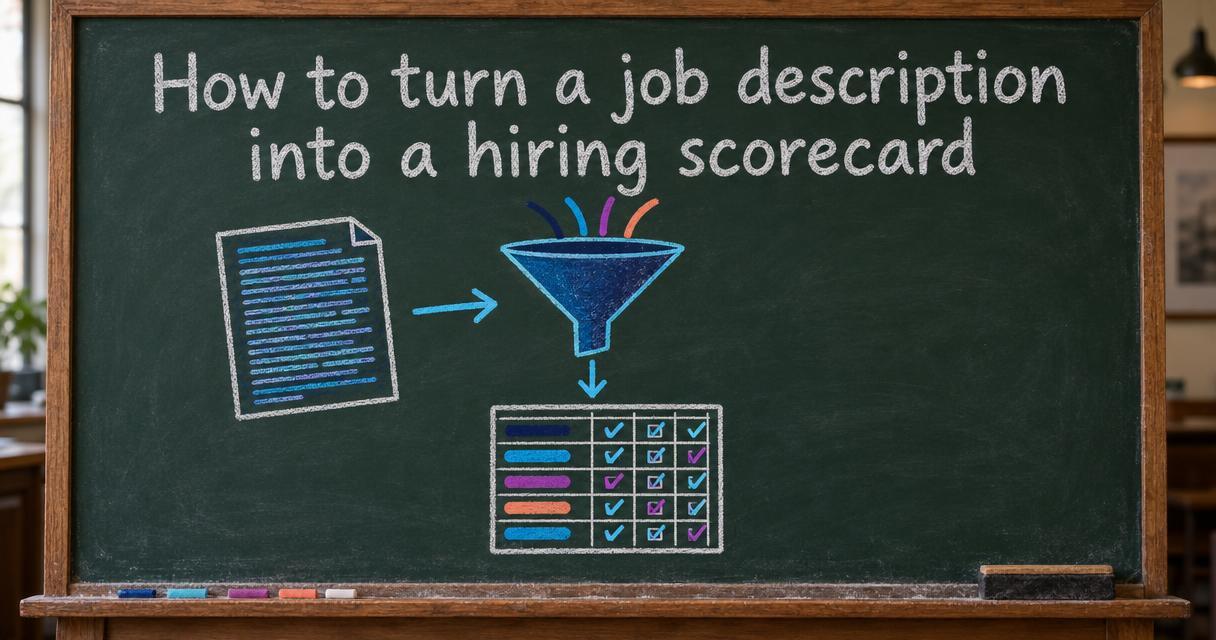
To turn a job description into a hiring scorecard to remove bias, standardise interviews, and make better recruitment decisions.

How behavioural science in hiring actually works, and why structured interviews and work-sample tests predict performance better than CVs.

Learn how to defend a hiring decision to the board using data-driven assessments, scoring rubrics, and a clear line of sight to business outcomes.
 Compono