

.webp)

 Mathan Allington


How to Build an Interview Scoring Rubric Template in 2026
 Compono
Stop relying on gut feeling when you hire. How to build an interview scoring rubric template that removes bias and finds top performers.
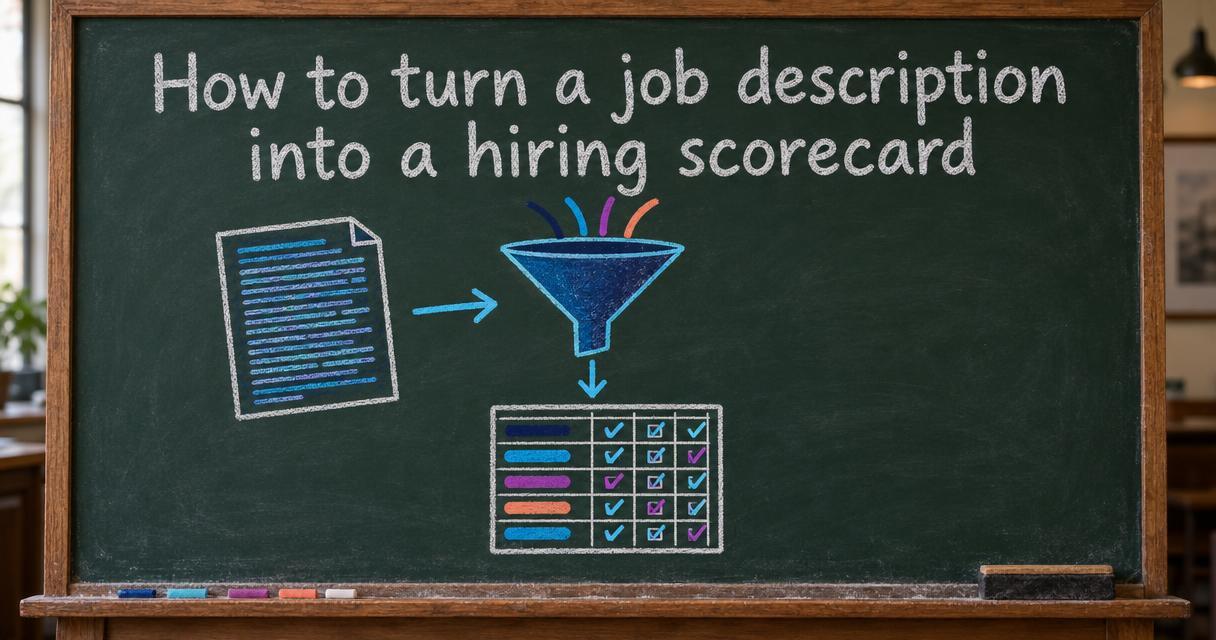
To turn a job description into a hiring scorecard, you must translate vague role requirements into observable behaviours and assign a standardised rating scale to measure them.
Last reviewed October 2026
Key takeaways
- Job descriptions are designed to attract candidates, which makes them terrible tools for evaluating them.
- A scorecard forces your hiring panel to agree on the exact evidence required to prove a candidate can do the job.
- Descriptive rating scales remove gut feeling and prevent interviewers from grading on completely different curves.
- Independent scoring before group discussions eliminates the loudest-voice bias in hiring decisions.
Most hiring managers walk into an interview with a printed CV and a copy of the original job advertisement. They scan the bullet points, ask a few questions about the candidate's background, and then make a decision based on how well the conversation flowed.
This approach relies entirely on gut feeling. Job descriptions are marketing documents written to sell the opportunity to the market. They are packed with generic phrases like "excellent communication skills" and "proven leadership ability". These phrases sound professional on a careers page but offer zero practical guidance for an interviewer trying to differentiate between two capable applicants.
When you turn a job description into a hiring scorecard, you bridge the gap between marketing and measurement. You give your interview panel a concrete rubric that defines exactly what good looks like. This forces everyone to evaluate candidates against the same standard rather than their own personal preferences.
The first step to build your scorecard is to deconstruct the job advertisement. You need to separate the actual requirements from the corporate filler.
Take a critical look at the components of a job description and highlight the non-negotiable outcomes. If your ad asks for "five years of B2B sales experience", ask yourself what that experience is supposed to prove. The real competency you want to measure is likely "the ability to work through complex enterprise procurement processes".
If your job ads are full of vague requirements, you might want to run them through a tool like Roast My Job Ad to see where the language is too ambiguous. Once you have stripped away the jargon, you should be left with five to eight core competencies. Anything more than eight will make your interview process too complicated and dilute your focus on the skills that actually matter.
A competency is just a label until you define how to measure it. For every item on your new scorecard, you must write down the specific evidence an interviewer needs to hear to verify the candidate possesses that skill.
If the competency is "conflict resolution", you cannot simply ask the interviewer to rate the candidate's conflict resolution skills out of five. One interviewer might give a high score because the candidate is polite. Another might give a low score because the candidate avoids confrontation.
Instead, define the observable behaviour. You might write: "Candidate provided a specific example of de-escalating a frustrated client and outlined the exact steps they took to rebuild the relationship." This gives the interviewer a clear target to listen for. If the candidate gives a vague, theoretical answer, the interviewer knows they have not provided the required evidence.
Numbers are meaningless without context. A standard 1-to-5 rating scale is notoriously unreliable because every human being interprets the middle numbers differently. Some managers use a 3 as a baseline for "meets expectations". Others treat a 3 as a polite failure.
To fix this, you need to use a scoring key for fairer hiring decisions. This involves writing descriptive anchors for each number on your scale. This removes the guesswork and forces the interviewer to select the description that best matches the candidate's performance.
| Rating | Observable Evidence |
|---|---|
| 1 (Poor) | Cannot provide a relevant example. Speaks in generalities or theory. |
| 2 (Below Average) | Provides an example but the outcome was poor or their personal contribution was unclear. |
| 3 (Good) | Clearly explains a specific situation, their direct actions, and a positive business outcome. |
| 4 (Excellent) | Demonstrates mastery. Shows proactive problem-solving, strategic thinking, and quantifiable results. |
When you provide a rubric like this, you standardise the grading process. An interviewer can easily look at their notes, compare the candidate's answer to the table, and select the appropriate score.
Technical skills will get a candidate hired, but behavioural misalignment will get them fired. Your scorecard must measure how a candidate prefers to work alongside what they know how to do.
This requires moving beyond the standard "beer test" where interviewers judge if they want to socialise with the candidate. You need to evaluate their work personality. If the role requires deep, uninterrupted focus and strict adherence to compliance rules, you need to score their natural inclination toward detail and structure.
If you are using a comprehensive interview scorecard template, dedicate a specific section to these behavioural traits. Compono Hire automates this process by assessing candidates against your unique organisational culture before the interview even begins, giving your panel verified data on how well the candidate aligns with your working environment.
The most perfectly designed scorecard is useless if your panel falls victim to groupthink. When interviewers discuss a candidate immediately after they leave the room, the most senior person usually speaks first. Their opinion anchors the entire conversation, and the rest of the panel will subconsciously adjust their scores to match the boss.
You must enforce a strict rule of independent scoring. Every interviewer must complete their scorecard and lock in their ratings before they are allowed to discuss the candidate with anyone else.
When you gather the independent scores, you will often find fascinating discrepancies. One interviewer might have rated the candidate's technical skills a 4, while another rated them a 2. These differences highlight areas where the panel interpreted the evidence differently, leading to a much richer and more objective hiring discussion.
Moving from gut-feel hiring to structured evaluation requires the right technology. We build software that embeds objective scoring and culture matching directly into your recruitment workflow.
A job description outlines the responsibilities and requirements of a role to attract applicants to your business. A scorecard is an internal evaluation tool used by interviewers to grade those applicants against specific, measurable criteria during the interview process.
Most effective scorecards track between five and eight key competencies. Adding more criteria makes the interview too complex and dilutes the focus on the most important skills required for the role.
Every person who interviews the candidate should complete their own scorecard independently. They must submit their final scores before discussing the candidate with the rest of the hiring panel to prevent groupthink and bias.
While you do not need to share the physical scorecard document, it is highly beneficial to tell candidates what competencies they will be evaluated on before the interview. This helps them prepare relevant examples and leads to a much more productive conversation.

Stop relying on gut feeling when you hire. How to build an interview scoring rubric template that removes bias and finds top performers.

How behavioural science in hiring actually works, and why structured interviews and work-sample tests predict performance better than CVs.

Learn proven strategies for crafting great interview questions to enhance recruitment success.