


 Mathan Allington


How to post job ads on LinkedIn: A step-by-step guide for HR managers
 Mathan Allington
How to post a job ad on LinkedIn in six steps: set up your page, write the ad, choose free or promoted, then track and improve performance.
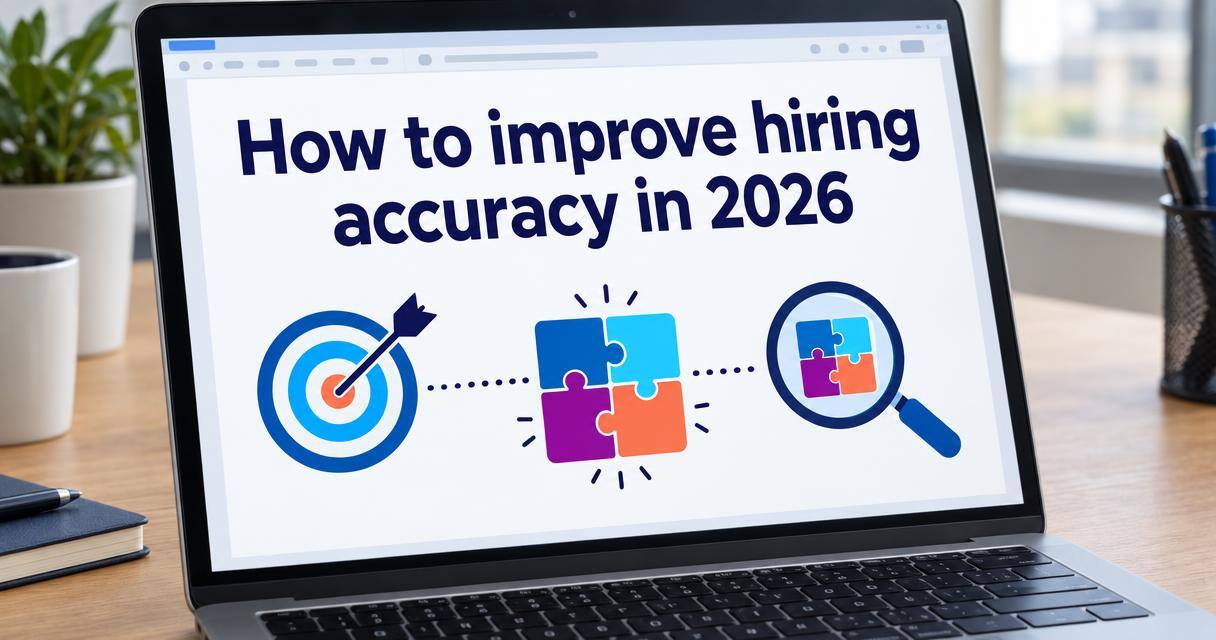
You improve hiring accuracy by replacing unstructured interviews and resume screening with a standardised evaluation framework that measures skills, cognitive ability, and organisational fit.
Last reviewed October 2026
Key takeaways
- Hiring accuracy is a better predictor of long-term business success than time to hire.
- Unstructured interviews and keyword matching create massive blind spots in the recruitment process.
- You can measure accuracy by tracking quality of hire metrics over an 18-month period.
- AI-generated applications make traditional CV screening unreliable and actively harm your hiring hit rate.
- Post-hire performance data must feed back into your interview scorecards to calibrate hiring manager bias.
Most HR teams track efficiency because the data is easy to extract from their applicant tracking system. They build dashboards around the distinction between time to hire and time to fill, or they obsess over cost per hire. These metrics show how fast a recruitment team operates. They tell you nothing about whether the organisation is actually acquiring the right talent.
Hiring fast means very little if the person you select leaves the business six months later. Accuracy is the metric that protects your organisation. It measures the percentage of new employees who meet or exceed performance expectations and integrate well into the team culture. When you focus solely on speed, you manage process risk but ignore people insight risk. You end up with a highly efficient system that fills seats with people who struggle to perform.
Traditional recruitment processes rely heavily on lagging indicators. The resume is a historical document that outlines what a candidate has done, while the unstructured interview relies on a hiring manager's gut feeling about how a candidate presents in a 45-minute conversation. Neither of these tools effectively predicts future performance.
Research shared by Jobful shows that an estimated 46% of new hires fail within 18 months, while 89% of those failures are attributed to attitude or coachability rather than technical skills. When you hire based on a list of technical keywords, you miss the behavioural traits that determine whether someone will thrive in your specific work environment. The reasons why new hires fail rarely show up on a CV.
A candidate might possess every technical certification required for a senior engineering role. If they prefer working in isolation and your engineering team relies on highly collaborative, rapid iteration cycles, that candidate will likely fail. Unstructured interviews fail to uncover these misalignments because interviewers naturally gravitate toward candidates who remind them of themselves, leading to biased decisions rather than accurate predictions.
You cannot improve a metric you do not measure. Data published by Sapia reveals that only 20% of organisations track quality of hire, limiting their ability to determine which hiring signals predict later performance. To understand how to improve hiring accuracy, you must build a feedback loop that scores past decisions.
Hiring accuracy is typically calculated by averaging your Quality of Hire (QoH) scores across a specific period. You can create a simple, retrospective scorecard that evaluates each new employee across four dimensions after they reach their 90-day or 180-day milestone.
| Metric | Definition and measurement |
|---|---|
| Job performance | The employee's rating on their first formal performance review, scored out of 5. |
| Ramp-up time | How quickly the employee reached full productivity compared to expectations, scored out of 5. |
| Cultural contribution | The employee's alignment with team values and working styles, scored out of 5 by their direct manager. |
| Retention status | A binary score. If they are still employed and performing at 12 months, score 5. If they exited, score 0. |
To calculate the QoH score for a single hire, add the four scores together and divide by 20 to get a percentage. If a candidate scores a 4 on performance, a 3 on ramp-up, a 5 on culture, and a 5 for retention, their total is 17 out of 20. This gives them an 85% Quality of Hire score. By tracking these scores across your organisation, you can pinpoint exactly how to reduce bias and improve quality of hire systemically.
Modern recruitment faces a completely new threat to hiring accuracy. Generative AI tools allow candidates to mass-apply for roles using perfectly tailored cover letters and highly polished resumes that do not reflect their actual capability.
According to Gartner research cited by Sapia, 39% of candidates in a 2025 survey said they used AI in applications, including 29% who used it for assessment answers, and 6% admitted to interview fraud. When candidates use AI to mimic the exact keywords your ATS looks for, your screening process breaks down. You end up advancing candidates who look right on paper but lack the fundamental skills to execute the role.
To maintain accuracy, you must redesign your early-stage screening. The résumé is dead, and AI buried it. Instead of reading documents, modern talent acquisition teams deploy behavioural and cognitive assessments before the first interview. A psychometric assessment cannot be easily spoofed by a language model because it measures inherent working styles rather than regurgitated knowledge. By shifting the evaluation from 'what you say you can do' to 'how you actually behave', you filter out AI-inflated applications early in the funnel.
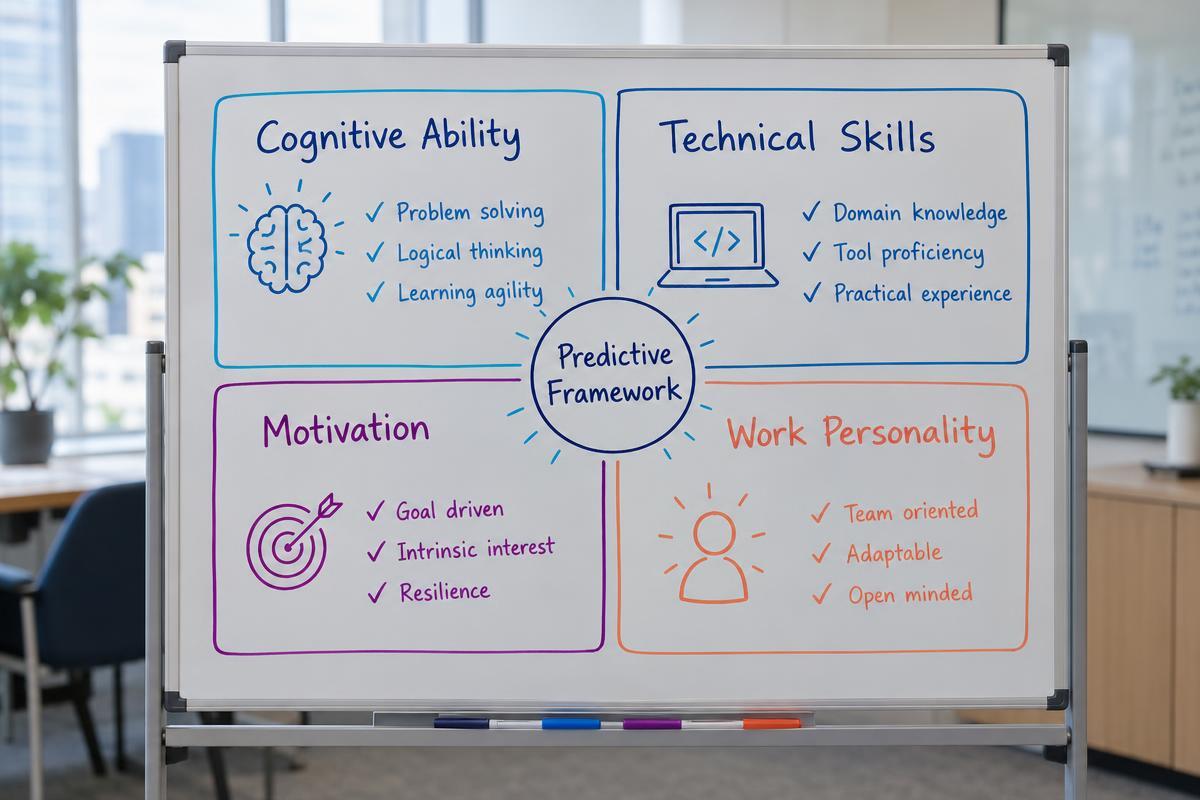
Accurate hiring requires a multi-signal approach. Relying on a single data point causes hiring managers to make poor assumptions. A reliable selection framework evaluates true capability across four distinct pillars.
First, evaluate cognitive ability. This measures how well a candidate processes complex information, solves problems, and adapts to new situations. It is heavily correlated with job performance in mid-level and executive roles.
Second, assess work personality. You need to know if their natural behavioural tendencies align with the daily reality of the job. A sales role might require high resilience and assertiveness, while a compliance role demands high attention to detail and a preference for routine.
Third, verify technical skills through work-sample tests. Instead of asking a candidate to describe a time they solved a problem, give them a real problem from your business and ask them to walk you through their solution. Work-sample tests strip away interview polish and reveal actual competence.
Fourth, measure motivation. Understanding what drives a candidate ensures they will find long-term satisfaction in the role. If a candidate is highly motivated by rapid promotion but your business offers a flat structure, they will become a turnover risk regardless of their skill level.
To put this framework into practice, you must standardise how your panel evaluates candidates. Sapia notes that structured interviews show a predictive-validity correlation of 0.42, compared with 0.19 for unstructured interviews and 0.07 for years of experience.
Start by defining the exact criteria required for the role before you post the job advertisement. Bring the hiring manager and relevant stakeholders together to agree on the non-negotiable skills and the necessary behavioural traits. Document these in a clear rubric.
Next, assign specific questions to specific interviewers. Do not allow three different interviewers to ask the candidate where they see themselves in five years. Have one interviewer focus on technical capability, another on cultural alignment, and a third on problem-solving. This ensures you gather a complete picture of the candidate without overlapping or wasting time.
Finally, require all interviewers to score the candidate independently against the agreed rubric before they discuss their opinions. This prevents the most senior person in the room from anchoring the group's perception and ensures the final decision is based on aggregate data rather than whoever spoke loudest.
Even with scorecards in place, human bias creeps into the process. To continuously improve hiring accuracy, you must audit the decisions your hiring managers make. You do this by comparing their interview scorecards against the post-hire performance data you collect at the 90-day mark.
Export the hiring data for the last 12 months. Look at the candidates who scored exceptionally high in their interviews but failed to pass probation or required extensive performance management. Review the notes the hiring managers left on those scorecards.
You will often find clear patterns. A specific manager might consistently overrate candidates who share their educational background. Another might mistake extreme extroversion for leadership capability, leading to poor hires in management roles. When you identify these patterns, you can actively calibrate your rubrics and build a fairer bias-free hiring process. You can sit down with managers and show them the data, helping them understand where their instincts mislead them.
With Compono Hire, you can create customised fit metrics to ensure candidates align with both the role and your company culture. Our applicant tracking system scores and ranks each applicant against your specific requirements, minimising mismatches and reducing the number of interviews needed to find your ideal hire. By bringing behavioural science directly into your recruitment workflow, you capture both the process efficiency and the people insight you need to predict long-term performance.
Hiring accuracy measures the percentage of your new hires who meet or exceed expectations and integrate well into the company culture. It tracks the quality of your decisions rather than just the speed of your recruitment process.
Time to hire is not inherently bad, but it only measures process efficiency. It does not account for the quality of the candidate. Optimising solely for speed often leads to rushed decisions, poor cultural fit, and high early turnover rates.
Structured interviews use a standardised set of questions and a predetermined scoring rubric for all candidates. This prevents conversational drift, limits unconscious bias, and ensures every applicant is evaluated against the same objective criteria.
You calculate Quality of Hire by scoring a new employee across key areas like job performance, ramp-up time, and cultural contribution after 90 or 180 days. You then aggregate these scores across your organisation to determine your overall hiring success rate.
Generative AI allows candidates to create perfectly tailored resumes and cover letters that may not reflect their actual abilities. This makes traditional resume screening highly inaccurate, forcing companies to rely on early-stage behavioural and skills assessments instead.

How to post a job ad on LinkedIn in six steps: set up your page, write the ad, choose free or promoted, then track and improve performance.

How culture fit hiring software works, what the behavioural science does and does not predict, and how to use it without screening for sameness.

What an applicant tracking system does, what Australian teams need (SEEK, Privacy Act, local support), the core features, and how to choose one in...