

.webp)



If you're an HR leader and you've ever sat in a quarterly review explaining why the third hire for the same role hasn't worked out, this is for you.
It's a frustrating conversation. The job description was right. The interview process was structured. References were checked. Compliance was clean. By every measure that the recruitment software is built to track, the process worked. And yet, eight months later, the role is open again.
The instinct in that meeting is to look at what the person did wrong, or what the manager could have spotted, or whether the whole pipeline needs another tightening. That instinct is misplaced, because it points at the wrong thing.
Bad hires aren't bad luck. They're built in.
Most applicant tracking systems are very good at one thing: managing the hiring process. They post jobs, parse resumes, schedule interviews, track candidates, automate workflows and keep audit trails. That's process risk, and process risk is mostly a solved problem in the mid-market. Pick any modern ATS and the basic mechanics of hiring will run faster than they did five years ago.
The problem is that the job of an ATS, as the industry has defined it, ends at the moment a candidate is shortlisted. Whether the person you shortlist is actually the person who'll thrive in your team, your culture and your role is treated as something the hiring manager will figure out from a 45-minute conversation. That's a story we keep telling ourselves, and it's not true.
Bad hires aren't bad luck. They happen when speed is optimised, but fit isn't understood.
The market has spent a decade making the process of hiring faster, cheaper and more compliant. It hasn't spent the same decade making the decision better. So the decision is now made on the same evidence it always was: a resume, a couple of conversations, and a manager's gut. That's not negligence. It's just what's left when the tools stop short.
Two risks, not one.
Once you start looking at it this way, the picture sharpens. HR leaders are managing two fundamentally different types of risk, and most of the tooling only addresses the first one.
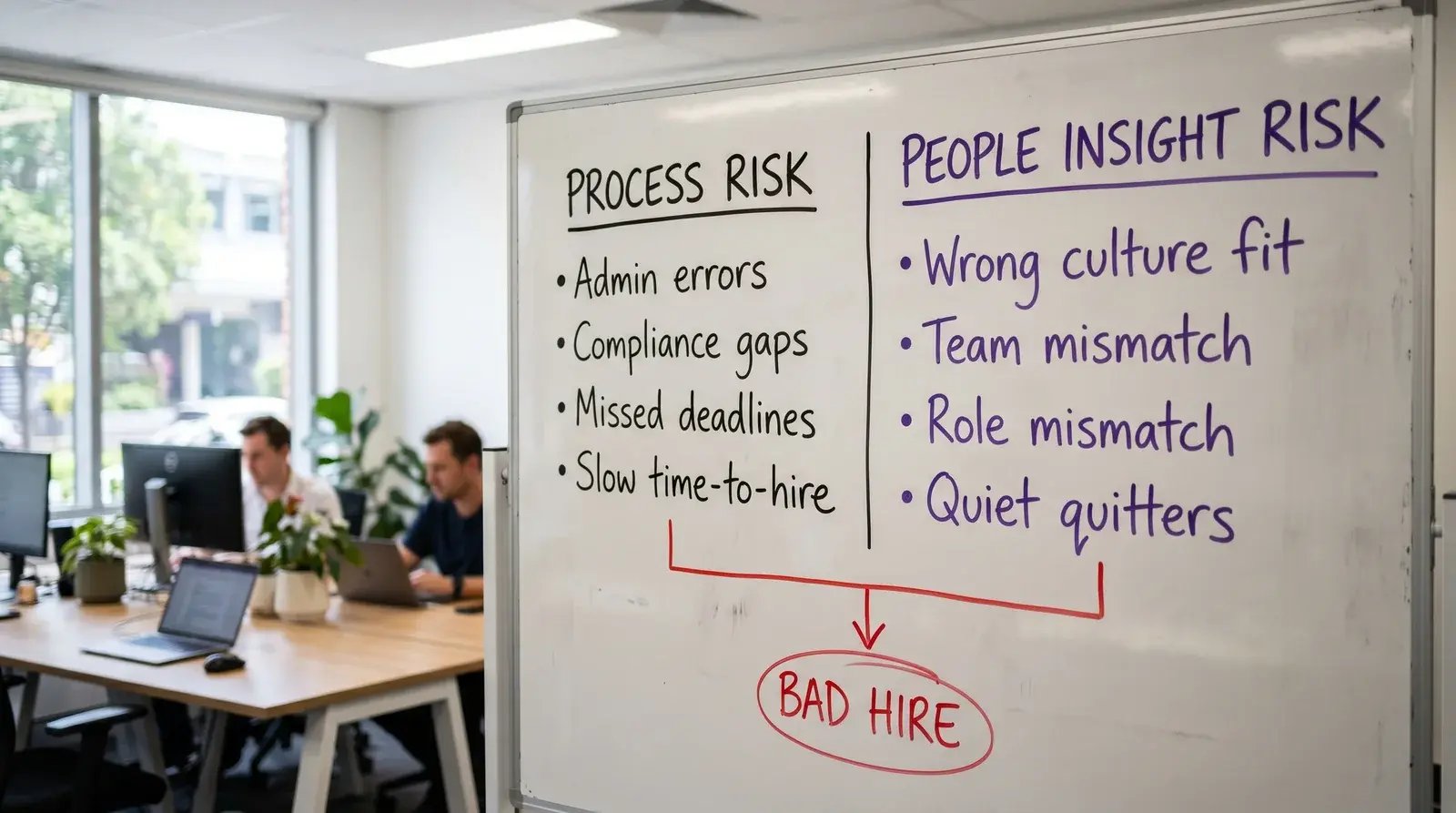
Process risk is errors in admin and compliance, missed deadlines, manual work, slow time to hire. The ATS market handles this well. Automate, centralise, keep records, fire reminders. The result is a faster, more accountable hiring process.
People insight risk is everything else. Who will actually thrive in your culture. Who fits the team you're hiring into. Who has the motivation and work style for this specific role, on this specific day, under this specific leader. The reputational hit when the answer to those questions turns out to be wrong, and the cost of fixing it later. This is the risk most ATS tools quietly leave on the table.
HR doesn't lack data. It lacks clarity. I don't know why this keeps happening. I'm guessing more than I'd like. I've got data, but not insight. If any of that sounds familiar, that's people insight risk. It's the part of the job that doesn't show up on the compliance dashboard, but it's the part that decides whether the hire works out.
What actually predicts whether a hire works out.
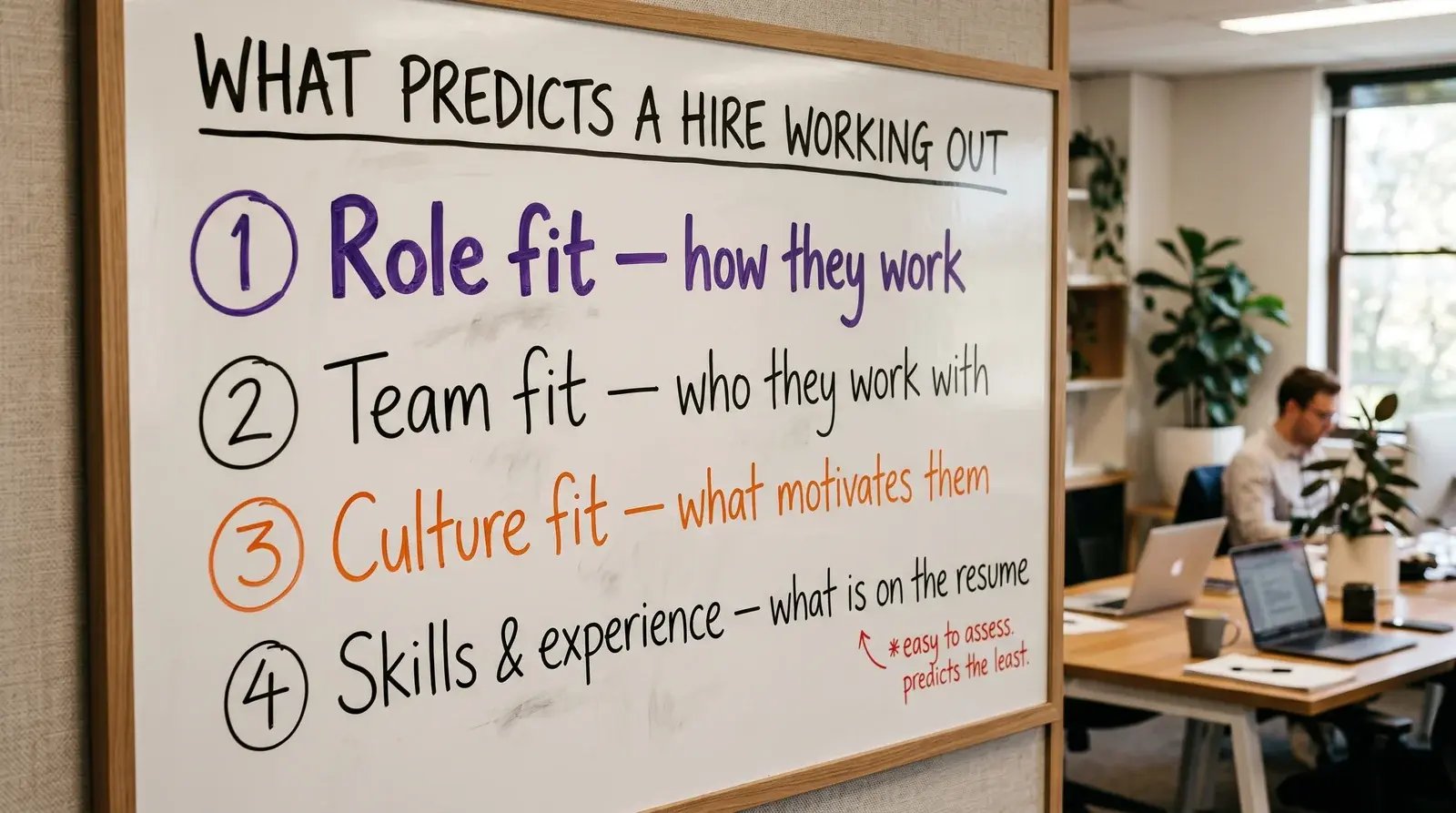
Decades of organisational psychology give a fairly consistent answer to the question of what makes a new hire succeed or fail. Four things, roughly in this order of weight, and none of them are visible on a resume:
- Role fit. Does the way this person works actually match the work the role demands? Detail-oriented or big-picture, autonomous or collaborative, deliberate or fast-moving. Resumes describe what someone has done. They don't describe how.
- Team fit. Will this person mesh with the team they're joining, or pull against it? Personality clashes show up early when teams are imbalanced, and they're some of the hardest problems to fix once a hire is in seat.
- Culture fit. Not "do they share our values" in the marketing sense. Closer to: do the things this organisation rewards line up with the things this person is motivated by. Mismatches here are the quietest reason great candidates leave inside a year.
- Skills and experience. Yes, they matter. They're the easy ones to assess, which is why they get most of the weight in a typical hiring process. They also predict less of the eventual outcome than the three above.
A good hiring decision has all four. Most ATS-driven hiring decisions only have the fourth, and a guess at the other three. That's the gap. That's where the failure rate comes from — 70% at executive level, 46% across all hires.
The system is incomplete. The people aren't.
Here's the part that matters, and it's the part that gets missed most often. The HR leaders running these processes are not the problem. They're working with tools that solve half the brief and treating the other half as a personal judgement call. They're being asked to be both the police and the policy maker, on the strength of a resume and a calendar invite.
That's not a people problem. It's a tools problem. People problems don't appear from nowhere. They happen when the tools manage process risk and ignore people insight risk. Once you name it that way, the fix is obvious. The tooling has to do both.
What "doing both" looks like in practice.
It looks like every candidate being psychometrically profiled at the point of application, not at the offer stage. It looks like a shortlist that ranks people on culture, team and role fit alongside experience. It looks like the manager opening the system and seeing how the person they're about to interview is likely to work, where they'll thrive, and where they'll struggle. It looks like a defensible decision the HR leader can stand behind in front of executives, legal, or a board.
None of that is futuristic. The science behind it is decades old. What's new is the ability to bake it into the hiring tools that HR teams already use. That's the gap we built Compono Hire to close.
A NOTE ON COMPONO HIRE
Compono Hire is an applicant tracking system (ATS) that pairs the standard mechanics of recruitment with built-in culture, team and role fit intelligence, backed by validated organisational psychology. We're an Australian company. 4.8 average on Capterra. Compono technology is trusted by NSW Government, The Coffee Club, Lyre's, Reali and around 400 other organisations. More on the product here.
What HR leaders can do this quarter.
If you can't change your hiring stack tomorrow, three things are still worth doing this quarter:
- Audit your last twelve hires. For the ones that didn't work out, write down the actual reason. Not "wasn't a fit." Be specific. How many of those reasons were visible on the resume? How many were people insight, masquerading as luck?
- Add one structured fit signal. Even a basic work-personality assessment, used consistently, will surface mismatches your interview process is missing. Done well, it gives the hiring manager a different conversation to have in the room.
- Push back on speed-only metrics. Time to hire is a useful metric. It's not the only one, and it's a poor proxy for hiring quality. Pair it with quality of hire (90 day, 12 month) and you'll see the real picture sharpen quickly.
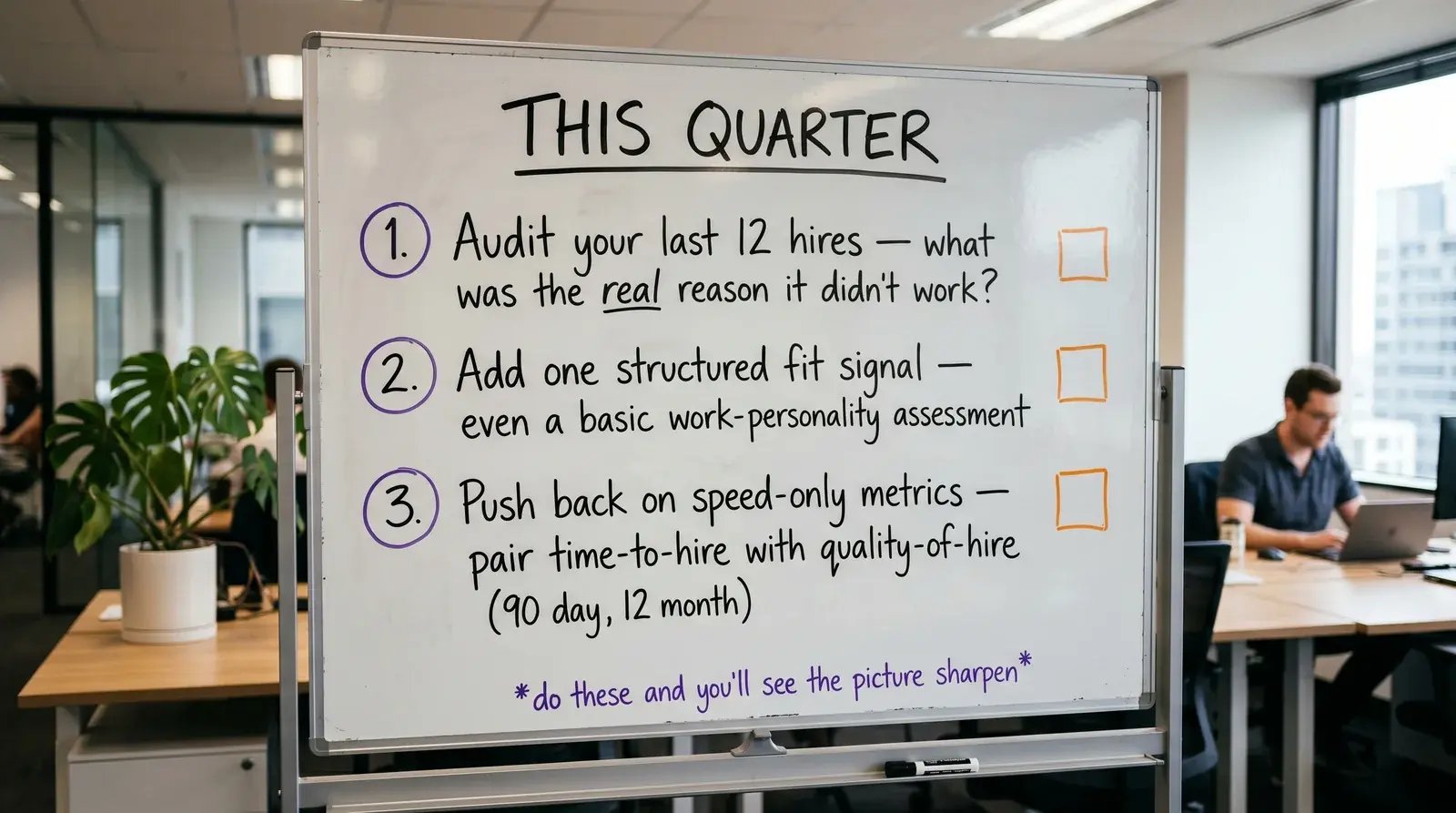
None of these will fix the failure rate on their own. Together, used consistently, they're enough to tell you whether your current ATS is actually doing the job, or quietly leaving the most expensive risk for you to carry alone.
You're better than the half-built system you've been handed. So is your team.