

The products
Platform overviewSee how Hire, Engage, Develop and Assure work together on one platform.By size
By role
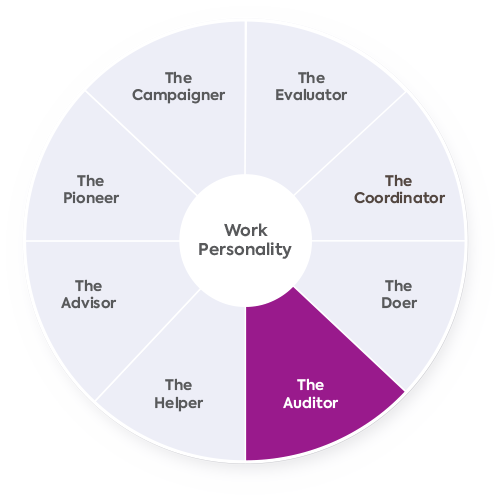
Work Personalityone of eight types
The Auditor
βLet's focus on the details!β
Your personality has been mapped against the types of work crucial for high-performing teams.
Introduction
This personality type embodies thoroughness, accuracy, and an exacting mindset coupled with a reflective and contemplative nature. Auditors are naturally drawn to fact-based, intricate tasks, persisting patiently until they reach their goal.
They are a unique blend of diligent detail-orientation and thoughtful introspection. Their cautious disposition and risk-averse approach further set them apart.
Major characteristics
- Thorough, accurate, and exacting.
- Reserved, reflective, and contemplative.
- Prefers facts and detail-oriented tasks.
- Patient and persistent
- Cautious and risk-averse
Main preferences for work
Auditors are known for their precision, with an incredible ability to place focus on the minute details of the present. They cherish a systematic approach to work, enforcing standards, procedures, and control mechanisms. High value is placed on thoroughness and accuracy in all tasks and there's a deep sense of satisfaction in maintaining order and compliance.
- Enjoys scrutinising and inspecting.
- Prefers to focus on present details and precision.
- Enforces standards, procedures, and control mechanisms.
- Values thoroughness and accuracy in all tasks.
- Finds satisfaction in maintaining order and compliance.
Potential blind-spots at work
In our deep dive into work personalities, we focused on their strengths, but now it's time to shed some light on potential blind spots. These not-so-obvious areas may occasionally hamper their productivity or work relations. From getting overly engrossed in minute details to resistance towards rapid, innovative changes, let's unpack the areas where an Auditor may need to tread carefully.
- May become overly focused on minor details, missing the bigger picture.
- Can be slow in decision-making due to excessive deliberation.
- Might resist quick or innovative changes that disrupt established methods.
- Occasionally struggles with tasks requiring high levels of creativity.
Tips for collaborating with this personality type
Known for their keen eye for detail and firm grip on standards and protocols, interacting with them brings a unique dynamic to the workplace. Here, we've compiled a comprehensive list of do's and don'ts that will enhance your collaborative efforts with an Auditor.
Do's
- Do provide specific, detailed instructions for best results.
- Do allow time for thorough review and quality control.
- Do recognise their contributions to precision and accuracy.
- Do use their strengths in tasks requiring meticulous attention to detail.
Don'ts
- Don't rush them through tasks that require careful analysis.
- Don't undervalue their focus on standards and procedures.
- Don't overlook their need for clear and structured guidelines.
- Don't dismiss their caution in decision-making as unnecessary delay.
Knowing Me (worksheet)
Jam-packed with insightful questions, this is a worksheet all about you.
Yes, you heard it right, YOU.
This worksheet is intended to help you delve deeper into your work personality and understand how you tick. And once you gain clarity about yourself, you wonβt be keeping it a secret.
The "Knowing Me" worksheet is a fantastic way to share your insights with your team. By inviting your colleagues into your world, you are encouraging a more cohesive and understanding work environment.
So, let's get down to business and start filling it out, shall we?
- Are you skilled at paying careful attention to detail and ensuring task accuracy and completion?
- Can you provide grounded and realistic perspectives on immediate issues?
- Do you tend to work in a reliable and consistent manner?
Remember, these examples are just a starting point - your worksheet is your canvas to fill with your own unique colors and shades.
Download the Knowing Me worksheet for The Auditor βGuess who?
Peer into the minds of the world's most influential leaders π£
Ever wondered if you share a personality type with Nelson Mandela, Steve Jobs, or perhaps Mother Teresa? Here's your chance to find out, but there's a catch! We aren't revealing them upfront.
Try guessing them first. As you click each mystery card, the leader will be revealed.
These leaders are reserved, detail-oriented, methodical, cautious, dependable, and thorough. π€
Bill Gates π
Co-founder of Microsoft, known for his analytical and detail-focused approach to business and technology.
Angela Ahrendts π
Former VP of Retail at Apple, known for her methodical leadership and focus on building a strong operational framework.
Satya Nadella π
CEO of Microsoft, admired for his quiet, reflective, and detail-focused leadership style that emphasises thoroughness and precision.
Want to guess more influential leaders? Explore all eight types β
Career paths
The Auditor is best known for their attention to detail, practicality, and ability to work independently. They thrive in careers that need precision, methodical processes, and are well-suited to roles that allow them to apply their analytical skills.
Whether it's examining data, interpreting complex information, or evaluating systems for efficiency, their precise and diligent nature sets them up for success.
They excel as Financial Controllers, focusing on company finances and ensuring everything is in order. Their independent nature allows them to flourish as Surveyors, Pharmacists, or Civil Engineers, where precision is paramount.
They can also show their prowess as Data Analysts or Quality Control Analysts where keen observation and analytical skills are at a premium. Since Auditors are natural problem solvers, careers like Mechanics, Carpenters, or Electricians can let them put their practical skills to use.
- Surveyor
- Financial Controller
- Pharmacist
- Civil Engineer
- Auditor
- Accountant
- Statistician
- Librarian
- Data Analyst
- Paralegal
- Healthcare Administrator
- Archivist
- Quality Control Analyst
- Compliance Officer
- Administrative Assistant
- Mechanic
- Electrician
- Carpenter
- Veterinary Technician
Leadership style
Individuals have natural or preferred leadership styles that align with their personality types.
For Auditors, they may find aspects of their preferred leadership style easier or more challenging in certain circumstances. But that doesn't mean they can't adapt to specific situations.
Effective leaders are flexible and change their approach based on the situation.
By remaining flexible in their approach, Auditors can harness their strengths while also adapting to the team's needs and the demands of the task.
Non-Directive Leadership
See how Auditors adapt to the other two βWhat does this mean? π€
Non-Directive Leadership takes a hands-off approach, providing teams with autonomy and trusting them to make their own decisions. Leaders using this style focus on empowering their team, offering guidance only when necessary.
This leadership style is effective in environments that rely on innovation, where highly skilled teams require minimal supervision and are trusted to manage themselves. Read more.
HOW to ADAPT TO other situations
Any leadership style can be adjusted to fit different situations and team needs.
Click each tab below to discover what's easy and hard when adapting to each leadership style.
β Pick a style to compare
Adapting to Non-Directive Leadership (natural style)
What's easy?
Auditors will excel in directive leadership when it involves clear, structured processes and well-defined goals. They are comfortable following and providing precise instructions.
Blindspots?
They may struggle with adapting to changing or ambiguous situations that require flexible problem-solving.
What's easy?
Auditors can appreciate democratic leadership when they are invited to contribute detailed, methodical insights to the decision-making process.
Blindspots?
They may find it hard to participate in open-ended discussions that lack clear direction or when decisions are made based on emotions rather than facts.
What's easy?
Auditors naturally enjoy non-directive leadership when they have well-defined processes in place and can work independently without much interference.
Blindspots?
They may struggle with situations where the lack of clear direction leads to uncertainty or inconsistency in execution.
Want to be sure if Directive, Democratic or Non-Directive Leadership is right for the current situation or decision your team faces?
In 10 short questions, find out the most appropriate leadership approach you can use for every team situation.
Assess my situation now β

Resolving conflict in teams
For leaders, conflict within a team can seem like a daunting challenge.
Yet, when equipped with a deep understanding of each team member's unique personality, leaders can harness these moments to foster growth, spark innovation, and cultivate harmony.
Below is practical advice for leaders to navigate such scenarios effectively, based on the personality types in their team.
Click each personality type below to see practical advice for a leader to manage conflict with the Auditor.
Guide the Helper to value detailed planning, e.g., βThis thorough approach will benefit the team in the long runβhow do you feel about it?β
Encourage the Auditor to consider emotional aspects of decisions, e.g., βHow might these details impact the teamβs morale?β
Help the Advisor focus on specifics, e.g., βWe need to make sure all the details are accounted for before we finalise.β
Guide the Auditor to engage more collaboratively, e.g., βLetβs integrate your detailed input into the broader plan.β
Guide the Pioneer to appreciate structure, e.g., βLetβs ensure we address all the details before implementing this idea.β
Help the Auditor remain open to innovation, e.g., βLetβs explore how this creative idea fits into your detailed framework.β
Help the Campaigner communicate clearly and patiently, e.g., βLetβs walk through the plan step by step.β
Encourage the Auditor to engage earlier in the discussion, e.g., βWe need your detailed perspectiveβcan you provide some initial feedback?β
Encourage the Evaluator to take a step back and reflect on specifics, e.g., βCan we address these details before finalising the plan?β
Help the Auditor share detailed feedback earlier and more regularly, e.g., βCan you share your insights on this part of the project?β
Help the Coordinator respect detailed input, e.g., βCan we take the time to ensure all details are correct?β
Encourage the Auditor to participate more actively in discussions, e.g., βYour feedback is essentialβplease share it with the team earlier.β
Help the Doer slow down and focus on details, e.g., βLetβs take time to ensure weβve covered all the details before moving ahead.β
Encourage the Auditor to engage earlier in discussions, e.g., βWe need your feedbackβhow can we incorporate your detailed input into the plan?β
Encourage both Auditors to prioritise key details, e.g., βWhat are the most critical elements we need to address before moving forward?β
Help them set a reasonable deadline for decision-making, e.g., βLetβs aim to finalise the plan by the end of the week.β
One result is interesting.
Eight of them is a map.
Send this page to the people you work with and ask for theirs. Most friction at work starts in the gap between how you prefer to work and how they do, and that gap is easier to talk about once it has a name.
Everyone can take the assessment free, in about two minutes.
The eight Work Personality types
Tap a segment to see what each type brings, and where each one gets stuck.
β Tap or click a segment
The Evaluator
"Let's weigh up our options!"
Tests the thinking and finds the risk before it finds you.
Read the full Evaluator page βEight types, one of them is yours.
Not sure which one is yours? Take the assessment β Four questions. About two minutes.
How you prefer to work
is not how everyone works.
Work Personality maps your preferences against the kinds of work high-performing teams rely on, and gives you one of eight types. It is not a measure of ability. One person thinks out loud and decides fast, another needs quiet first. Neither is wrong, and most friction at work starts in that gap.
For one person it is a conversation starter. For a whole team it is a map: which kinds of work are covered twice over, and which are not covered at all.
This page
The short assessment. Four questions. One of eight types. Free, and a strong indication rather than a diagnosis.
The platform
The validated assessment. Psychometrically validated, measured by degree, and detailed enough to make decisions you can defend.
Designed by corporate psychologist Rudy Crous. Related reading: leadership styles and your personality and what the Auditor type means at work.
Common questions about the Auditor
This personality type embodies thoroughness, accuracy, and an exacting mindset coupled with a reflective and contemplative nature. The Auditor's catchphrase is βLet's focus on the details!β. It is one of the eight Work Personality types, each matched to a kind of work high-performing teams need covered.
Thorough, accurate, and exacting; Reserved, reflective, and contemplative; Prefers facts and detail-oriented tasks; Patient and persistent; Cautious and risk-averse.
They excel as Financial Controllers, focusing on company finances and ensuring everything is in order. Their independent nature allows them to flourish as Surveyors , Pharmacists , or Civil Engineers , where precision is paramount. They can also show their prowess as Data Analysts or Quality Control Analysts where keen observation and analytical skills are at a premium. Since Auditors are natural problem solvers, careers like Mechanics , Carpenters , or Electricians can let them put their practical skills to use.
Non-Directive Leadership. Non-Directive Leadership takes a hands-off approach, providing teams with autonomy and trusting them to make their own decisions. Leaders using this style focus on empowering their team, offering guidance only when necessary. Effective leaders are flexible and change their approach based on the situation.
Do provide specific, detailed instructions for best results. Do allow time for thorough review and quality control. Do recognise their contributions to precision and accuracy. Do use their strengths in tasks requiring meticulous attention to detail.
Not sure which of the eight you are? Four questions. Two minutes. Free.
Take the free assessment
.webp)
