

The products
Work Personalityone of eight types
The Advisor
βLet's investigate the problem!β
Your personality has been mapped against the types of work crucial for high-performing teams.
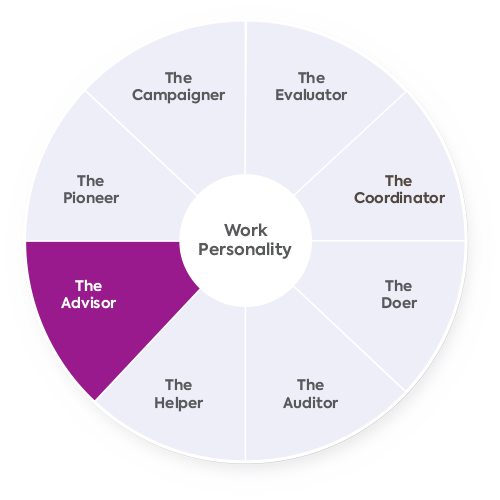
Introduction
This personality type is known primarily for their collaborative, mentoring, and counselling abilities. They are flexible, open-minded individuals who seek to understand and exhibit tolerance in a wide range of situations.
The Advisor is also noted for their diplomacy and strong encouragement of others. Their approachable nature makes it easy for others to share with them, further enhancing their likeability.
Major characteristics
- Collaborator, mentor, and counsellor.
- Open-ended and flexible.
- Seeks to understand and is tolerant.
- Diplomatic and encouraging.
- Easy to share with and likeable.
Main preferences for work
The Advisor is a distinct work personality that thrives on knowledge and growth. They possess a strong inclination for gathering and disseminating information, revel in roles that amplify their advising prowess, and thrive in environments that cater to their intellectual curiosity.
Advisors are sought-after for advice on intricate matters and are driven by a passion for fostering development in others.
- Enjoys gathering information, sharing knowledge.
- Values roles that use their knowledge-sharing capabilities.
- Prefers environments that allow for intellectual exploration.
- Appreciates being consulted on complex issues.
- Finds motivation in helping others develop and grow.
Potential blind-spots at work
Although robust and flexible, this personality type is not without its potential pitfalls. It's essential to highlight and understand these blind spots to harness strengths and counteract weaknesses. Here's a list of the potential blind spots that an 'Advisor' personality type might face, from over-accommodation to lack of urgency during crunch times.
- Can be overly accommodating, affecting decisiveness.
- May spend too much time exploring all possible options.
- Might avoid taking firm stances in conflicts.
- Occasionally lacks urgency in time-sensitive situations.
Tips for collaborating with this personality type
Driven by their natural ability to gather and analyse information, Advisors shine in consultant or mentor roles within the team. It's crucial to promote flexibility in their problem-solving approach and support their appreciation for diverse perspectives.
However, remember not to overlook their need for thorough research before decisions, press them into hasty conclusions without analysis, or neglect their prowess in diplomacy and mediation.
Do's
- Do use their ability to gather and analyse information.
- Do encourage their role as a consultant or mentor within the team.
- Do provide flexibility in their approach to solving problems.
- Do support their desire to understand and tolerate diverse perspectives.
Don'ts
- Don't restrict their access to information they might find useful.
- Don't dismiss their need for thorough investigation before decision-making.
- Don't force them into quick conclusions without proper analysis.
- Don't ignore their potential in roles that require diplomacy and mediation.
Knowing Me (worksheet)
Jam-packed with insightful questions, this is a worksheet all about you.
Yes, you heard it right, YOU.
This worksheet is intended to help you delve deeper into your work personality and understand how you tick. And once you gain clarity about yourself, you wonβt be keeping it a secret.
The "Knowing Me" worksheet is a fantastic way to share your insights with your team. By inviting your colleagues into your world, you are encouraging a more cohesive and understanding work environment.
So, let's get down to business and start filling it out, shall we?
- Do you easily adapt to new situations, promoting team flexibility and adaptability?
- Do you encourage team harmony through empathy and understanding?
- Are you skilled at ensuring everyone's voice is heard and valued in the team?
Remember, these examples are just a starting point - your worksheet is your canvas to fill with your own unique colors and shades.
Download the Knowing Me worksheet for The Advisor βGuess who?
Peer into the minds of the world's most influential leaders π£
Ever wondered if you share a personality type with Nelson Mandela, Steve Jobs, or perhaps Mother Teresa? Here's your chance to find out, but there's a catch! We aren't revealing them upfront.
Try guessing them first. As you click each mystery card, the leader will be revealed.
These leaders are flexible, empathetic, open-minded, collaborative, supportive, and adaptable. π€
Dalai Lama π§
Known for his compassionate, open-minded, and collaborative approach to leadership, always emphasising peace and flexibility.
Malala Yousafzai π§
Nobel Peace Prize laureate and advocate for education, admired for her empathy and flexibility in handling global challenges.
Arianna Huffington π§
Founder of The Huffington Post and Thrive Global, known for her open-minded, empathetic, and supportive leadership style.
Want to guess more influential leaders? Explore all eight types β
Career paths
In their professional lives, the Advisor is often found at their best when they are aiding others. Fuelled by their empathy and open-minded nature, they prefer dynamic workplaces where they can provide counsel and foster positive change.
Their unique ability to understand and connect with people positions them perfectly to thrive in careers that focus on human relations and interpersonal dynamics.
Advisors make excellent HR Business Partners, Consultants, or Generalists, where their empathetic and strategic skills can bring out the best in an organisation's talent.
Their passion for helping people grow can lead them to roles as Training & Development Managers or Learning & Development Specialists.
Advisors' creative side can be explored in fields like Interior Design or Graphic Design. Their people skills also allow them to shine as Travel Agents, Talent Agents, Life Coaches, or in any role that facilitates social interaction and enriching exchanges.
- HR Business Partner or Consultant
- Mediator
- Organisational Development Consultant
- Talent Development Manager
- Public Relations Specialist
- Corporate Communications Specialist
- Corporate Social Responsibility (CSR) Manager
- Diversity and Inclusion Officer
- Training & Development Manager
- Learning & Development Specialist
- Life Coach
- Occupational Therapist
- Social Worker
- Counsellor
- Rehabilitation Counsellor
- Interior Designer
- Travel Agent
- Talent Agent
- Graphic Designer
Leadership style
Individuals have natural or preferred leadership styles that align with their personality types.
For Advisors, they may find aspects of their preferred leadership style easier or more challenging in certain circumstances. But that doesn't mean they can't adapt to specific situations.
Effective leaders are flexible and change their approach based on the situation.
By remaining flexible in their approach, Advisors can harness their strengths while also adapting to the team's needs and the demands of the task.
Non-Directive Leadership
See how Advisors adapt to the other two βWhat does this mean? π€
Non-Directive Leadership takes a hands-off approach, providing teams with autonomy and trusting them to make their own decisions. Leaders using this style focus on empowering their team, offering guidance only when necessary.
This leadership style is effective in environments that rely on innovation, where highly skilled teams require minimal supervision and are trusted to manage themselves. Read more.
HOW to ADAPT TO other situations
Any leadership style can be adjusted to fit different situations and team needs.
Click each tab below to discover what's easy and hard when adapting to each leadership style.
β Pick a style to compare
Adapting to Non-Directive Leadership (natural style)
What's easy?
Advisors can take on directive leadership when necessary but prefer to guide rather than control. They may give direction in a way that feels collaborative and supportive.
Blindspots?
They will struggle with being overly rigid or controlling, as they naturally prefer a flexible approach and involving others in decision-making.
What's easy?
Advisors excel in democratic leadership as they value input from others and enjoy fostering collaboration. They are adept at finding balance between guidance and openness.
Blindspots?
They may find it hard to make firm decisions when there are differing viewpoints, as they donβt want to alienate or override others' contributions.
What's easy?
They may struggle with situations where teams need more structure or guidance, as they naturally tend toward flexibility and autonomy.
Blindspots?
Pioneers may struggle with situations that require more hands-on guidance, follow-up, or strict deadlines.
Want to be sure if Directive, Democratic or Non-Directive Leadership is right for the current situation or decision your team faces?
In 10 short questions, find out the most appropriate leadership approach you can use for every team situation.
Assess my situation now β

Resolving conflict in teams
For leaders, conflict within a team can seem like a daunting challenge.
Yet, when equipped with a deep understanding of each team member's unique personality, leaders can harness these moments to foster growth, spark innovation, and cultivate harmony.
Below is practical advice for leaders to navigate such scenarios effectively, based on the personality types in their team.
Click each personality type below to see practical advice for a leader to manage conflict with the Advisor.
Help the Pioneer stay focused on practical outcomes, e.g., βCan we agree on a timeline for these ideas to ensure progress?β
Encourage the Advisor to focus on decision-making, e.g., βLetβs set a deadline for making a final decision.β
Help the Campaigner define clear, actionable goals, e.g., βWhatβs the first step in getting this idea started?β
Encourage the Advisor to set deadlines to avoid procrastination, e.g., βLetβs set a deadline to finalise decisions.β
Help the Evaluator consider alternative approaches, e.g., βLetβs explore other options before finalising.β
Encourage the Advisor to set decision timelines, e.g., βLetβs ensure we finalise by the end of this discussion.β
Encourage the Coordinator to integrate flexibility, e.g., βHow can we adjust the plan to include creativity and flexibility?β
Help the Advisor drive decisions, e.g., βLetβs aim to finalise this by the end of the meeting.β
Help the Doer be open to flexible approaches, e.g., βCan we adjust the plan to allow for new ideas?β
Encourage the Advisor to ensure timely decisions, e.g., βLetβs set a deadline to finalise this decision and keep the project moving.β
Guide the Auditor to engage more collaboratively, e.g., βLetβs integrate your detailed input into the broader plan.β
Help the Advisor focus on specifics, e.g., βWe need to make sure all the details are accounted for before we finalise.β
Encourage the Helper to assert their needs, e.g., βPlease share your thoughts on how this decision might impact the team.β
Guide the Advisor to focus on decision-making, e.g., βLetβs make sure we find a resolution that works for everyone.β
Encourage both Advisors to balance flexibility with decision-making, e.g., βI appreciate your collaboration, but we need to make a decision by [time].β
Help them recognise that avoiding tough conversations may hinder progress, promoting constructive, honest dialogue.
One result is interesting.
Eight of them is a map.
Send this page to the people you work with and ask for theirs. Most friction at work starts in the gap between how you prefer to work and how they do, and that gap is easier to talk about once it has a name.
Everyone can take the assessment free, in about two minutes.
The eight Work Personality types
Tap a segment to see what each type brings, and where each one gets stuck.
β Tap or click a segment
The Evaluator
"Let's weigh up our options!"
Tests the thinking and finds the risk before it finds you.
Read the full Evaluator page βEight types, one of them is yours.
Not sure which one is yours? Take the assessment β Four questions. About two minutes.
How you prefer to work
is not how everyone works.
Work Personality maps your preferences against the kinds of work high-performing teams rely on, and gives you one of eight types. It is not a measure of ability. One person thinks out loud and decides fast, another needs quiet first. Neither is wrong, and most friction at work starts in that gap.
For one person it is a conversation starter. For a whole team it is a map: which kinds of work are covered twice over, and which are not covered at all.
This page
The short assessment. Four questions. One of eight types. Free, and a strong indication rather than a diagnosis.
The platform
The validated assessment. Psychometrically validated, measured by degree, and detailed enough to make decisions you can defend.
Designed by corporate psychologist Rudy Crous. Related reading: leadership styles and your personality and what the Advisor type means at work.
Common questions about the Advisor
This personality type is known primarily for their collaborative, mentoring, and counselling abilities. The Advisor's catchphrase is βLet's investigate the problem!β. It is one of the eight Work Personality types, each matched to a kind of work high-performing teams need covered.
Collaborator, mentor, and counsellor; Open-ended and flexible; Seeks to understand and is tolerant; Diplomatic and encouraging; Easy to share with and likeable.
Advisors make excellent HR Business Partners , Consultants , or Generalists , where their empathetic and strategic skills can bring out the best in an organisation's talent. Their passion for helping people grow can lead them to roles as Training & Development Managers or Learning & Development Specialists .
Non-Directive Leadership. Non-Directive Leadership takes a hands-off approach, providing teams with autonomy and trusting them to make their own decisions. Leaders using this style focus on empowering their team, offering guidance only when necessary. Effective leaders are flexible and change their approach based on the situation.
Do use their ability to gather and analyse information. Do encourage their role as a consultant or mentor within the team. Do provide flexibility in their approach to solving problems. Do support their desire to understand and tolerate diverse perspectives.
Not sure which of the eight you are? Four questions. Two minutes. Free.
Take the free assessment
.webp)