

The products
Platform overviewSee how Hire, Engage, Develop and Assure work together on one platform.By size
By role
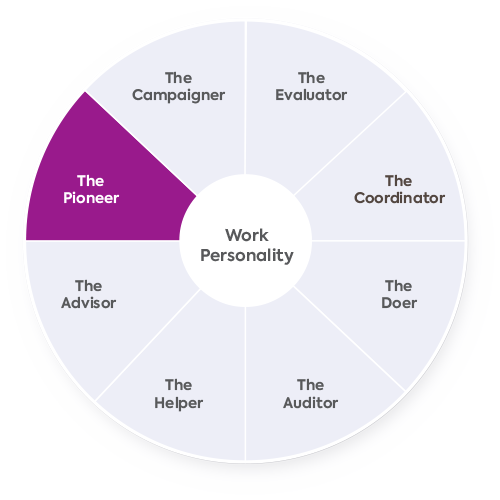
Work Personalityone of eight types
The Pioneer
βLet's do it differently!β
Your personality has been mapped against the types of work crucial for high-performing teams.
Introduction
Unbound by the shackles of routine, the Pioneer thrives in spontaneity and flexibility, possessing an unparalleled skill to navigate through the unplanned and envision the future. They are the innovators, the conceptual thinkers who relish every opportunity that comes with risk.
Delve deeper into the characteristics that define a Pioneer, and paint a comprehensive picture of their abstract thought process, creative imaginations, and their love for complexity.
Major characteristics
- Innovator and conceptual thinker.
- Spontaneous, flexible, open-ended.
- Unplanned and future oriented.
- Creative, imaginative, and conceptually abstract.
- Risk taking and enjoys complexity.
Main preferences for work
Aptly named, this personality type thrives in change, constantly challenging the status quo and driving innovation. Preferring independence and autonomy in their role, a Pioneer flourishes in a dynamic environment that's constantly evolving.
- Driven by a need to innovate and initiate change.
- Enjoys challenging the status quo and generating new ideas.
- Seeks roles that challenge traditional methods.
- Values independence and autonomy in tasks.
- Thrives in dynamic and evolving environments.
Potential blind-spots at work
While pioneers are usually visionaries and innovators, they do have, like all personality types, some potential blind spots. From overlooking valued established processes, favouring grand theories over details, to occasionally causing disruptions with revolutionary ideas, and facing hurdles with routine tasks, these areas provide insight into the potential challenges Pioneers may encounter.
- Can overlook established processes that still hold value.
- Might ignore details in favour of overarching theories.
- Occasionally disrupts team harmony with radical ideas.
- May struggle with tasks that require routine and consistency.
Tips for collaborating with this personality type
Pioneers are known for their innovative and visionary nature, often drawing outside the lines to come up with fresh ideas and solutions. It's key to harness these unique traits while avoiding common pitfalls that could stifle their creativity.
Here is a list of essential do's and don'ts that will help you engage with Pioneers in the most productive and inspiring way.
Do's
- Do channel their innovative tendencies into structured brainstorming.
- Do provide opportunities for them to lead projects that require new ideas.
- Do encourage their visionary and future-oriented thinking.
- Do support their spontaneous and flexible approach to work.
Don'ts
- Don't confine them to traditional methods without room for innovation.
- Don't underestimate their need to challenge the status quo.
- Don't ignore their suggestions for radical improvements or changes.
- Don't stifle their creativity with too many restrictions or rigid guidelines
Knowing Me (worksheet)
Jam-packed with insightful questions, this is a worksheet all about you.
Yes, you heard it right, YOU.
This worksheet is intended to help you delve deeper into your work personality and understand how you tick. And once you gain clarity about yourself, you wonβt be keeping it a secret.
The "Knowing Me" worksheet is a fantastic way to share your insights with your team. By inviting your colleagues into your world, you are encouraging a more cohesive and understanding work environment.
So, let's get down to business and start filling it out, shall we?
- Are you the one who consistently suggests creative, out-of-the-box solutions?
- Or perhaps, you're the adaptable team player who keeps the team flexible and open?
- Do you encourage brainstorming and exploration of new approaches?
Remember, these examples are just a starting point - your worksheet is your canvas to fill with your own unique colors and shades.
Download the Knowing Me worksheet for The Pioneer βGuess who?
Peer into the minds of the world's most influential leaders π£
Ever wondered if you share a personality type with Nelson Mandela, Steve Jobs, or perhaps Mother Teresa? Here's your chance to find out, but there's a catch! We aren't revealing them upfront.
Try guessing them first. As you click each mystery card, the leader will be revealed.
These leaders are imaginative, innovative, visionary, risk-taker, future-focused, and spontaneous. π€
Elon Musk π‘
CEO of SpaceX and Tesla, known for his visionary and risk-taking approach to pushing the boundaries of innovation and technology.
Steve Jobs π‘
Co-founder of Apple, renowned for his pioneering spirit, ability to think outside the box, and focus on groundbreaking innovation.
Mark Zuckerberg π‘
Co-founder of Facebook (Meta), admired for his visionary approach to transforming how people connect through social media.
Want to guess more influential leaders? Explore all eight types β
Career paths
When contemplating career prospects, Pioneers crave roles that cater to their penchant for adaptability, problem-solving, and creative expression.
Their adaptability allows them to thrive in fluctuating work conditions, constantly finding new and creative ways to solve problems and fulfill their responsibilities.
With their vast imagination and incredible adaptability, Pioneers are well-suited to a range of careers that require the ability to innovate and think outside the box.
Careers such as Growth Hackers, UX/UI Designers, and Product Development Managers allow them to use their creativity to develop new strategies and designs.
Their problem-solving skills make them excellent candidates for roles like Changes & Transformation Manager or Corporate Strategist.
Additionally, their talent for creative expression can be well utilised in positions like Scriptwriter, Concept Artist, or Documentary Filmmaker.
- Growth Hacker
- New Ventures Lead
- Creative Brand Strategist
- UX/UI Designer
- Product Development Manager
- User Experience Researcher
- Design Thinking Consultant
- Mergers & Acquisitions (M&A) Specialist
- Changes & Transformation Manager
- Corporate Strategist
- Strategic Partnerships Manager
- Sustainability Consultant
- Trend Analyst
- Innovation Consultant
- Corporate Social Responsibility (CSR) Manager
- Scriptwriter
- Creative Producer
- Documentary Filmmaker
- Concept Artist
Leadership style
Individuals have natural or preferred leadership styles that align with their personality types.
For Pioneers, they may find aspects of their preferred leadership style easier or more challenging in certain circumstances. But that doesn't mean they can't adapt to specific situations.
Effective leaders are flexible and change their approach based on the situation.
By remaining flexible in their approach, Pioneers can harness their strengths while also adapting to the team's needs and the demands of the task.
Non-Directive Leadership
See how Pioneers adapt to the other two βWhat does this mean? π€
Non-Directive Leadership takes a hands-off approach, providing teams with autonomy and trusting them to make their own decisions. Leaders using this style focus on empowering their team, offering guidance only when necessary.
This leadership style is effective in environments that rely on innovation, where highly skilled teams require minimal supervision and are trusted to manage themselves. Read more.
HOW to ADAPT TO other situations
Any leadership style can be adjusted to fit different situations and team needs.
Click each tab below to discover what's easy and hard when adapting to each leadership style.
β Pick a style to compare
Adapting to Non-Directive Leadership (natural style)
What's easy?
Pioneers can handle directive leadership when the task requires a bold, innovative vision, but they prefer to lead in ways that allow flexibility and creativity.
Blindspots?
Pioneers will struggle with strict processes, rigid expectations, and limited room for experimentation.
What's easy?
Pioneers enjoy democratic leadership when it allows for brainstorming and sharing new ideas with the team. They thrive in open, creative environments.
Blindspots?
Pioneers may find it hard to navigate team dynamics when thereβs too much structure or when collaboration slows down innovation.
What's easy?
Pioneers excel in non-directive leadership, as they love giving their team the freedom to innovate and explore new possibilities. They prefer minimal oversight and maximum creativity.
Blindspots?
Pioneers may struggle with situations that require more hands-on guidance, follow-up, or strict deadlines.
Want to be sure if Directive, Democratic or Non-Directive Leadership is right for the current situation or decision your team faces?
In 10 short questions, find out the most appropriate leadership approach you can use for every team situation.
Assess my situation now β

Resolving conflict in teams
For leaders, conflict within a team can seem like a daunting challenge.
Yet, when equipped with a deep understanding of each team member's unique personality, leaders can harness these moments to foster growth, spark innovation, and cultivate harmony.
Below is practical advice for leaders to navigate such scenarios effectively, based on the personality types in their team.
Click each personality type below to see practical advice for a leader to manage conflict with the Pioneer.
Encourage the Campaigner to guide decisions, e.g., βWhatβs the next actionable step?β
Help the Pioneer stay focused on decision-making, e.g., βHow can we translate these ideas into concrete milestones?β
Encourage the Evaluator to embrace creative solutions, e.g., βWhat innovative approaches can we consider here?β
Guide the Pioneer to commit to timelines, e.g., βLetβs agree on a course of action and timeline to keep the project on track.β
Encourage the Coordinator to leave room for creative ideas, e.g., βCan we create some flexibility in the plan to allow for innovation?β
Guide the Pioneer to commit to timelines, e.g., βLetβs set milestones to keep the project on track while exploring new ideas.β
Encourage the Doer to incorporate creative thinking into their tasks, e.g., βHow can we fit these new ideas into our plan?β
Guide the Pioneer to stay focused on practical implementation, e.g., βLetβs set a timeline for these ideas to ensure progress.β
Help the Auditor remain open to innovation, e.g., βLetβs explore how this creative idea fits into your detailed framework.β
Guide the Pioneer to appreciate structure, e.g., βLetβs ensure we address all the details before implementing this idea.β
Encourage the Helper to participate more actively, e.g., βHow do you feel about the direction weβre going in?β
Help the Pioneer consider emotional impacts, e.g., βLetβs think about how this approach might affect team morale.β
Encourage the Advisor to focus on decision-making, e.g., βLetβs set a deadline for making a final decision.β
Help the Pioneer stay focused on practical outcomes, e.g., βCan we agree on a timeline for these ideas to ensure progress?β
Guide both Pioneers to narrow down their ideas and commit to specific plans, e.g., βWhich idea has the most immediate impact, and what can we do this week to get it started?β
Ensure both Pioneers are accountable by setting timelines for action, e.g., βLetβs set a deadline for when you will begin implementing this plan.β
One result is interesting.
Eight of them is a map.
Send this page to the people you work with and ask for theirs. Most friction at work starts in the gap between how you prefer to work and how they do, and that gap is easier to talk about once it has a name.
Everyone can take the assessment free, in about two minutes.
The eight Work Personality types
Tap a segment to see what each type brings, and where each one gets stuck.
β Tap or click a segment
The Evaluator
"Let's weigh up our options!"
Tests the thinking and finds the risk before it finds you.
Read the full Evaluator page βEight types, one of them is yours.
Not sure which one is yours? Take the assessment β Four questions. About two minutes.
How you prefer to work
is not how everyone works.
Work Personality maps your preferences against the kinds of work high-performing teams rely on, and gives you one of eight types. It is not a measure of ability. One person thinks out loud and decides fast, another needs quiet first. Neither is wrong, and most friction at work starts in that gap.
For one person it is a conversation starter. For a whole team it is a map: which kinds of work are covered twice over, and which are not covered at all.
This page
The short assessment. Four questions. One of eight types. Free, and a strong indication rather than a diagnosis.
The platform
The validated assessment. Psychometrically validated, measured by degree, and detailed enough to make decisions you can defend.
Designed by corporate psychologist Rudy Crous. Related reading: leadership styles and your personality and what the Pioneer type means at work.
Common questions about the Pioneer
Unbound by the shackles of routine, the Pioneer thrives in spontaneity and flexibility, possessing an unparalleled skill to navigate through the unplanned and envision the future. The Pioneer's catchphrase is βLet's do it differently!β. It is one of the eight Work Personality types, each matched to a kind of work high-performing teams need covered.
Innovator and conceptual thinker; Spontaneous, flexible, open-ended; Unplanned and future oriented; Creative, imaginative, and conceptually abstract; Risk taking and enjoys complexity.
With their vast imagination and incredible adaptability, Pioneers are well-suited to a range of careers that require the ability to innovate and think outside the box. Careers such as Growth Hackers , UX/UI Designers , and Product Development Managers allow them to use their creativity to develop new strategies and designs.
Non-Directive Leadership. Non-Directive Leadership takes a hands-off approach, providing teams with autonomy and trusting them to make their own decisions. Leaders using this style focus on empowering their team, offering guidance only when necessary. Effective leaders are flexible and change their approach based on the situation.
Do channel their innovative tendencies into structured brainstorming. Do provide opportunities for them to lead projects that require new ideas. Do encourage their visionary and future-oriented thinking. Do support their spontaneous and flexible approach to work.
Not sure which of the eight you are? Four questions. Two minutes. Free.
Take the free assessment
.webp)
