

Skip to the main content.

Work Personalityone of eight types

The Campaigner

β€œLet's sell the dream!”

Your personality has been mapped against the types of work crucial for high-performing teams.
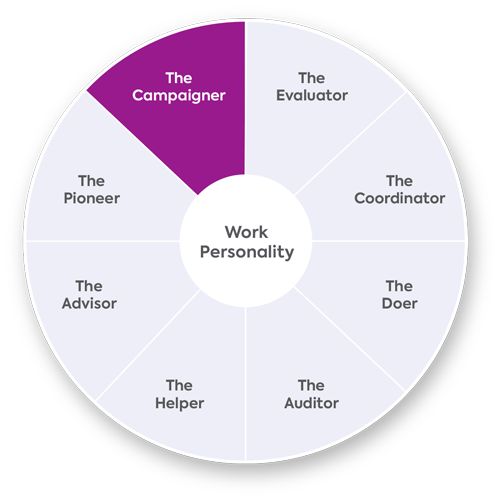
Type
The Campaigner, one of eight Work Personality types
Natural leadership style
Democratic Leadership
Assessment
Four questions, two minutes, free
Reading time
About 7 minutes
The Work Personality wheel with the Campaigner segment highlighted

Introduction

Campaigners are the vibrant, magnetic personas that light up our work environments and social spaces. They embody roles of negotiators, sellers, and promoters with unbridled enthusiasm and a people-oriented approach.

Their instinctive ability to draw in and attract audiences pairs perfectly with their powerful talent for inspiring, persuading and influencing. With imagination at their core, they are big picture thinkers, always looking beyond the obvious and mundane.

The Campaigner

Major characteristics

  • Negotiator, seller, promoter.
  • People-oriented, enthusiastic.
  • Draws people in, attracts audiences.
  • Inspiring, persuading & influential.
  • Big picture thinker, imaginative
At work

Main preferences for work

Best understood for their inherent zest and drive, they flourish in lively, stimulating environments. Key traits setting them apart include a preference for variety, a knack for networking, and an exceptional ability to persuade and influence others.

They thrive on strategic creativity and relish the thrill of pursuing their goals.

  • Prefers variety and excitement over routine.
  • Enjoys networking and building relationships.
  • Thrives on persuading and influencing others.
  • Prefers strategic creative ideation.
  • Enjoys the thrill of the chase.
Watch for

Potential blind-spots at work

Despite their captivating charm and invigorating energy, Campaigners don't come without their potential blind spots. Their enthusiastic nature may lead to overlooking details, prioritising popularity over practicality, a susceptibility to overcommit and overpromise, and a tendency to disregard routine tasks.

  • May overlook details for broader vision.
  • Can prioritise popularity over practicality.
  • Risk of overcommitting or overpromising.
  • Might neglect routine or structured tasks.

Tips for collaborating with this personality type

It's important to remember a few key do's and don'ts when collaborating with this spirited and inventive personality type. Ensuring a balance between structure and freedom, while promoting expression and valuing creativity, is crucial.

Let's take a closer look at the effective ways to harmonise with the Campaigners, ensuring that their unique spark breeds success, not chaos.

Do's

  • Do set clear, measurable goals to focus their energy.
  • Do provide platforms for their creativity and expression.
  • Do encourage them to delegate detail-oriented tasks.
  • Do use structured feedback to guide their enthusiasm.

Don'ts

  • Don't confine them to routine, repetitive tasks.
  • Don't criticise their ideas without offering constructive alternatives.
  • Don't limit their interaction with others.
  • Don't ignore their need for personal expression and visibility.

Knowing Me (worksheet)

Jam-packed with insightful questions, this is a worksheet all about you.
Yes, you heard it right, YOU.

This worksheet is intended to help you delve deeper into your work personality and understand how you tick. And once you gain clarity about yourself, you won’t be keeping it a secret.

The "Knowing Me" worksheet is a fantastic way to share your insights with your team. By inviting your colleagues into your world, you are encouraging a more cohesive and understanding work environment.

So, let's get down to business and start filling it out, shall we?

  • Do you find yourself bringing an endless supply of energy and enthusiasm while constantly striving to motivate others?
  • Are you the kind of person who thrives on building strong relationships and networks within the team?
  • Can you naturally persuade and influence others through your dynamic and enthusiastic approach?

Remember, these examples are just a starting point - your worksheet is your canvas to fill with your own unique colors and shades.

Download the Knowing Me worksheet for The Campaigner
Knowing Me The Campaigner

PDF, opens in a new tab.

Guess who?

Peer into the minds of the world's most influential leaders πŸ“£

Ever wondered if you share a personality type with Nelson Mandela, Steve Jobs, or perhaps Mother Teresa? Here's your chance to find out, but there's a catch! We aren't revealing them upfront.

Try guessing them first. As you click each mystery card, the leader will be revealed.

These leaders are enthusiastic, visionary, future-focused, big-picture thinkers, energetic, and persuasive. πŸ€”

Revealed
Nelson Mandela πŸ“£

Known for his ability to inspire and unite people around a vision of a better future for South Africa.

Revealed
Oprah Winfrey πŸ“£

A visionary in media, driven by passion and the desire to empower others to reach their full potential.

Revealed
Richard Branson πŸ“£

Founder of Virgin Group, known for his adventurous spirit, optimism, and ability to inspire innovation.

Want to guess more influential leaders? Explore all eight types

Career paths

When it comes to their career paths, The Campaigner desires more than just a regular 9-5 schedule. They, driven by their future possibilities, are passionate about inspiring others and enjoy collaborating.

Their creative spirit and forward-thinking mindset often allow them to thrive in a dynamic environment where they can explore new ideas and inspire change. The Campaigners often prefer careers that provide them with the freedom to innovate and the potential to influence.

Their innate passion for inspiring others and their creativity make them perfect for careers as Marketing Specialists, Public Relations Managers, Journalists, Communications Managers, or even Brand Strategists.

Their ability to think ahead and their drive to implement change make them excellent candidates for roles such as Business Development Managers, Product Managers, or even Political Campaign Managers.

The campaigners' knack for people engagement also makes them successful Social Media Managers, Corporate Trainers, Sales Managers, and more.

The full list:
Inspiring others
  • Marketing Specialist
  • Public Relations Manager
  • Journalist
  • Communications Manager
  • Brand Strategist
  • Creative Director
  • Advertising Executive
Driving change
  • Business Development Manager
  • Product Manager
  • Political Campaign Manager
  • Lobbyist
  • Venture Capitalist
Engaging people
  • Social Media Manager
  • Corporate Trainer
  • Sales Manager
  • Event Coordinator
  • Event Planner
  • Community Organiser
  • Brand Ambassador

Leadership style

Individuals have natural or preferred leadership styles that align with their personality types.

For Campaigners, they may find aspects of their preferred leadership style easier or more challenging in certain circumstances. But that doesn't mean they can't adapt to specific situations.

Effective leaders are flexible and change their approach based on the situation.

By remaining flexible in their approach, Campaigners can harness their strengths while also adapting to the team's needs and the demands of the task.
The Campaigner's natural leadership style is:

Democratic Leadership

See how Campaigners adapt to the other two
What does this mean? πŸ€”

Democratic Leadership focuses on collaboration, shared decision-making, and input from the team. Democratic leaders encourage participation and value the contributions of their team members, guiding them toward a common goal.

This style is best suited to environments where creativity, innovation, and diverse perspectives are valued, as it allows for greater engagement and ownership from team members. Read more.

HOW to ADAPT TO other situations

Any leadership style can be adjusted to fit different situations and team needs.

Click each tab below to discover what's easy and hard when adapting to each leadership style.

Pick a style to compare

Adapting to Democratic Leadership (natural style)

What's easy?

Campaigners can handle directive leadership when it aligns with a vision that they are passionate about, helping them rally others behind a clear and exciting goal.

Blindspots?

They will struggle with rigid control and strict processes, feeling constrained by a lack of room for creative thinking or innovation.

What's easy?

Campaigners thrive in democratic leadership because they enjoy involving others in creative problem-solving and value diverse perspectives. They excel at inspiring collaboration.

Blindspots?

They may find it hard to balance democratic processes with the need to make final decisions, as they can get caught up in discussions and visioning.

What's easy?

Campaigners love autonomy and innovation, making non-directive leadership appealing, especially when they can explore new ideas and encourage their teams to do the same.

Blindspots?

They may find it hard to focus on practical execution and ensuring follow-through without clear structure or accountability measures.

Related tool Β· leadership style assessment

Want to be sure if Directive, Democratic or Non-Directive Leadership is right for the current situation or decision your team faces?

In 10 short questions, find out the most appropriate leadership approach you can use for every team situation.

Assess my situation now

Leadership style dial

Resolving conflict in teams

For leaders, conflict within a team can seem like a daunting challenge.

Yet, when equipped with a deep understanding of each team member's unique personality, leaders can harness these moments to foster growth, spark innovation, and cultivate harmony.

Below is practical advice for leaders to navigate such scenarios effectively, based on the personality types in their team. 

Click each personality type below to see practical advice for a leader to manage conflict with the Campaigner.

Encourage the Evaluator to consider long-term benefits, e.g., β€œLet’s discuss how this approach could improve our results down the line.”

Help the Campaigner break ideas into logical components, e.g., β€œHow can we turn these ideas into a project timeline?”

Encourage the Coordinator to allow flexibility before imposing deadlines, e.g., β€œLet’s explore options before locking in the timeline.”

Help the Campaigner frame ideas with structure, e.g., β€œCan you map out the steps for execution?”

Encourage the Doer to connect their work to long-term goals, e.g., β€œHow does this task contribute to our overall strategy?”

Help the Campaigner focus on immediate priorities, e.g., β€œWhat needs to happen now to make progress on the bigger picture?”

Encourage the Auditor to engage earlier in the discussion, e.g., β€œWe need your detailed perspectiveβ€”can you provide some initial feedback?”

Help the Campaigner communicate clearly and patiently, e.g., β€œLet’s walk through the plan step by step.”

Help the Helper feel safe to express their concerns, e.g., β€œYour input is importantβ€”how do you feel about this idea?”

Encourage the Campaigner to consider team dynamics, e.g., β€œHow do you think this plan will affect the overall team atmosphere?”

Encourage the Advisor to set deadlines to avoid procrastination, e.g., β€œLet’s set a deadline to finalise decisions.”

Help the Campaigner define clear, actionable goals, e.g., β€œWhat’s the first step in getting this idea started?”

Help the Pioneer stay focused on decision-making, e.g., β€œHow can we translate these ideas into concrete milestones?”

Encourage the Campaigner to guide decisions, e.g., β€œWhat’s the next actionable step?”

Help both Campaigners narrow their focus to prevent idea overload, e.g., β€œLet’s pick one key idea to test first before moving on to others.”

Reinforce that creativity is a strength but emphasise the importance of follow-through, e.g., β€œWhat’s the next step in bringing this idea to life?”

One result is interesting.
Eight of them is a map.

Send this page to the people you work with and ask for theirs. Most friction at work starts in the gap between how you prefer to work and how they do, and that gap is easier to talk about once it has a name.

Everyone can take the assessment free, in about two minutes.

The eight Work Personality types

Tap a segment to see what each type brings, and where each one gets stuck.

Tap or click a segment

 EvaluatorCoordinatorDoerAuditorHelperAdvisorPioneerCampaignerEightWORK TYPES
This page

The Evaluator

"Let's weigh up our options!"

Tests the thinking and finds the risk before it finds you.

Read the full Evaluator page

Eight types, one of them is yours.


Not sure which one is yours? Take the assessment Four questions. About two minutes.

How you prefer to work
is not how everyone works.

Work Personality maps your preferences against the kinds of work high-performing teams rely on, and gives you one of eight types. It is not a measure of ability. One person thinks out loud and decides fast, another needs quiet first. Neither is wrong, and most friction at work starts in that gap.

For one person it is a conversation starter. For a whole team it is a map: which kinds of work are covered twice over, and which are not covered at all.

The two assessments

This page

The short assessment. Four questions. One of eight types. Free, and a strong indication rather than a diagnosis.

The platform

The validated assessment. Psychometrically validated, measured by degree, and detailed enough to make decisions you can defend.

Designed by corporate psychologist Rudy Crous. Related reading: leadership styles and your personality and what the Campaigner type means at work.

Common questions about the Campaigner

Campaigners are the vibrant, magnetic personas that light up our work environments and social spaces. The Campaigner's catchphrase is β€œLet's sell the dream!”. It is one of the eight Work Personality types, each matched to a kind of work high-performing teams need covered.

Negotiator, seller, promoter; People-oriented, enthusiastic; Draws people in, attracts audiences; Inspiring, persuading & influential; Big picture thinker, imaginative.

Their innate passion for inspiring others and their creativity make them perfect for careers as Marketing Specialists , Public Relations Managers , Journalists , Communications Managers , or even Brand Strategists . Their ability to think ahead and their drive to implement change make them excellent candidates for roles such as Business Development Managers , Product Managers , or even Political Campaign Managers .

Democratic Leadership. Democratic Leadership focuses on collaboration, shared decision-making, and input from the team. Democratic leaders encourage participation and value the contributions of their team members, guiding them toward a common goal. Effective leaders are flexible and change their approach based on the situation.

Do set clear, measurable goals to focus their energy. Do provide platforms for their creativity and expression. Do encourage them to delegate detail-oriented tasks. Do use structured feedback to guide their enthusiasm.