

The products
Platform overviewSee how Hire, Engage, Develop and Assure work together on one platform.By size
By role
Work Personalityone of eight types
The Evaluator
“Let's weigh up our options!”
Your personality has been mapped against the types of work crucial for high-performing teams.
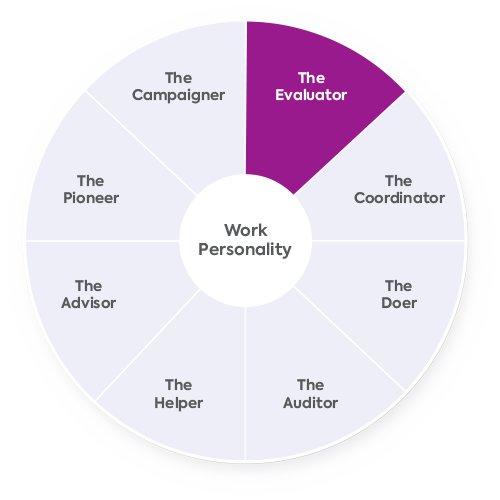
Introduction
Dominating any work environment with their logical, critical, and realistic approach, Evaluators are instrumental in bringing unmatched objectivity to risk evaluation. With their investigative and analytical mindsets, they constantly critique and tirelessly seek improvements.
They strike a distinct balance between action-oriented and prudent decision-making, all while crafting their unique path in a sociable yet individualistic manner.
Major characteristics
- Logical, critical, realistic.
- Objective risk evaluator.
- Investigative, analytical, critiquing.
- Action oriented, deliberate, & prudent.
- Outgoing yet individualistic.
Main preferences for work
Famed for their quest to weigh-up alternatives and test new ideas, Evaluators are the maestros of strategising and problem-solving in the workplace. They thrive on data-backed decisions and show a fondness for managing strategic risks.
Take a look at their key work preferences, from their penchant for variety over routine to their affinity for experimentation.
- Enjoys testing ideas and weighing-up alternatives.
- Likes to experiment and problem-solve.
- Prefers variety over routine in problem-solving.
- Prefers data-driven decision-making.
- Likes strategic risk management.
Potential blind-spots at work
As meticulous and analytical as they are, Evaluators are not exempt from having their blind spots. These potential pitfalls can hinder their growth, limit their effectiveness, and even strain their relationships at work. From a perceived critical nature to a tendency to be confrontational, these blind spots are part and parcel of their meticulous nature.
- Perceived as overly critical.
- Desire for detailed analysis can delay decision-making.
- May dismiss intuitive or less rational ideas.
- Can be confrontational in discussions.
- Often sceptical of unproven concepts.
Tips for collaborating with this personality type
This personality thrives on strategic planning, analytical challenges, and risk assessment, wielding these strengths to enhance team efforts.
But how can we efficiently collaborate with such a personality type? Here is a simple list of do's and don'ts that will help you work harmoniously and productively with our Evaluator colleagues.
Do's
- Do provide opportunities for analytical challenges.
- Do use their skills in strategic planning and risk assessment.
- Do encourage open and constructive expression of thoughts.
- Do balance their critique with positive reinforcement.
Don'ts
- Don't dismiss their need for data and thorough analysis.
- Don't rush them into decisions without proper evaluation.
- Don't sideline them in brainstorming that values quantity over quality.
- Don't ignore their insights on potential risks and drawbacks.
Knowing Me (worksheet)
Jam-packed with insightful questions, this is a worksheet all about you.
Yes, you heard it right, YOU.
This worksheet is intended to help you delve deeper into your work personality and understand how you tick. And once you gain clarity about yourself, you won’t be keeping it a secret.
The "Knowing Me" worksheet is a fantastic way to share your insights with your team. By inviting your colleagues into your world, you are encouraging a more cohesive and understanding work environment.
So, let's get down to business and start filling it out, shall we?
- Do you shine with your ability to make clear and logical decisions that aim for team coherence and success?
- Are you proficient at identifying potential risks and setting effective action steps toward achieving the team's goals?
- Do you have the knack to keep the team grounded and focused through your objective analysis?
Remember, these examples are just a starting point - your worksheet is your canvas to fill with your own unique colors and shades.
Download the Knowing Me worksheet for The Evaluator →Guess who?
Peer into the minds of the world's most influential leaders 📣
Ever wondered if you share a personality type with Nelson Mandela, Steve Jobs, or perhaps Mother Teresa? Here's your chance to find out, but there's a catch! We aren't revealing them upfront.
Try guessing them first. As you click each mystery card, the leader will be revealed.
These leaders are logical, analytical, direct, results-driven, decisive, and objective. 🤔
Margaret Thatcher ⚖️
Former Prime Minister, known for her strong, logical decision-making and results-oriented leadership.
Sheryl Sandberg ⚖️
Former COO of Facebook (Meta), a pragmatic and strategic thinker known for her focus on results and leadership in technology.
Jeff Bezos ⚖️
Founder of Amazon, known for his analytical mindset, long-term strategic vision, and relentless focus on efficiency and results.
Want to guess more influential leaders? Explore all eight types →
Career paths
When it comes to the career environment, the Evaluator strives for more than just a static position. They have an analytical mind, they are results-oriented, and they enjoy engaging with others while investigating ideas and concepts.
Evaluators thrive in careers that satisfy their analytical nature and their interest in interacting with others while investigating ideas and concepts.
As analytical thinkers, they can excel as Lawyers, Venture Capitalists, Project Managers, or even Operations Managers. Their results-driven nature makes them perfect for roles such as Sales Manager and Product Development.
They are also known for their ability to understand and dissect complex concepts, making them suitable for roles in Management Consulting, Investment Banking, or as Economists.
The evaluators' knack for strategic thinking also makes them excellent Business Strategists, Business Intelligence Analysts, and Risk Managers.
- Lawyer
- Venture Capitalist
- Project Manager
- Operations Manager
- Sales Manager
- Product Development
- Judge
- Marketing Manager
- Corporate Attorney
- Construction Manager
- Military Officer
- Investment Banker
- Management Consultant
- Financial Analyst
- Economist
- Business Analyst
- Business Strategist
- Business Intelligence Analyst
- Risk Manager
Leadership style
Individuals have natural or preferred leadership styles that align with their personality types.
For Evaluators, they may find aspects of their preferred leadership style easier or more challenging in certain circumstances. But that doesn't mean they can't adapt to specific situations.
Effective leaders are flexible and change their approach based on the situation.
By remaining flexible in their approach, Evaluators can harness their strengths while also adapting to the team's needs and the demands of the task.

Directive Leadership
See how Evaluators adapt to the other two →What does this mean? 🤔
Directive Leadership is characterised by a high degree of control and structure. Leaders adopting this style provide clear instructions, set specific goals, and expect their team to follow a defined path to achieve those goals.
This leadership style works well in situations that require order, efficiency, and quick decision-making, often found in fast-paced, high-stakes environments. This style is best suited for situations where quick decisions are necessary, or the team requires clear direction to succeed. Read more.
HOW to ADAPT TO other situations
Any leadership style can be adjusted to fit different situations and team needs.
Click each tab below to discover what's easy and hard when adapting to each leadership style.
↓ Pick a style to compare
Adapting to Directive Leadership (natural style)
What's easy?
Evaluators thrive in directive leadership because they prefer making decisions based on logic and efficiency. They’re comfortable setting clear goals and expectations for their team.
Blindspots?
They may struggle with being overly controlling, finding it difficult to delegate / letting go of control or allow flexibility when it's needed.
What's easy?
Evaluators can appreciate team input if it improves efficiency and results, especially when team expertise is valued.
Blindspots?
They may find it hard to fully embrace a collaborative approach, as they prefer making decisions independently and quickly.
What's easy?
Evaluators may enjoy giving experienced teams autonomy if it leads to efficient outcomes.
Blindspots?
They will likely struggle with completely letting go of control and might feel uncomfortable with a lack of oversight, especially if they don’t trust the team's decision-making process.
Want to be sure if Directive, Democratic or Non-Directive Leadership is right for the current situation or decision your team faces?
In 10 short questions, find out the most appropriate leadership approach you can use for every team situation.
Assess my situation now →

Resolving conflict in teams
For leaders, conflict within a team can seem like a daunting challenge.
Yet, when equipped with a deep understanding of each team member's unique personality, leaders can harness these moments to foster growth, spark innovation, and cultivate harmony.
Below is practical advice for leaders to navigate such scenarios effectively, based on the personality types in their team.
Click each personality type below to see practical advice for a leader to manage conflict with the Evaluator.
Encourage the Coordinator to consider flexibility, e.g., “How can we build more strategic adjustments into the timeline?”
Help the Evaluator present analysis in a clear, actionable way, e.g., “Can we break this down into tasks?”
Encourage the Doer to see the long-term impact, e.g., “How does this task build toward our strategy?”
Help the Evaluator integrate immediate tasks with strategy, e.g., “How can we make sure we hit today’s goals while thinking ahead?”
Help the Auditor share detailed feedback earlier and more regularly, e.g., “Can you share your insights on this part of the project?”
Encourage the Evaluator to take a step back and reflect on specifics, e.g., “Can we address these details before finalising the plan?”
Encourage the Helper to voice their concerns, e.g., “Your thoughts are valuable here—how do you feel about this decision?”
Help the Evaluator acknowledge the emotional aspects of decisions, e.g., “Let’s consider the team’s feelings about this plan.”
Encourage the Advisor to set decision timelines, e.g., “Let’s ensure we finalise by the end of this discussion.”
Help the Evaluator consider alternative approaches, e.g., “Let’s explore other options before finalising.”
Guide the Pioneer to commit to timelines, e.g., “Let’s agree on a course of action and timeline to keep the project on track.”
Encourage the Evaluator to embrace creative solutions, e.g., “What innovative approaches can we consider here?”
Help the Campaigner break ideas into logical components, e.g., “How can we turn these ideas into a project timeline?”
Encourage the Evaluator to consider long-term benefits, e.g., “Let’s discuss how this approach could improve our results down the line.”
Help both Evaluators set clear decision deadlines, e.g., “You’ve both provided great analyses—let’s settle on the most practical solution and move forward.”
Encourage them to communicate their logical arguments clearly and avoid unnecessary competition.
One result is interesting.
Eight of them is a map.
Send this page to the people you work with and ask for theirs. Most friction at work starts in the gap between how you prefer to work and how they do, and that gap is easier to talk about once it has a name.
Everyone can take the assessment free, in about two minutes.
The eight Work Personality types
Tap a segment to see what each type brings, and where each one gets stuck.
↓ Tap or click a segment
The Evaluator
"Let's weigh up our options!"
Tests the thinking and finds the risk before it finds you.
Read the full Evaluator page →Eight types, one of them is yours.
Not sure which one is yours? Take the assessment → Four questions. About two minutes.
How you prefer to work
is not how everyone works.
Work Personality maps your preferences against the kinds of work high-performing teams rely on, and gives you one of eight types. It is not a measure of ability. One person thinks out loud and decides fast, another needs quiet first. Neither is wrong, and most friction at work starts in that gap.
For one person it is a conversation starter. For a whole team it is a map: which kinds of work are covered twice over, and which are not covered at all.
This page
The short assessment. Four questions. One of eight types. Free, and a strong indication rather than a diagnosis.
The platform
The validated assessment. Psychometrically validated, measured by degree, and detailed enough to make decisions you can defend.
Designed by corporate psychologist Rudy Crous. Related reading: leadership styles and your personality and what the Evaluator type means at work.
Common questions about the Evaluator
Dominating any work environment with their logical, critical, and realistic approach, Evaluators are instrumental in bringing unmatched objectivity to risk evaluation. The Evaluator's catchphrase is “Let's weigh up our options!”. It is one of the eight Work Personality types, each matched to a kind of work high-performing teams need covered.
Logical, critical, realistic; Objective risk evaluator; Investigative, analytical, critiquing; Action oriented, deliberate, & prudent; Outgoing yet individualistic.
As analytical thinkers, they can excel as Lawyers , Venture Capitalists , Project Managers , or even Operations Managers . Their results-driven nature makes them perfect for roles such as Sales Manager and Product Development. They are also known for their ability to understand and dissect complex concepts, making them suitable for roles in Management Consulting , Investment Banking , or as Economists .
Directive Leadership. Directive Leadership is characterised by a high degree of control and structure. Leaders adopting this style provide clear instructions, set specific goals, and expect their team to follow a defined path to achieve those goals. Effective leaders are flexible and change their approach based on the situation.
Do provide opportunities for analytical challenges. Do use their skills in strategic planning and risk assessment. Do encourage open and constructive expression of thoughts. Do balance their critique with positive reinforcement.
Not sure which of the eight you are? Four questions. Two minutes. Free.
Take the free assessment
.webp)
