

The products
Platform overviewSee how Hire, Engage, Develop and Assure work together on one platform.By size
By role
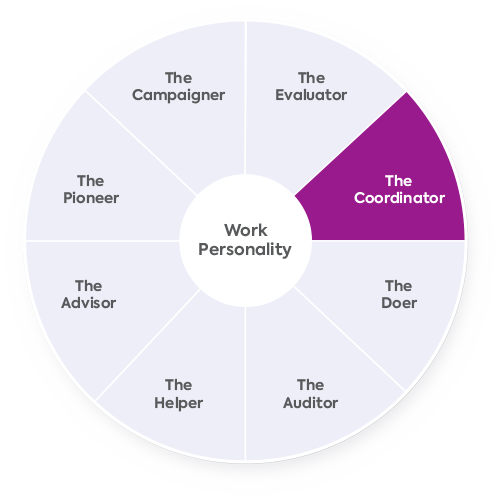
Work Personalityone of eight types
The Coordinator
βLet's make a plan!β
Your personality has been mapped against the types of work crucial for high-performing teams.
Introduction
This compelling personality type encapsulates those who are organised, prepared, and dependable - the backbone of any efficient workplace.
Coordinators are known for their prompt decision making, unwavering determination, persistent efforts and their tenacity for being action and results-oriented. Furthermore, Coordinators set themselves apart with their analytical and objective mindset, laying a well-structured path towards success.
Major characteristics
- Organised, prepared, dependable.
- Deliberate and quick to make decisions.
- Determined and persistent.
- Action and results oriented.
- Analytical and objective.
Main preferences for work
Known for their structured approach and love for efficiency, Coordinators distinctly set priorities, implement targets, and enforce deadlines as they perform their tasks. They revel in the creation of procedures and systems, methodically working towards their set goals.
Their real strength lies in their preference for structured and well-planned environments.
- Sets priorities, implements targets, enforces deadlines.
- Enjoys developing procedures and systems.
- Works methodically towards goals.
- Values efficiency and effectiveness.
- Prefers structured and planned environments.
Potential blind-spots at work
With a focus on structure, systems, and consistency, this personality type is often the backbone of many successful teams. However, just as with every personality type, the Coordinator has potential blind spots that might create challenges.
- Struggles with flexibility and spontaneous changes.
- May be overly rigid in processes and systems.
- Can prioritise process over people.
- Sometimes dismisses unconventional ideas.
Tips for collaborating with this personality type
The Coordinator is all about structure, order, and methodical decision making. They thrive on clarified roles, authority, and regular updates on goals. However, spontaneous decisions or frequent change without consultation can be challenging for them.
Here, we provide a handy list of do's and don'ts to help you synergise better with colleagues of this personality type.
Do's
- Do clearly define roles and expectations for them.
- Do provide them authority to enforce standards and procedures.
- Do regularly update goals and seek their input on plans.
- Do encourage them to consider and evaluate alternative approaches.
Don'ts
- Don't expect spontaneous decision-making without preparation.
- Don't frequently change plans or goals without consultation.
- Don't overlook the importance they place on structure and order.
- Don't devalue their methodical approach to problem-solving.
Knowing Me (worksheet)
Jam-packed with insightful questions, this is a worksheet all about you.
Yes, you heard it right, YOU.
This worksheet is intended to help you delve deeper into your work personality and understand how you tick. And once you gain clarity about yourself, you wonβt be keeping it a secret.
The "Knowing Me" worksheet is a fantastic way to share your insights with your team. By inviting your colleagues into your world, you are encouraging a more cohesive and understanding work environment.
So, let's get down to business and start filling it out, shall we?
- Do you excel at organising tasks and setting clear priorities for effective workflow within the team?
- Do you play a key role in keeping the team focused on set goals and deadlines?
- Are you a consistent advocate for process efficiency and reliability?
Remember, these examples are just a starting point - your worksheet is your canvas to fill with your own unique colors and shades.
Download the Knowing Me worksheet for The Coordinator βGuess who?
Peer into the minds of the world's most influential leaders π£
Ever wondered if you share a personality type with Nelson Mandela, Steve Jobs, or perhaps Mother Teresa? Here's your chance to find out, but there's a catch! We aren't revealing them upfront.
Try guessing them first. As you click each mystery card, the leader will be revealed.
These leaders are organised, structured, efficient, results-driven, dependable, and practical. π€
Tim Cook π
CEO of Apple, known for his organisational skills, operational efficiency, and methodical leadership in driving Appleβs growth.
Angela Merkel π
Former Chancellor of Germany, respected for her steady, structured, and pragmatic leadership style.
Warren Buffet π
CEO of Berkshire Hathaway, admired for his structured and disciplined approach to business and investments.
Want to guess more influential leaders? Explore all eight types β
Career paths
For the Coordinator, the world of work offers a wealth of opportunities where their rational, decisive, and structured mindset is not only welcome but also essential.
Coordinators are drawn to roles that require meticulous organisation, efficient execution, and logical decision-making. They thrive in environments where order and efficiency are paramount, often making them the bedrock of a smoothly operating workplace.
Their knack for being rational and decisive makes them suitable for roles such as School Principals, Lawyers, and Judges, where they can use their logical approach to effect positive changes.
Positions like Quality Assurance Manager, Financial Manager, and Project Manager allow them to utilise their organisational skills to deliver projects efficiently.
Coordinators are also sought after in roles like Compliance Officer, Actuary, Economist, Insurance Underwriter, and Contracts Manager, where their analytical and detail-oriented approach is highly appreciated.
- School Principal
- Lawyer
- Judge
- Engineer
- IT Manager
- Military Officer
- Quality Assurance Manager
- Financial Manager
- Project Manager
- Procurement Manager
- Accountant
- Operations Manager
- Financial Planner
- Investment Banker
- Compliance Officer
- Actuary
- Economist
- Insurance Underwriter
- Contracts Manager
Leadership style
Individuals have natural or preferred leadership styles that align with their personality types.
For Coordinators, they may find aspects of their preferred leadership style easier or more challenging in certain circumstances. But that doesn't mean they can't adapt to specific situations.
Effective leaders are flexible and change their approach based on the situation.
By remaining flexible in their approach, Coordinators can harness their strengths while also adapting to the team's needs and the demands of the task.

Directive Leadership
See how Coordinators adapt to the other two βWhat does this mean? π€
Directive Leadership is characterised by a high degree of control and structure. Leaders adopting this style provide clear instructions, set specific goals, and expect their team to follow a defined path to achieve those goals.
This leadership style works well in situations that require order, efficiency, and quick decision-making, often found in fast-paced, high-stakes environments. This style is best suited for situations where quick decisions are necessary, or the team requires clear direction to succeed. Read more.
HOW to ADAPT TO other situations
Any leadership style can be adjusted to fit different situations and team needs.
Click each tab below to discover what's easy and hard when adapting to each leadership style.
β Pick a style to compare
Adapting to Directive Leadership (natural style)
What's easy?
Coordinators excel in directive leadership roles, as they thrive on structure, clear processes, and focused execution. They are naturally inclined to take charge and ensure tasks are completed.
Blindspots?
They may find it hard to flex and allow input or creative freedom, especially when deadlines are tight.
What's easy?
Coordinators can handle collaboration if it contributes to achieving the end goal. They might enjoy structured collaboration where everyone has defined roles.
Blindspots?
They may find it challenging to manage a less structured, open-ended decision-making process where multiple viewpoints need to be considered.
What's easy?
Coordinators may enjoy giving autonomy to highly organized, self-sufficient teams that deliver results.
Blindspots?
They will struggle with the ambiguity of non-directive leadership, finding it difficult to work without clear goals, deadlines, or control over the process.
Want to be sure if Directive, Democratic or Non-Directive Leadership is right for the current situation or decision your team faces?
In 10 short questions, find out the most appropriate leadership approach you can use for every team situation.
Assess my situation now β

Resolving conflict in teams
For leaders, conflict within a team can seem like a daunting challenge.
Yet, when equipped with a deep understanding of each team member's unique personality, leaders can harness these moments to foster growth, spark innovation, and cultivate harmony.
Below is practical advice for leaders to navigate such scenarios effectively, based on the personality types in their team.
Click each personality type below to see practical advice for a leader to manage conflict with the Coordinator.
Help the Doer connect short-term tasks to long-term outcomes, e.g., βHow does todayβs task contribute to our overall goal?β
Encourage the Coordinator to remain flexible, e.g., βCan we adjust the plan to incorporate new priorities?β
Encourage the Auditor to participate more actively in discussions, e.g., βYour feedback is essentialβplease share it with the team earlier.β
Help the Coordinator respect detailed input, e.g., βCan we take the time to ensure all details are correct?β
Help the Helper voice concerns confidently, e.g., βWe value your perspectiveβhow do you think this approach will affect team morale?β
Encourage the Coordinator to check in on emotional well-being, e.g., βHow do you think this plan impacts the team emotionally?β
Help the Advisor drive decisions, e.g., βLetβs aim to finalise this by the end of the meeting.β
Encourage the Coordinator to integrate flexibility, e.g., βHow can we adjust the plan to include creativity and flexibility?β
Guide the Pioneer to commit to timelines, e.g., βLetβs set milestones to keep the project on track while exploring new ideas.β
Encourage the Coordinator to leave room for creative ideas, e.g., βCan we create some flexibility in the plan to allow for innovation?β
Help the Campaigner frame ideas with structure, e.g., βCan you map out the steps for execution?β
Encourage the Coordinator to allow flexibility before imposing deadlines, e.g., βLetβs explore options before locking in the timeline.β
Help the Evaluator present analysis in a clear, actionable way, e.g., βCan we break this down into tasks?β
Encourage the Coordinator to consider flexibility, e.g., βHow can we build more strategic adjustments into the timeline?β
Help both Coordinators define clear areas of responsibility, e.g., βLetβs assign specific tasks to each of you to manage independently.β
Encourage them to remain adaptable as the project evolves, e.g., βHow can we build more flexibility into your process?
One result is interesting.
Eight of them is a map.
Send this page to the people you work with and ask for theirs. Most friction at work starts in the gap between how you prefer to work and how they do, and that gap is easier to talk about once it has a name.
Everyone can take the assessment free, in about two minutes.
The eight Work Personality types
Tap a segment to see what each type brings, and where each one gets stuck.
β Tap or click a segment
The Evaluator
"Let's weigh up our options!"
Tests the thinking and finds the risk before it finds you.
Read the full Evaluator page βEight types, one of them is yours.
Not sure which one is yours? Take the assessment β Four questions. About two minutes.
How you prefer to work
is not how everyone works.
Work Personality maps your preferences against the kinds of work high-performing teams rely on, and gives you one of eight types. It is not a measure of ability. One person thinks out loud and decides fast, another needs quiet first. Neither is wrong, and most friction at work starts in that gap.
For one person it is a conversation starter. For a whole team it is a map: which kinds of work are covered twice over, and which are not covered at all.
This page
The short assessment. Four questions. One of eight types. Free, and a strong indication rather than a diagnosis.
The platform
The validated assessment. Psychometrically validated, measured by degree, and detailed enough to make decisions you can defend.
Designed by corporate psychologist Rudy Crous. Related reading: leadership styles and your personality and what the Coordinator type means at work.
Common questions about the Coordinator
This compelling personality type encapsulates those who are organised, prepared, and dependable - the backbone of any efficient workplace. The Coordinator's catchphrase is βLet's make a plan!β. It is one of the eight Work Personality types, each matched to a kind of work high-performing teams need covered.
Organised, prepared, dependable; Deliberate and quick to make decisions; Determined and persistent; Action and results oriented; Analytical and objective.
Their knack for being rational and decisive makes them suitable for roles such as School Principals , Lawyers , and Judges , where they can use their logical approach to effect positive changes. Positions like Quality Assurance Manager , Financial Manager , and Project Manager allow them to utilise their organisational skills to deliver projects efficiently.
Directive Leadership. Directive Leadership is characterised by a high degree of control and structure. Leaders adopting this style provide clear instructions, set specific goals, and expect their team to follow a defined path to achieve those goals. Effective leaders are flexible and change their approach based on the situation.
Do clearly define roles and expectations for them. Do provide them authority to enforce standards and procedures. Do regularly update goals and seek their input on plans. Do encourage them to consider and evaluate alternative approaches.
Not sure which of the eight you are? Four questions. Two minutes. Free.
Take the free assessment
.webp)
