

.webp)

 Compono


The Complete Guide to Behavioural Assessment for Hiring (2026)
 Mathan Allington
How a behavioural assessment for hiring predicts job performance, reduces bias, and helps you build teams that work well together.

If you want to know how behavioural science in hiring actually works, you have to accept one uncomfortable truth: almost everything we traditionally do to assess candidates is fundamentally flawed.
Key takeaways
- Traditional résumés and unstructured interviews predict job performance with only 14 to 18 percent accuracy.
- Structured interviews predict candidate success roughly twice as well as unstructured conversations.
- General mental ability and conscientiousness are the strongest indicators of future performance, far outweighing years of experience.
- Replacing gut feel with evidence-based behavioural assessments can raise prediction accuracy to 70 percent.
Most recruitment processes are built on a foundation of habit rather than evidence. Hiring managers scan a résumé for familiar brand names, look for an arbitrary number of years in a similar role, and then bring the candidate in for an unstructured chat to see if they "click". This approach feels natural and comfortable. It gives the interviewer a sense of control and intuition.
The data tells a completely different story. When we look at the actual evidence behind candidate selection, human intuition is a terrible judge of future job performance. We are easily swayed by confidence, shared hobbies, and articulate answers that have nothing to do with the daily realities of the role. To build high-performing teams, we need to stop relying on instinct and start applying behavioural science.
The first step in most hiring processes is also the weakest. Résumés are essentially marketing documents designed to present a candidate in the most favourable light possible. They list past responsibilities, but they rarely provide verified evidence of competence, behaviour, or problem-solving ability.
When researchers analyse what actually leads to success on the job, the metrics we traditionally value fall flat. According to a hiring research summary, years of experience, education level, and other résumé signals are among the weakest predictors of future success, compared with structured assessment of actual behaviour and work. A candidate who has spent ten years in a role has not necessarily mastered it – they may have simply repeated their first year of experience ten times over.
This reliance on historical data creates a flawed filter. It screens out candidates who have the raw capability and behavioural traits to excel but lack the specific background a hiring manager expects to see. It also lets through candidates who look perfect on paper but lack the conscientiousness or adaptability required to thrive in a new environment.

Once a candidate passes the résumé screen, they usually face an unstructured interview. The interviewer asks a few standard questions before letting the conversation flow naturally. They probe into interesting areas, ask hypothetical questions, and ultimately make a decision based on whether they liked the person.
This is where bias thrives. Traditional hiring methods such as resume screening and unstructured interviews predict job performance at only about 14% to 18% accuracy. You would get slightly worse odds by simply flipping a coin.
Unstructured interviews measure a candidate's ability to build rapport and project confidence, rather than their ability to do the job. A charismatic candidate can easily mask a lack of technical depth or poor work habits. Meanwhile, a highly competent but introverted candidate might be rejected simply because the conversation felt a bit stiff. If you want to understand why new hires fail, you usually have to look no further than the unstructured interview that brought them in.
Behavioural science offers a clear alternative to the gut-feel approach. Decades of organisational psychology research have identified exactly which assessment methods correlate most strongly with actual on-the-job performance.
The most reliable predictors are not years of experience or confidence in the interview, but whether candidates can think through problems, show conscientiousness, stay dependable, and perform realistic tasks. When we measure these specific traits and abilities, our prediction accuracy skyrockets.
Meta-analytic evidence shows that structured interviews predict job performance roughly twice as well as unstructured interviews. In a structured interview, every candidate is asked the exact same questions in the exact same order, and their answers are scored against a predetermined rubric. This removes the conversational drift that allows bias to creep in. It forces the interviewer to evaluate the candidate's actual responses rather than their general likability.
Alongside structured interviews, work-sample tests and cognitive ability assessments provide the highest validity. General mental ability indicates how quickly a person can learn new information and adapt to complex situations. Conscientiousness – a personality trait linked to reliability, organisation, and goal-directed behaviour – adds significant incremental value to these predictions.
Knowing the science is one thing. Implementing it in a busy HR department is another. The transition from unstructured, résumé-based hiring to an evidence-based approach requires a shift in both tools and mindset.
Start by standardising your interview process. Define the specific behaviours and competencies required for the role before you look at a single application. Draft a set of behavioural questions that ask candidates to describe past situations where they demonstrated those competencies. Create a scoring key that defines what a poor, average, and excellent answer looks like. This is the foundation of any behavioural science HR guide.
Next, integrate objective assessments early in the process. Rather than waiting until the final round to test a candidate's abilities, use psychometric and behavioural assessments to screen your initial talent pool. This ensures you are spending your interview time on candidates who actually have the underlying traits required for success.
This is where technology bridges the gap between academic science and practical application. Compono Hire evaluates candidates across three critical dimensions – Organisation Fit, Skills, and Qualifications – allowing you to automatically score and rank applicants based on objective data rather than résumé keywords. By embedding these assessments directly into the workflow, you remove the friction of applying behavioural science at scale.
You can design the most scientifically rigorous selection process in the world, but it will fail if your hiring managers ignore the data in favour of their own intuition. Managers often resist structured processes because they feel it restricts their autonomy or turns the interview into a robotic exercise.
Education is critical here. Managers need to understand why the traditional methods fail and how structured data actually protects them from making expensive hiring mistakes. When leaders are trained to use objective selection criteria, the results are immediate and measurable.
Research published in Science found that manager training in selection reduced bias and improved shortlist outcomes: trained managers made it 12% more likely for a woman to be preselected, and significantly more likely for diverse applicants to be hired. Training forces decision-makers to justify their choices using the scoring rubric and the assessment data, rather than vague statements about a candidate "not being the right fit".
By combining structured interviews, validated behavioural assessments, and manager training, you build a selection architecture that actually works. You stop guessing who will perform well and start predicting it with accuracy.
Key insights
- Human intuition and unstructured "chats" are highly susceptible to bias and are poor predictors of actual job performance.
- Structured interviews require asking every candidate the same questions and scoring them against a predefined rubric, doubling predictive accuracy.
- Cognitive ability and conscientiousness consistently rank as the top indicators of long-term success across almost all job categories.
- Training hiring managers to rely on structured data rather than gut feel significantly improves diversity and quality of hire.
If you are ready to move away from gut-feel recruitment and start making evidence-based decisions, we can help you build a smarter process.
Related reading
Behavioural science in hiring is the application of psychological research and data to the recruitment process. It involves using validated assessments, structured interviews, and objective scoring to predict a candidate's future job performance, rather than relying on résumés and gut instinct.
Unstructured interviews are highly vulnerable to unconscious bias. Because the conversation flows naturally, interviewers tend to favour candidates who are similar to themselves or who build easy rapport. Data shows that unstructured interviews predict job performance with only 14 to 18 percent accuracy.
Decades of research indicate that general mental ability, work-sample tests, and structured behavioural interviews are the strongest predictors of job performance. Personality traits, particularly conscientiousness, also provide highly reliable indicators of long-term success.
To structure an interview, you must define the required competencies beforehand, ask every candidate the exact same questions in the same order, and score their answers against a predetermined rubric. This ensures all candidates are evaluated on a level playing field.
Yes. By replacing subjective opinions with objective data and structured scoring, behavioural science minimises the impact of unconscious bias. Training managers to use these structured methods has been proven to increase the selection rates of diverse and underrepresented candidates.
How a behavioural assessment for hiring predicts job performance, reduces bias, and helps you build teams that work well together.

What actually predicts job performance: work personality, cognitive fit and structured scoring, and why gut-feel hiring lands only the lucky hire.
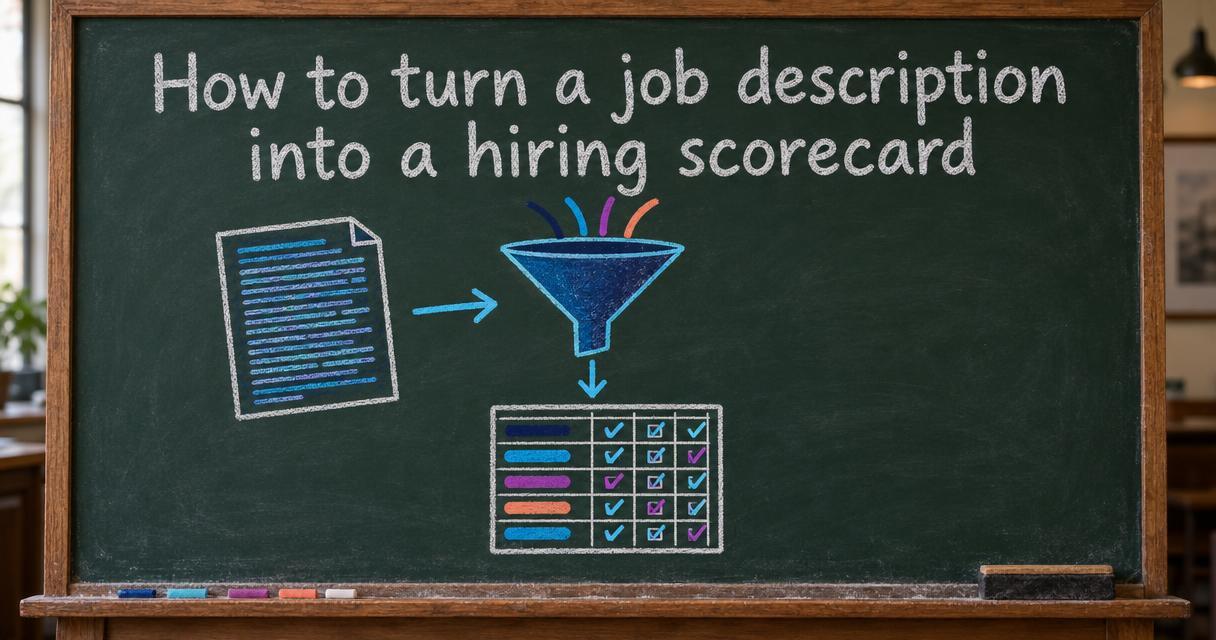
To turn a job description into a hiring scorecard to remove bias, standardise interviews, and make better recruitment decisions.