

 Mathan Allington
Situational interview questions for employers
 Mathan Allington
To use situational interview questions to assess problem-solving skills and build a structured scoring rubric that predicts job performance.

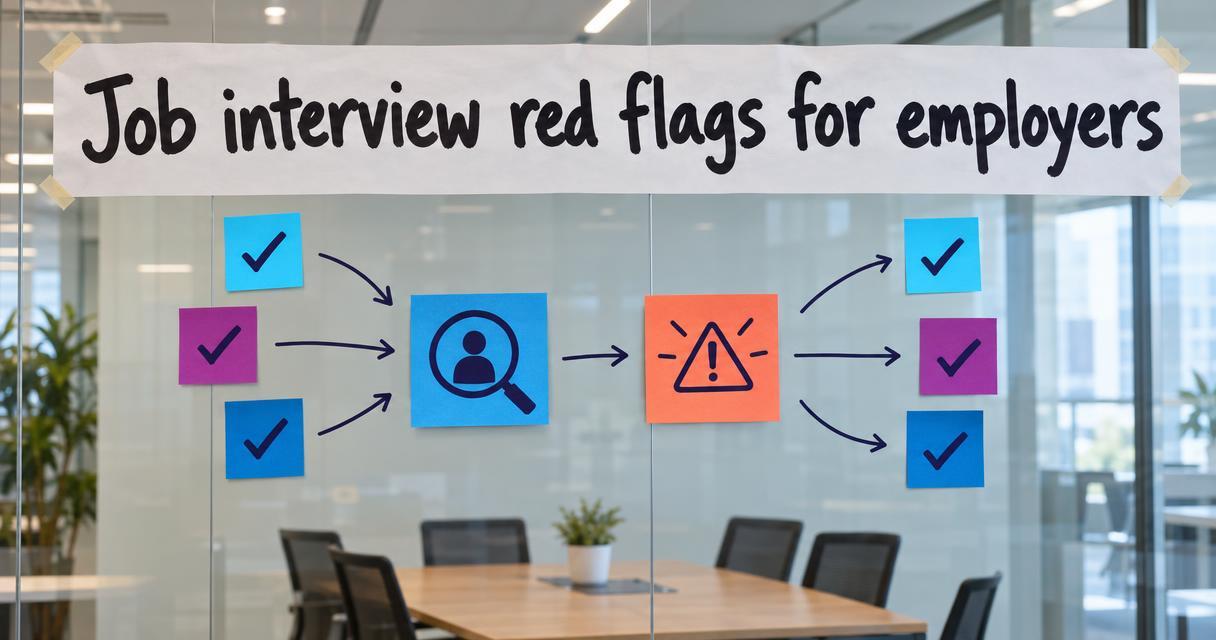
Job interview red flags for employers are specific, observable candidate behaviours that indicate a high risk of future performance issues or culture failure.
Last reviewed November 2026
Key takeaways
- Dishonesty and a lack of preparation are the most common indicators of candidate risk across all industries.
- Hiring managers must actively distinguish between genuine red flags and false positives caused by neurodivergence or simple interview anxiety.
- Remote interviews introduce new risks like resume fraud and AI-assisted deception.
- Using an objective scoring rubric prevents personal bias from mislabeling candidate behaviour.
- When you spot a potential warning sign, you should use targeted behavioural questions to test your assumption before rejecting the candidate.
Hiring is an expensive exercise in risk management. When you hire someone based on a gut feeling, you often miss the behavioural cues that predict how they will actually perform on the job. A candidate might look right on paper and say all the right things in a casual chat, but if you ignore early warning signs, you invite a toxic culture into your team.
Many hiring managers fall into the trap of unstructured conversations. They chat with an applicant, find common ground, and walk away feeling good about the interaction. This approach leaves the door open for "brilliant jerks" who interview well but damage team morale. To avoid common hiring mistakes, you need a framework that separates a charming candidate from a competent one, and a nervous candidate from a deceptive one.
Certain behaviours are universal warning signs. When candidates exhibit these traits, they are showing you how they will handle conflict, feedback, and accountability on the job.
Integrity is not negotiable. When a candidate contradicts their own resume or gives evasive answers about their employment history, you face a significant risk. In a 2024 survey of 625 U.S. hiring managers, 63% identified dishonesty as an interview red flag, making it their most frequently cited concern (Harvard Business Review, cited by Emily Backes).
How a candidate speaks about their past managers tells you how they will eventually speak about you. While it is normal for candidates to seek new opportunities because of poor past experiences, constantly criticising former employers shows a lack of self-awareness. The same research found that 53% of hiring managers flagged rude language or behaviour during interviews as a serious concern, while 31% said criticising former employers or coworkers is a major warning sign.
A candidate does not need to memorise your annual report, but they should understand what your business does. Failing to research the company or asking questions that the job description clearly answers demonstrates poor initiative. It shows they want a job, not necessarily your job.
Remote interviewing and asynchronous video screens have created entirely new categories of red flags. Today, hiring managers must look out for candidates who use artificial intelligence to script their answers in real time, or who misrepresent their location and identity.
According to research on candidate behaviour, 6% of surveyed job candidates admitted to interview fraud, while Gartner predicted that one in four candidate profiles worldwide could be fake by 2028 (Gartner, cited by Kelly Services).
Common indicators of potentially fraudulent candidates include unexplained difficulty answering basic questions about their stated location, reading off a second screen just out of camera view, and requesting to change a laptop-shipping address at the last minute. If a candidate cannot clearly articulate the technical steps behind a project they claim to have led, you should treat it as a serious warning sign.
One of the biggest mistakes hiring managers make is confusing poor interview skills with poor job skills. You must actively separate a genuine behavioural red flag from personal bias, interview anxiety, or neurodivergence.
A lack of eye contact is a classic example. Many traditional hiring guides list poor eye contact as a sign of dishonesty. In reality, it is often a trait of neurodivergent candidates or people experiencing severe anxiety. Unless the role explicitly requires aggressive stakeholder presentations, judging someone on eye contact eliminates highly capable technical talent.
Similarly, an introverted candidate might give short, direct answers. This is not arrogance; it is just a different communication style. You must judge candidates against the actual requirements of the role, not their ability to perform in an artificial interview setting.
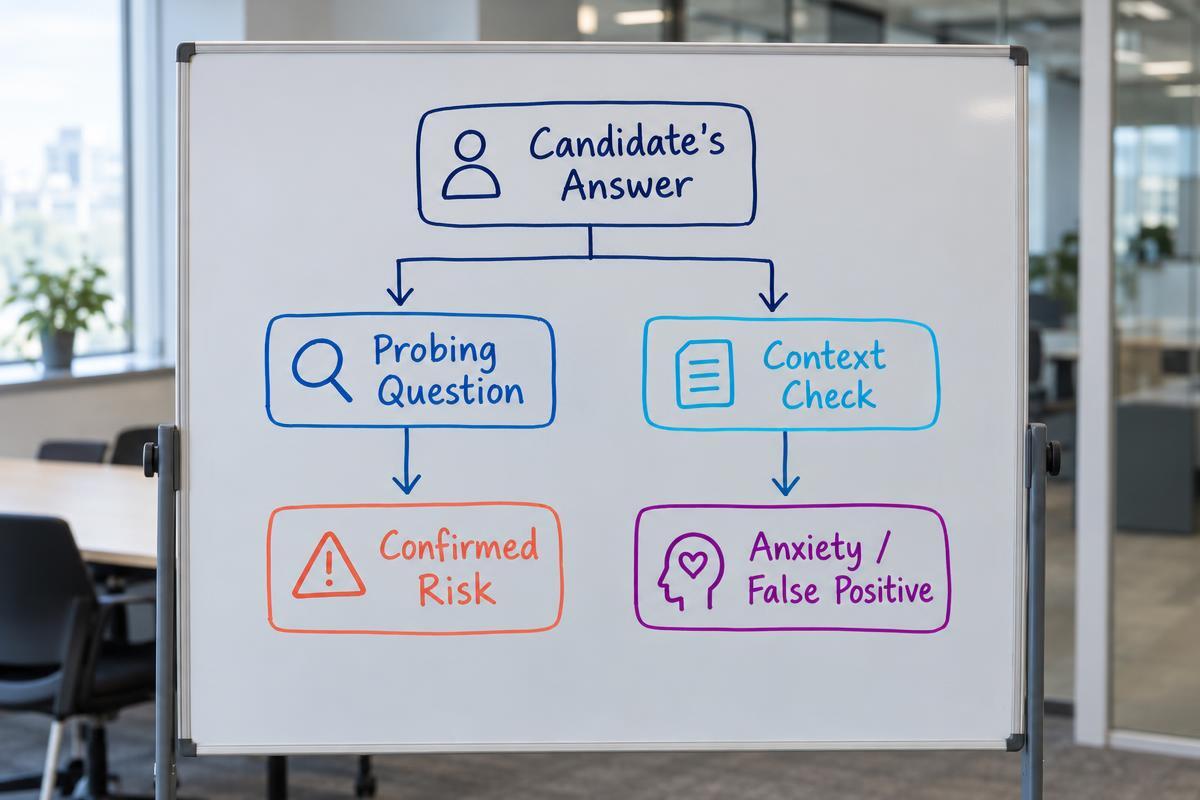
When you spot a potential red flag, do not reject the candidate immediately. Instead, use strategic follow-up questions to test your assumption. This is where a structured interview approach proves its value.
If a candidate gives a vague answer that sounds like it was copied from a textbook, ask for specific operational details. You might say, "Walk me through the exact steps you took to achieve that metric." A candidate who actually did the work will easily explain the process. A deceptive candidate will stumble.
If a candidate blames a previous team for a failed project, test their accountability. Ask, "Looking back at that situation, what is one thing you would do differently today?" A strong candidate will own their part of the failure and explain what they learned. A toxic candidate will double down on blaming others.
The only way to standardise how your team evaluates red flags is to use an interview scoring rubric template. When every interviewer scores candidates against the same defined behaviours, you remove subjective gut feelings from the process.
| Behaviour observed | Potential red flag | False positive check | Follow-up question |
|---|---|---|---|
| Avoids eye contact | Dishonesty or lack of confidence | Is it just anxiety or neurodivergence? | Focus on the content of their technical answers. |
| Vague about past results | Exaggerated resume claims | Are they bound by confidentiality? | "Without naming names, what was your exact role in the project?" |
| Criticises past manager | Toxic negativity | Was the workplace genuinely abusive? | "What did you learn about your own working style from that conflict?" |
By defining exactly what a good answer and a bad answer look like before the interview starts, your hiring team makes defensible decisions. This consistency works at scale. The Coffee Club used Compono Hire to apply one hiring standard across more than 400 stores. This structured approach helped them achieve an 8% lower turnover rate and a 4.8 out of 5 rating on Capterra by screening people in for fit and screening out genuine risks.
Compono Hire is an applicant tracking system that matches candidates to your culture while standardising your interview process. It gives your hiring managers the tools to score candidates objectively, spot behavioural risks early, and make defensible hiring decisions backed by data.
The most common red flags are dishonesty about past experience, criticising former employers or colleagues, arriving unprepared, and exhibiting rude or arrogant behaviour during the interview process.
Fake candidates often read from a second screen, struggle to answer basic questions about their supposed local area, have audio that does not match their lip movements, or give highly scripted, generic answers to specific technical questions.
Unless the candidate is openly abusive or offensive, you should complete the interview. Use the remaining time to ask probing behavioural questions to confirm whether the red flag is a genuine risk or just a misunderstanding caused by interview nerves.
Hiring managers can avoid bias by using a structured interview scorecard. This forces interviewers to rate candidates against predefined criteria and observable behaviours rather than relying on subjective feelings about a candidate's personality.
To use situational interview questions to assess problem-solving skills and build a structured scoring rubric that predicts job performance.

Learn proven strategies for crafting great interview questions to enhance recruitment success.
Learn why you cannot ask candidates about their carer responsibilities during a job interview, the legal risks involved, and the compliant questions...
 Compono