

 Mathan Allington
A panel interview scoring guide gives your hiring team a structured, mathematical way to evaluate candidates fairly instead of relying on collective gut feelings.
Last reviewed November 2026
Key takeaways
- Unstructured panel interviews increase bias and often allow the most senior person in the room to dictate the hiring outcome.
- A functional scoring system requires specific evaluation criteria, weighted importance, and clear behavioural rating scales.
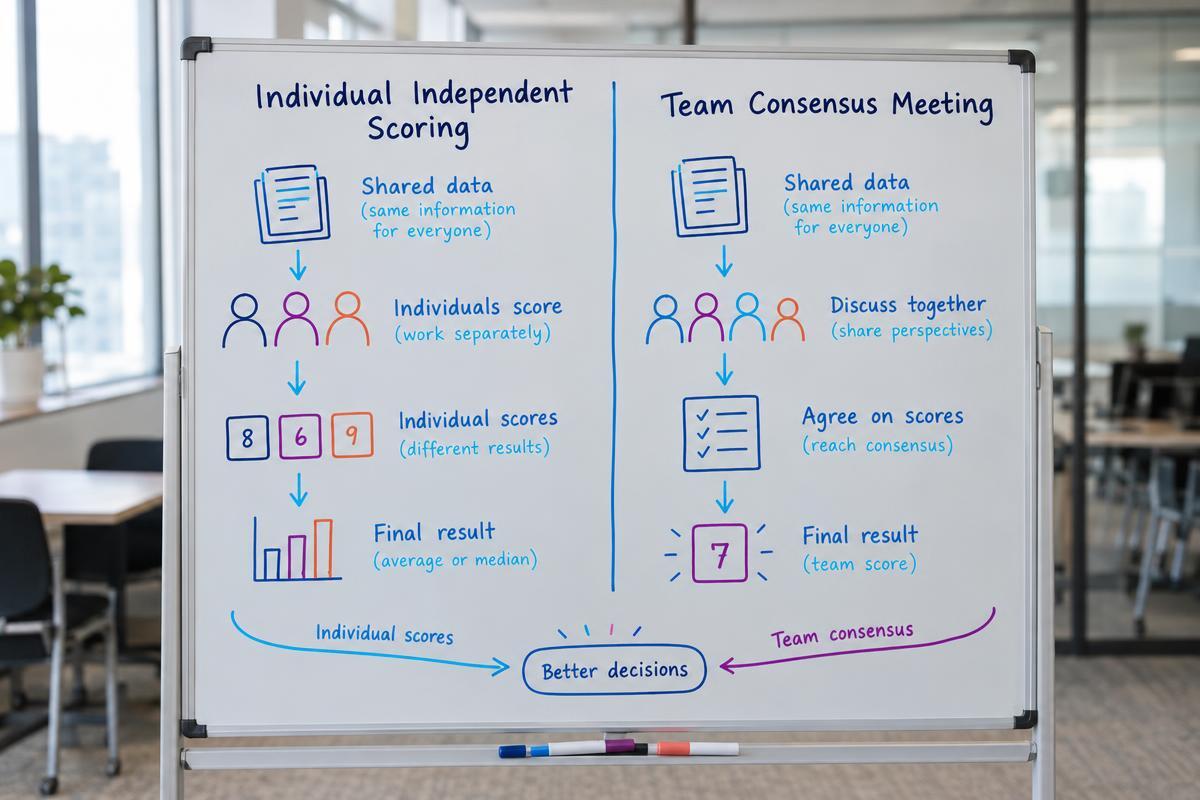
- Panellists must score candidates independently during the interview before any group discussion takes place.
- A structured debrief meeting resolves discordant scores through evidence rather than groupthink.
- Standardised scoring rubrics create legally defensible records that protect your organisation under Australian employment law.
The problem with unstructured panel evaluations
Panel interviews are supposed to provide a balanced, multi-perspective view of a candidate. In reality, they often create a breeding ground for bias and groupthink. When three or four people sit in a room and ask a candidate random questions, the outcome is rarely objective.
Without a panel interview scoring guide, hiring teams default to subjective impressions. The discussion usually starts with the most senior panellist stating their opinion. The rest of the room then falls in line to avoid conflict. This is known as the highest paid person's opinion effect, and it completely undermines the purpose of having a panel.
We know that a structured interview process produces better hiring decisions. According to a Pinn report, structured interviewing can reduce the measured bias effect from a standard deviation of 0.59 in unstructured interviews down to 0.23, which is a reduction of more than half. Despite this clear advantage, the same research notes that only about two-thirds of employers use a structured evaluation process, leaving roughly one-third without a consistent interview framework.
If you want your panel interviews to predict job performance accurately, you need to remove the ambiguity. You must replace casual conversations with structured evaluations.
Core components of a panel scoring system
A reliable panel interview scoring guide is built on three foundational pillars. If any of these elements are missing, your data becomes unreliable and your hiring decisions suffer.
Defining the evaluation criteria
You cannot score a candidate if you do not know exactly what you are measuring. Your evaluation criteria must map directly to the requirements of the job description. This includes both technical competencies and soft skills.
Before the interview process begins, the hiring manager and the human resources team must agree on the five to eight core competencies required for success in the role. These criteria become the foundation of your interview scoring rubric template. Every question asked during the interview must tie back to one of these defined competencies.
Applying weighted scoring methodologies
Not all skills carry the same importance. A candidate applying for a senior financial controller role needs exceptional technical accounting skills. While communication is important, a slight weakness in presentation skills should not carry the same penalty as a fundamental misunderstanding of cash flow modelling.
Weighted scoring solves this problem. By assigning a multiplier to your most critical competencies, you ensure that candidates who excel in the most important areas rise to the top of your ranking. This prevents a candidate with great conversational skills but poor technical ability from outscoring a highly competent specialist.
Establishing clear rating scales
A simple one to five rating scale is useless if your panellists define those numbers differently. One manager might view a three as an average, acceptable answer. Another manager might view a three as a failure. You must standardise what the numbers mean across the entire panel.
Creating a scoring rubric with behavioural anchors
The most effective way to standardise your rating scale is by using Behavioural Anchor Rating Scales. This method ties each numerical score to specific, observable behaviours rather than vague adjectives like poor or excellent.
A 2025 systematic review published in F1000Research found that standardised questions and scoring rubrics improve reliability and perceived fairness, although they do not eliminate interviewer bias entirely. By giving your panel explicit examples of what a good answer looks like, you reduce the cognitive load on the interviewer and force them to evaluate evidence rather than personality.
Here is an example of a behavioural anchor rating scale for a problem solving competency.
| Score | Rating label | Behavioural anchor (Problem Solving) |
|---|---|---|
| 1 | Inadequate | Candidate could not describe a clear problem or relied entirely on others to find a solution. Shows no analytical thinking. |
| 2 | Marginal | Candidate identified a problem but applied a superficial fix. Did not consider long-term consequences or root causes. |
| 3 | Acceptable | Candidate identified the root cause and started a standard solution that resolved the immediate issue successfully. |
| 4 | Strong | Candidate analysed complex data, identified the root cause, consulted stakeholders, and started a lasting solution. |
| 5 | Exceptional | Candidate anticipated the problem before it occurred, built an able to grow system to prevent it, and improved overall team efficiency. |
When you provide this level of detail, your panel knows exactly what evidence they need to justify a high score.
Calibrating your hiring team before the interview
You cannot hand a complex scoring guide to a technical manager five minutes before the candidate walks into the room and expect a fair assessment. Pre-interview calibration is a non-negotiable step in the structured hiring process.
The hiring manager should convene a brief alignment meeting with the panel at least twenty-four hours before the interviews begin. During this meeting, the panel must review the scoring guide and agree on the definition of success. If one panellist expects a highly technical answer and another expects a broad strategic answer for the same question, your scoring data will be completely skewed.
This calibration session is also the time to assign specific roles. Divide the competencies among the panellists. If you have three interviewers, one might focus entirely on technical skills, another on project management, and the third on stakeholder communication. This stops panellists talking over each other and ensures every core competency receives deep attention.
Managing panel changing during the live interview
How your panel behaves during the live interview directly dictates the validity of your data. The golden rule of panel interviewing is that all scoring must happen independently while the candidate is answering the questions.
If panellists wait until the candidate leaves the room to write down their thoughts, they fall victim to recency bias. They will only remember the final five minutes of the conversation or the candidate's most charismatic moment. Interviewers must take detailed notes against the rubric in real time.
Furthermore, panellists must not signal their thoughts to each other during the interview. A raised eyebrow, an aggressive nod, or a dismissive sigh from a senior leader will instantly influence how junior panellists score the candidate. The panel must remain neutral and focus entirely on recording evidence against the behavioural anchors.
This is where a behavioural interview format excels. By asking candidates to describe past actions rather than hypothetical scenarios, panellists have concrete evidence to map against their scoring guide.
The post-interview debrief: resolving score discrepancies
The post-interview debrief meeting is the most critical phase of the panel process. Research cited by BrightHire from Personnel Psychology indicates that structured interviews are approximately twice as effective as unstructured interviews at predicting job performance. However, that effectiveness is only realised if the debrief is handled correctly.
Before any verbal discussion begins, all panellists must submit their independent scores to the hiring manager or human resources representative. Once the scores are visible, the debrief meeting follows a strict, evidence-based format.
Addressing discordant scores
If all panellists gave the candidate a four out of five for communication, there is no need to debate that competency. Move on. The debrief time should be spent entirely on discordant scores. This happens when one panellist gives a candidate a two and another panellist gives them a five for the same competency.
When this occurs, the facilitator must ask both panellists to share the specific evidence they recorded. The conversation is not about how they felt about the candidate. It is about what the candidate actually said. Often, one panellist heard a critical detail that the other missed. By comparing notes against the behavioural anchors, the panel can usually reach a consensus score based on facts.
Managing the dominant voice
The facilitator plays an important role in preventing groupthink during the debrief. If a senior leader tries to override a junior panellist by saying they just did not like the candidate's energy, the facilitator must redirect the conversation back to the rubric.
Require every opinion to be backed by an example from the interview. If a panellist cannot point to an interview notes template or a specific quote to justify their low score, that score should carry less weight in the final decision.
Legal compliance and defensible hiring decisions
In the Australian context, a structured scoring guide does much more than identify the best candidate. It serves as your primary protection against claims of discrimination or unfair hiring practices.
Under the Fair Work Act, the Australian Human Rights Commission guidelines, and various state anti-discrimination Acts, employers have a legal obligation to ensure their hiring practices do not discriminate against protected categories. If an unsuccessful applicant challenges a hiring decision, claiming they were overlooked due to age, gender, or cultural background, a collective gut feeling is not a valid legal defence.
Your completed scorecards and structured interview notes are your evidence. They prove that you evaluated all candidates against the exact same job-relevant criteria using an objective scale.
The F1000Research review notes that standardised scoring improves fairness but should always be paired with consistent questions and anchored rating criteria because scoring alone does not fully prevent bias or error. This comprehensive approach ensures your recruitment records are objective, transparent, and legally defensible.
How Compono can help with structured interviewing
When you rely on paper rubrics and scattered spreadsheets, tracking panel consensus becomes an administrative nightmare. Compono Hire is an applicant tracking system that bakes structured scoring directly into your recruitment workflow. It standardises your evaluation criteria and centralises panel feedback, ensuring every hiring decision is based on objective data rather than opinion. This structured approach helps organisations like The Coffee Club maintain one consistent hiring standard across 400 outlets while delivering turnover rates eight percent lower than the industry average.
Frequently asked questions
What is a panel interview scoring guide?
A panel interview scoring guide is a structured evaluation tool used by hiring teams to assess candidates objectively. It includes specific job-relevant competencies, weighted criteria, and behavioural anchor rating scales. This ensures all panellists grade candidates against the exact same standards rather than relying on personal preferences or subjective feelings.
How do you prevent one person dominating the panel debrief?
The most effective way to prevent a dominant panellist from swaying the outcome is to require independent scoring before any discussion takes place. Once the scores are locked in, the facilitator must force panellists to justify their ratings using specific examples and quotes from the interview. Opinions not backed by evidence from the rubric are dismissed.
Should we share the interview scores with the applicant?
You should not share the raw numerical scores or the internal rubric sheets with candidates. However, you can use the aggregated data from the scoring guide to provide highly specific, constructive feedback. Telling a candidate they scored low on stakeholder management because their examples lacked specific resolution strategies is far more helpful than generic rejection feedback.
How many panellists should be involved in the interview?
The ideal panel size is three people. This allows for a diversity of perspectives without overwhelming the candidate or making scheduling impossible. A panel of three also provides a natural tie-breaker if two interviewers completely disagree on a candidate's overall suitability for the role. Anything beyond four panellists often leads to redundant questioning and administrative delays.
Can a scoring guide completely eliminate hiring bias?
No tool can eliminate human bias entirely. However, a scoring guide significantly reduces its impact by shifting the panel's focus away from a candidate's likability and toward their actual capability. By anchoring scores to specific behaviours and requiring evidence for every rating, a structured guide prevents unconscious biases from dictating the final hiring decision.