

.webp)

 Compono


Training Register Template Australia: Compliance Guide 2026
 Compono
Need a training register template in Australia? Learn what to include, how to meet WHS and NDIS compliance standards, and when to automate your...

Competency based interview questions and answers are structured exchanges designed to evaluate a candidate's past behaviour as a reliable predictor of their future workplace performance.
Key takeaways
- Structured behavioural interviews are significantly more accurate at predicting job success than unstructured conversations.
- Candidates should prepare five to eight specific examples of past experiences using the STAR method.
- Employers use these questions to standardise the hiring process and reduce unconscious bias.
- Evaluating competencies ensures a fairer comparison between candidates based on actual evidence rather than gut feeling.
Most hiring managers still rely on unstructured chats that feel good but predict almost nothing about actual job performance. You sit down, ask a candidate where they see themselves in five years, and hire the person you would most like to have a coffee with. This approach is fundamentally flawed.
When you switch to a structured format, the predictive power of your hiring process changes dramatically. A landmark Schmidt and Hunter meta-analysis found that structured interviews predict job performance at an operational validity of about 0.51, making them far more predictive than unstructured interviews. If you want to build high-performing teams, you need to ask questions that demand concrete evidence of past behaviour.
A competency-based interview is a systematic approach to hiring where every candidate is asked the exact same questions, mapped to specific skills required for the role. Instead of hypothetical scenarios, candidates must provide real examples of how they handled situations in the past.
This method removes the guesswork from recruitment. By standardising the questions and the evaluation rubric, hiring managers can compare candidates objectively. You are no longer measuring who is the most charismatic in a meeting room. You are measuring who actually possesses the skills required to do the job.
A later modern-corrections analysis found structured interviews at 0.42 versus 0.19 for unstructured interviews, widening the gap in predictive value. This data proves that relying on unstructured conversations is a risk modern businesses cannot afford to take.
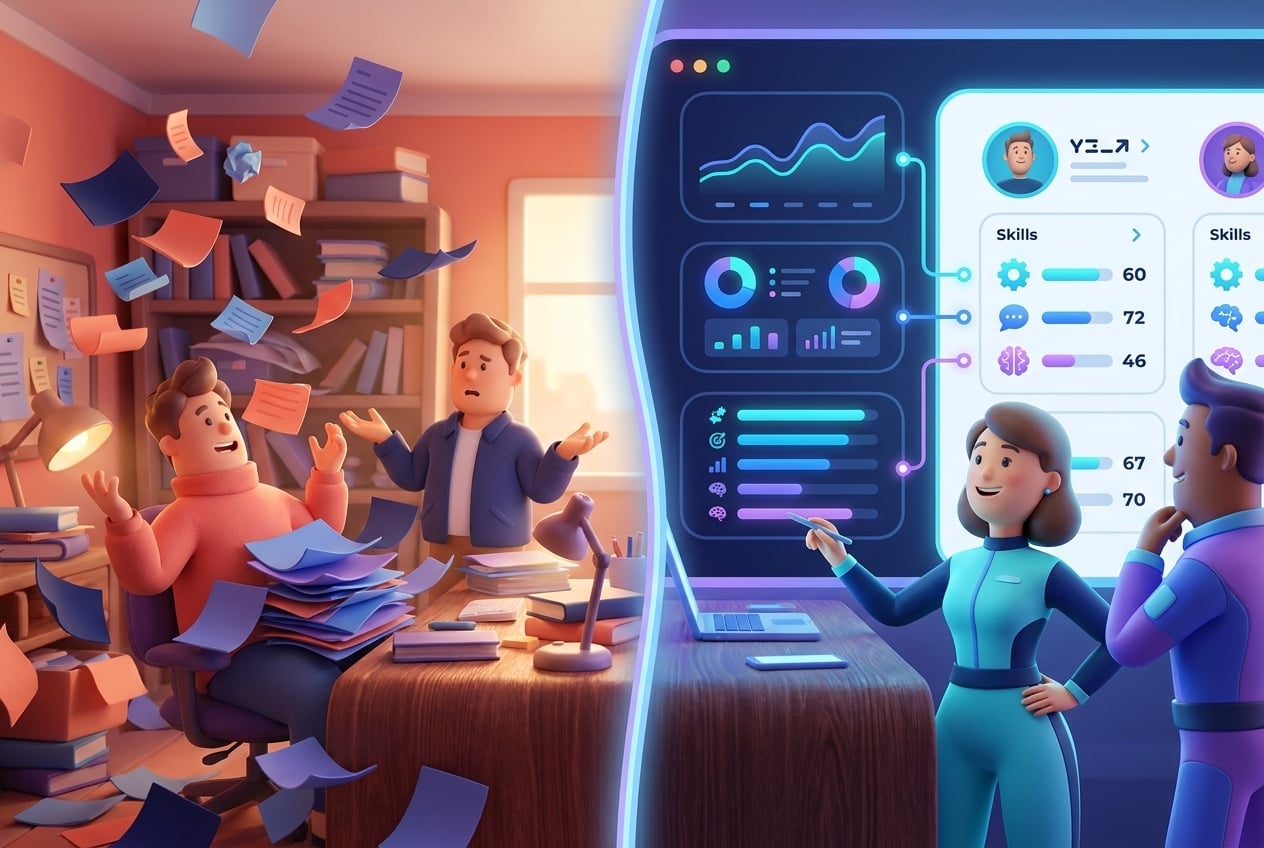
The shift towards structured hiring is accelerating. Data shows that 87% of employers use behavioural interviews as a primary method for skills-based hiring. This widespread adoption is driven by the need for better retention and higher performance.
Technical skills are no longer the sole focus of a successful hire. According to LinkedIn Talent Solutions, 92% of talent professionals say soft skills are equally or more important than technical abilities. Competency-based questions are the most effective way to measure these soft skills – such as communication, adaptability, and leadership – which are notoriously difficult to assess on a résumé.
If you want to understand why new hires fail, look at how they were interviewed. Poor cultural alignment and missing soft skills are usually the culprits. Structured interviews expose these gaps before an offer is ever made.
For candidates, the secret to mastering competency based interview questions and answers is the STAR method. This framework ensures your responses are structured, concise, and evidence-based.
STAR stands for:
A common preparation recommendation is to bring five to eight specific, recent examples mapped to the main competencies. Other experts advise preparing six to eight examples across competencies so you are not relying on a single rehearsed story. Having a diverse bank of examples allows you to adapt to whatever question is thrown your way.
Teamwork questions assess how well a candidate collaborates, resolves interpersonal friction, and contributes to group goals.
What the interviewer wants to see:
Emotional intelligence and conflict resolution skills. They want proof that you can maintain professionalism when challenged.
How to answer:
Outline a specific disagreement without badmouthing the colleague. Focus on the actions you took to understand their perspective and find common ground. The result should highlight a repaired working relationship or a successfully completed project.
What the interviewer wants to see: Flexibility and a focus on the broader objective rather than personal ego.
How to answer: Detail a scenario where your initial idea was rejected or modified. Explain how you objectively evaluated the alternative, supported the team's decision, and contributed to the final success.
What the interviewer wants to see: Proactive support and a collective mindset.
How to answer: Describe a time you noticed a colleague falling behind. Explain how you offered assistance without being condescending, helped them meet their deadline, and ensured they felt supported.
Problem-solving questions evaluate a candidate's analytical thinking and their ability to overcome obstacles.
What the interviewer wants to see: Foresight and proactive risk management.
How to answer: Share an example where you noticed a flaw in a process or a looming deadline risk. Outline the steps you took to alert stakeholders and implement a preventative solution.
What the interviewer wants to see: Resourcefulness and the ability to operate in ambiguous situations.
How to answer: Describe a high-stakes situation where data was missing. Explain your research process, who you consulted, and how you formulated a logical solution based on the available facts.
What the interviewer wants to see: Accountability and a growth mindset.
How to answer: Be honest about a genuine error. The critical part of your answer is the action you took immediately after discovering the mistake. Detail how you fixed the issue and the system you put in place to prevent it from happening again.
Leadership questions are not just for management roles. They assess initiative, influence, and accountability at all levels.
What the interviewer wants to see: Informal influence and a willingness to take ownership.
How to answer: Outline a project that was drifting off course. Explain how you stepped up to organise the team, set clear milestones, and drove the project to a successful completion without overstepping your authority.
What the interviewer wants to see: Tact, empathy, and clear communication.
How to answer: Describe a situation where a peer or direct report was underperforming. Detail how you prepared for the conversation, delivered the feedback constructively, and offered support to help them improve.
What the interviewer wants to see: Resilience and the ability to maintain morale under pressure.
How to answer: Share a scenario involving budget cuts, tight deadlines, or a major setback. Explain the specific actions you took to keep the team focused, acknowledge their hard work, and push through the difficult phase.
Adaptability questions test how well a candidate handles change, new environments, and shifting priorities.
What the interviewer wants to see: Agility and the ability to remain calm under pressure.
How to answer: Describe a sudden shift in client demands or business strategy. Explain how you quickly reassessed your resources, communicated the new plan to your team, and delivered the revised project on time.
What the interviewer wants to see: A commitment to continuous learning and self-sufficiency.
How to answer: Detail a scenario where you were thrown in the deep end with unfamiliar technology. Outline your self-directed learning process and how quickly you became proficient enough to train others.
What the interviewer wants to see: High emotional intelligence and stakeholder management skills.
How to answer: Share an instance where you had to present technical information to a non-technical audience, or pitch an idea to senior executives. Explain how you modified your language, tone, and presentation format to ensure your message was understood.
Decision-making questions reveal how a candidate processes information, evaluates risk, and commits to a course of action.
What the interviewer wants to see: Confidence and sound judgement in high-pressure situations.
How to answer: Describe an urgent crisis where waiting for perfect information would have caused failure. Explain the criteria you used to make the call and the positive outcome that followed.
What the interviewer wants to see: The ability to defend your logic while remaining open to feedback.
How to answer: Outline a scenario where someone pushed back on your strategy. Explain how you presented the data backing your decision, listened to their concerns, and ultimately gained their buy-in.
What the interviewer wants to see: Integrity and the courage to do what is right over what is easy.
How to answer: Share a time you had to enforce a strict policy or cut a beloved project. Detail how you communicated the reasoning transparently to the team and managed the subsequent frustration.
Asking the right questions is only half the battle. To truly avoid common hiring mistakes, you need a system that captures, scores, and compares candidate responses objectively.
Compono Hire helps teams standardise their assessment process. By building structured evaluations directly into your recruitment workflow, Compono Hire ensures every candidate is measured against the same objective criteria, reducing bias and improving hiring accuracy.
Understanding candidate behaviour also goes beyond the interview room. The Compono Work Personality assessment gives you deeper insight into how an individual naturally prefers to work, complementing the concrete evidence gathered during your competency questions.
Key insights
- Unstructured interviews are highly susceptible to bias and are poor predictors of future performance.
- The STAR method (Situation, Task, Action, Result) is the most effective framework for answering behavioural questions.
- Modern recruitment requires a balance of evaluating technical capabilities and critical soft skills.
- Standardising your interview questions ensures a fair, evidence-based comparison between all candidates.
Stop guessing and start predicting candidate success with structured, evidence-based hiring tools.
Related reading
These terms are often used interchangeably. Both focus on asking candidates to provide real examples of past behaviour to prove they possess specific skills or competencies required for the role.
You should prepare six to eight diverse examples from your recent work history. This ensures you have enough varied scenarios to adapt to different questions without repeating the same story.
It is perfectly acceptable to ask for a moment to think. If you genuinely cannot find a professional example, ask the interviewer if you can use a relevant example from your academic or volunteer experience.
A strong STAR response should take about two to three minutes to deliver. Keep the Situation and Task brief, focus the majority of your time on the Action, and finish with a clear, quantifiable Result.
Employers prefer this method because it is fairer and more predictive of actual job performance. It forces candidates to provide concrete evidence of their skills rather than relying on hypotheticals or rehearsed pitches.

Need a training register template in Australia? Learn what to include, how to meet WHS and NDIS compliance standards, and when to automate your...

Why workforce credentialing software is replacing spreadsheets in 2026, and how to automate compliance, reduce risk and deploy staff with confidence.

How to digitise licensing and certification programs, swapping manual paperwork for identity verification, automated grading and credentials.