

.webp)

 Compono


LMS for healthcare Australia: 2026 buyer's guide
 Compono
Compare the best LMS for healthcare in Australia. Learn how modern platforms manage compliance, verify knowledge, and build workforce capability in...
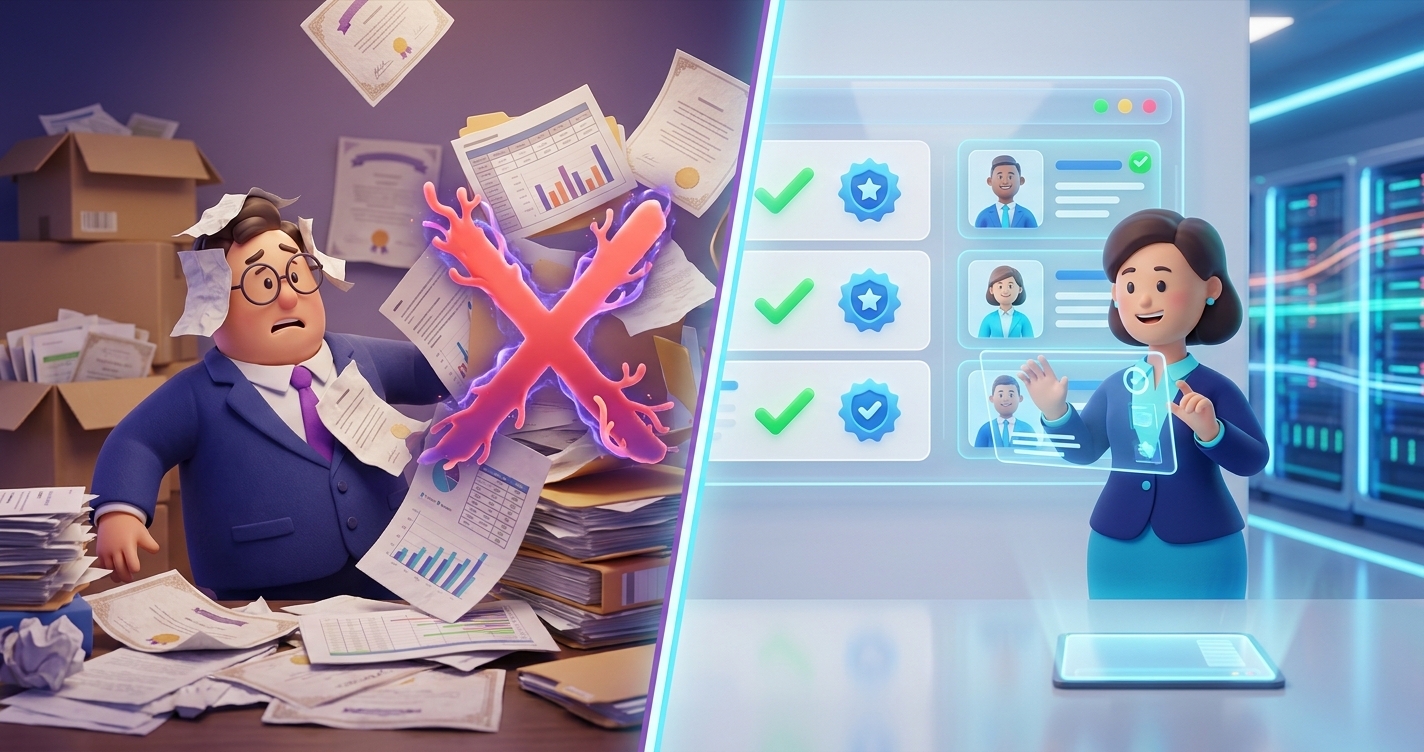
Workforce credentialing software is a digital platform that verifies, tracks, and manages employee licenses, certifications, and compliance requirements in real time.
The days of tracking expiry dates on a spreadsheet are over. Today, managing credentials is about deploying the right people to the right jobs without exposing your business to operational risk.
Key takeaways
- Workforce credentialing software replaces manual tracking with automated verification, ensuring staff are legally and operationally cleared to work.
- Nearly a quarter of all employees require some form of certification or license to perform their roles.
- Modern platforms connect compliance directly to workforce deployment, stopping unqualified staff from being rostered.
- The market is growing rapidly as mid-market companies move away from reactive compliance toward proactive capability management.
Managing employee qualifications used to be a simple administrative task. A manager would sight a certificate, take a photocopy, and file it away in a cabinet. That approach no longer works for modern teams.
The volume and complexity of required qualifications have exploded across almost every industry. To put this into perspective, the U.S. alone has 1,850,034 unique credentials offered by more than 134,000 providers, according to Credential Engine’s Counting Credentials 2025 report.
When you rely on manual processes to track this volume of data, human error is inevitable. A missed expiry date or a lapsed license does not just cause an administrative headache – it exposes your organisation to severe legal, financial, and reputational risk. If an incident occurs on site and the employee involved had an expired safety certification, the liability falls squarely on the business.

If you think credential tracking only applies to highly regulated industries like medicine or aviation, the data tells a different story. While the U.S. credentialing software and services in healthcare market was estimated at USD 267.72 million in 2024, the need for stringent compliance tracking has expanded far beyond hospitals and clinics.
According to the U.S. Bureau of Labor Statistics, nearly 24% of employed workers hold a certification or license as of 2024, rising to 25.1% among full-time employees. That means a quarter of your workforce likely requires active, ongoing verification to do their jobs legally.
When businesses track these requirements across multiple spreadsheets or disconnected HR systems, they create a false sense of security. HR teams spend hours chasing up renewals, managers accidentally roster unqualified staff, and the business carries the invisible risk of non-compliance.
Inefficient credential management drains productivity. Instead of focusing on capability and performance, your people leaders are stuck doing data entry and sending reminder emails.
Implementing a dedicated platform immediately resolves the friction points that plague manual compliance tracking. The most obvious benefit is the elimination of data entry errors. When a system automates verification and expiry dates, you remove the risk of a manager mistyping a year or forgetting to update a cell on a spreadsheet.
Audit anxiety is another major challenge that disappears. When regulators or clients request proof of compliance, scrambling through physical files or shared drives is stressful and unprofessional. A proper system allows you to generate a complete compliance report in minutes.
Finally, credentialing software drastically reduces onboarding delays. Waiting weeks to verify a new hire's qualifications means they are sitting idle instead of contributing to the business. Automated verification speeds up this process, getting your people onto the floor or into the field faster.
A proper workforce credentialing software platform is not just a digital filing cabinet for PDFs. It is an active management system that monitors your workforce's readiness in real time.
These platforms automate the entire lifecycle of a qualification. They verify the initial credential, track its validity period, and trigger automated workflows when a renewal is due. If a license expires, the system flags the employee as non-compliant immediately.
This is where Compono Assure changes the game for mid-market companies. It connects verified skills directly to role readiness, ensuring you always know who is cleared to work and who needs upskilling.
By centralising this data, business leaders get a clear, accurate view of their operational capability at any given moment.
We are seeing a massive shift in how organisations view their workforce data. The focus is moving from a defensive posture – simply trying to avoid compliance fines – to an offensive strategy built on capability.
This shift is driving heavy investment in the technology. The global digital credential management software market is estimated at USD 396.39 million in 2026 and is projected to reach USD 1,980.54 million by 2035.
Companies are realising that knowing exactly what their people are qualified to do is a competitive advantage. It allows for smarter resource allocation, faster deployment to new projects, and better succession planning. If you are still looking at credentialing purely as a compliance exercise, you are missing half the value of the data you are collecting.
Not all platforms are built the same. When evaluating workforce credentialing software for your organisation, you need to look past the basic storage features and focus on operational impact.
First, evaluate the automation capabilities. The system must handle reminders, escalations, and expiry notifications without human intervention. If your HR team still has to manually trigger an email when a license is 30 days from expiry, the software is failing you.
Second, consider how it integrates with your broader People Intelligence for Business strategy. Credential data should flow naturally into your rostering, learning, and performance systems.
Finally, look for reporting that gives managers immediate visibility into team readiness. A manager should be able to see exactly who is qualified for a shift in three clicks or less.
The future of credentialing is about assuring capability, not just ticking a box. A certificate proves someone passed a test on a specific date, but it does not guarantee they are ready to perform the role today.
This is why we focus heavily on the evolution from certified skills to assured capability. The best credentialing software helps you build a complete picture of an employee's readiness by combining formal qualifications with verified on-the-job assessments.
When you adopt this approach, you stop managing paperwork and start managing performance.
Key insights
- Spreadsheets are a liability when managing credentials for a modern workforce.
- Over 24% of the workforce requires active credential tracking to perform their jobs legally.
- Modern software automates the lifecycle of a qualification, removing the administrative burden from HR teams.
- The best platforms turn compliance data into operational capability insights, ensuring staff are always ready to deploy.
Stop managing compliance on spreadsheets and start deploying your workforce with confidence.
Related reading
Workforce credentialing software is a digital tool that helps organisations verify, track, and manage the licenses, certifications, and compliance requirements of their employees in real time.
Proper credential management ensures that only qualified and legally compliant staff are performing specific roles. It protects the business from operational risks, fines, and reputational damage caused by non-compliance.
It reduces risk by automating expiry tracking and verification. The software alerts managers and employees before a credential lapses, ensuring no one is rostered for a job they are no longer qualified to do.
Yes. A good platform completely replaces manual spreadsheets and calendar reminders, freeing up HR teams to focus on strategic capability building rather than data entry.
No. While healthcare relies heavily on credentialing, industries like construction, logistics, education, and professional services also require strict compliance tracking to operate safely and legally.

Compare the best LMS for healthcare in Australia. Learn how modern platforms manage compliance, verify knowledge, and build workforce capability in...

Need a training register template in Australia? Learn what to include, how to meet WHS and NDIS compliance standards, and when to automate your...

How contractor induction training software replaces paper registers with digital records, plus the core features that improve site safety.