

.webp)

Compono vs MBTI
The Myers-Briggs Type Indicator is the most recognised personality vocabulary in business, and its publisher is refreshingly honest about what it's for: self-awareness and development, explicitly not hiring. Compono's work personality shares the same Jungian ancestry and was built for a different job: work, teams and the decisions that follow. Here's the honest breakdown.
Last reviewed July 2026 · All comparisons
Workplace personality tools are popular for good reason. The well-known ones are accessible, quick to run, easy to interpret and genuinely useful for self-awareness. Their limits are just as consistent. Most read the individual in isolation, through general personality rather than behaviour at work, and say nothing about the team around them. Trait-based instruments go deeper and can be highly valid, but they're complex to interpret and usually need certification: a big jackhammer for a small problem. What matters is whether the instrument was built for work, and whether it can see the team as well as the person.
The full picture: Assessments vs video interviewing
The short answer
Choose Compono if you want
- Work personality measured for the work context, not general life preferences
- A stable, team-level read that connects to hiring, culture and development decisions
- Software you can act on without certifying a practitioner first
Choose MBTI if you want
- The most widely recognised personality language there is, for development workshops
- A global certified-practitioner ecosystem with 70+ years of interpretive material
- A non-evaluative frame that feels safe for self-awareness conversations
Side by side
| Compono | MBTI | |
|---|---|---|
| What it is | ✓A validated work-personality assessment inside a talent intelligence platform | A 16-type self-report preference instrument, practitioner-gated, published by The Myers-Briggs Company |
| What's measured | ✓Work personality: 8 validated types built for the workplace, plus organisation and culture fit | General personality preferences across four dichotomies, from Jung's 1921 type theory |
| Stability | ✓A consistent, validated measurement process. No self-report instrument is immune to retest change, but the instrument, properties and norms stay fixed | Published research found 39-76% of retakers get a different four-letter type within about five weeks; the publisher concedes roughly half change on retest |
| Use in hiring | ✓Built for hiring from the start: every candidate matched to the role and your measured culture, with instruments validated for selection decisions | ✗Prohibited by the publisher's own ethics: "not intended for use in selection of job candidates" |
| Team view | ✓Team work-personality mix read against culture, climate and what the role needs | MBTIonline Teams aggregates individual types with facilitation material |
| Delivery model | ✓Software-first: interpretation is built into the platform, with no certification course, no practitioner gatekeeping and no per-head report fees | Certified practitioners (US$2,995 certification; AU$4,595 on-site in Australia) or consumer MBTIonline (US$59.95) |
| What the data feeds | ✓Hiring, engagement, capability and competency decisions on one dataset | A development conversation and a type report |
| Best fit | Mid-market organisations (roughly 60-1,000 staff) that want people data driving decisions | Facilitated self-awareness and leadership development programs |
Facts checked July 2026 against The Myers-Briggs Company's published pages and research citations. Tell us if something's out of date and we'll fix it.

What MBTI genuinely does well
- Unmatched shared language. The four-letter types are the most recognised personality shorthand in the working world; roughly 2 million assessments a year on the company's own figures.
- A deep practitioner ecosystem. Certified practitioners across 115 countries, 29 language versions and seven decades of interpretive material and courses.
- A psychologically safe frame. No type is better than another, which makes MBTI comfortable ground for development conversations.
- Honesty about its own limits. The Myers-Briggs Company is clearer than most vendors about scope, publicly stating the MBTI should not be used to select candidates. That candour deserves credit.
Where Compono differs
Take the publisher at its word. The Myers-Briggs Company says the MBTI is not for hiring, and the Myers & Briggs Foundation calls screening applicants with it unethical. The research explains why: type assignments flip on retest for a large share of people, and measured correlations with job performance are low. None of that makes MBTI useless; it makes it a development tool, which is exactly what its publisher says it is.
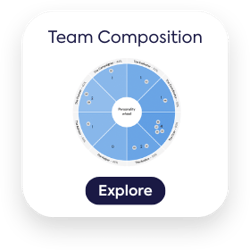
Compono's work personality shares the Jungian lineage and rebuilds it for work: 8 validated types normed on working data, read at team level, with a measurement process that stays consistent from one assessment to the next. Teams don't need 16 boxes; they need the eight ways of work covered, and a way to see how each candidate or team change affects the coverage. That's measurement you can take into a hiring decision and defend afterwards.
More than an assessment
Everything above compares assessment capability. Compono's work-personality data doesn't stop at a profile: Hire matches candidates against the role and your measured culture, Engage reads team work-personality mix alongside culture and climate, and Develop points development at what the measurement actually found. The profile is the start of the dataset, not the deliverable.
Comparing the two for your team?
Tell us what the decision hangs on. We'll give you a straight answer on fit, including where MBTI still earns its place in your development program.
Talk to usFrequently asked questions
Why can't MBTI be used for hiring?
Because its publisher says so. The Myers-Briggs Company states the assessment "is not intended for use in selection of job candidates", and the Myers & Briggs Foundation calls it unethical to screen applicants with it. The psychometrics back the policy: type results are self-reported, unstable on retest and weakly predictive of job performance.
Is Compono's work personality just MBTI with different labels?
No, though they share ancestry. Both are Jungian-derived type frameworks. The differences are the build and the job: Compono's 8 work personalities are measured for the work context, normed on Compono's own working data, read at team level, and connected to hiring, culture and development data in one platform. MBTI measures general preferences and stops at the report.
Is MBTI accurate?
As a development conversation starter, it's useful and widely loved. As measurement, published research found 39-76% of people get a different type on retest within weeks, and the publisher's own materials concede about half change. That's fine for self-reflection and a problem for decisions.
Can we keep MBTI for workshops and use Compono for decisions?
Yes, and plenty of organisations should. MBTI does the icebreaking and self-awareness job well. Compono does the measurement job: who to hire, how the team's mix covers the work, where development should point.