
.webp)

 Mathan Allington


Recruitment Metrics Dashboard: Essential KPIs for 2026
 Compono
How to build a recruitment metrics dashboard that tracks time-to-fill, cost-per-hire and quality of hire, and what to do with the numbers.
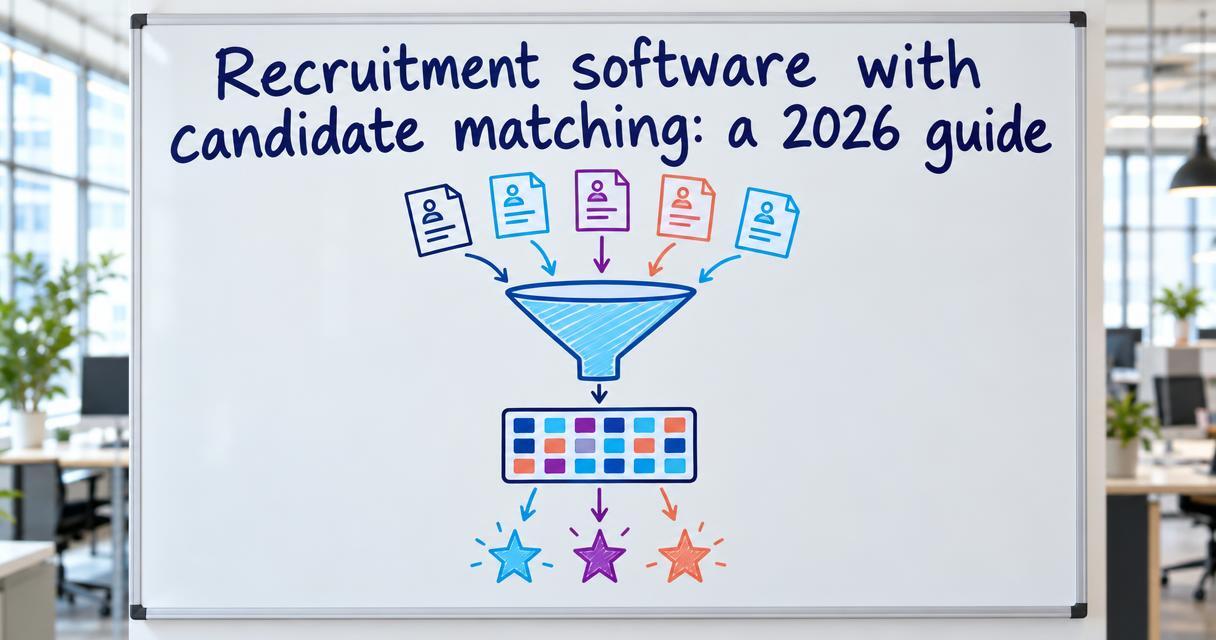
Recruitment software with candidate matching is a talent acquisition system that uses algorithmic scoring to automatically rank applicants based on how well their skills, experience and traits align with an open role.
Last reviewed October 2026
Key takeaways
- Semantic search and vector embeddings outperform traditional keyword matching by understanding the context behind a candidate's experience.
- Algorithmic matching significantly cuts time-to-hire and highlights qualified applicants manual screening often misses.
- Modern recruitment platforms must balance automated efficiency with compliance frameworks like the EU AI Act and local regulations.
- Success requires evaluating both process fit through skills and people fit through work personality.
For decades, the standard applicant tracking system operated as a digital filing cabinet. It managed the workflow of hiring perfectly. It moved candidates from stage to stage, tracked compliance and stored resumes. But it relied on recruiters to manually sift through hundreds of applications to find the right person.
This process is slow, prone to human error and heavily biased toward candidates who know how to stuff their resumes with the right keywords. The issue is not that HR teams lack data. The issue is that they lack insight. Most HR technology only manages process risk, which covers the compliance and tracking side of hiring. But this ignores people insight risk, which is what happens when someone looks great on paper but clashes with the team culture.
To hire effectively today, you need a system that handles both. Recruitment platforms have evolved past digital filing cabinets into intelligent engines that read, score and rank applications in seconds.
Not all candidate matching systems are built the same. Early versions relied on Boolean parsing and keyword extraction. If a job description asked for project management, the software scanned incoming resumes for that exact phrase. If a highly qualified candidate wrote that they oversaw project delivery instead, the system rejected them.
Keyword matching is broken because human language is complex. Modern matching tools use semantic search and vector embeddings to understand context. If an applicant lists financial oversight on their resume, the algorithm knows this is highly relevant to a requirement for budget management.
This contextual understanding changes the entire screening phase. When you move past basic keywords, you stop rejecting great talent on technicalities. This is why 75 percent of recruiters say AI surfaces qualified candidates they would have missed through manual review, according to LinkedIn's 2024 data published by Hyring.
A sophisticated platform like Compono Hire takes this further by measuring cultural alignment alongside technical skills. It evaluates candidates across multiple dimensions to ensure they have the qualifications for the role and the traits required to thrive in your specific work environment.

Evaluating recruitment technology requires a measurable return on investment. The cost of a bad hire is high, but the cost of a slow hiring process often drains budgets quietly through agency fees, premium job board placements and lost productivity.
When you automate the initial screening phase, you drastically reduce the hours recruiters spend reading unqualified resumes. Automated matching produced a 2.1-times improvement in time-to-shortlist, according to Ideal's candidate matching performance data cited by SigmaDAX. Furthermore, AI-powered matching can reduce hiring time by 50 percent and recruitment costs by 30 percent, according to a 2026 industry comparison from Navero.
| Hiring Metric | Manual Screening | AI Candidate Matching |
|---|---|---|
| Time to shortlist | Days or weeks | Seconds or minutes |
| Cost per hire | High agency dependency | Reduced by up to 30 percent |
| Candidate discovery | Limited by keyword exact matches | Expanded by semantic context |
| Screening bias | High risk of unconscious bias | Objective, evidence-based scoring |
By bringing candidate discovery in-house with an intelligent algorithm, mid-market businesses can redirect their talent acquisition budgets away from external agencies and toward employer branding or employee development.
Human beings naturally favour people who remind them of themselves. This affinity bias creeps into the hiring process every time a hiring manager glances at a name, a university or a home address on a resume. Manual screening relies heavily on these subjective hunches.
Algorithmic matching shifts the focus from background details to hard evidence. When configured correctly, the software evaluates applicants solely on their verified skills, capabilities and alignment with the job requirements. This levels the playing field for non-traditional candidates.
The results speak for themselves. AI matching makes recruiters 3.4 times more likely to interview a qualified diverse candidate than keyword filtering, according to Harvard Business Review research via Hyring. Understanding a candidate's actual Work Personality rather than relying on surface-level traits gives you objective data about how they prefer to operate, communicate and solve problems.
This is how candidate matching software improves hiring quality. It forces hiring managers to justify their decisions with data rather than relying on a gut feeling.
Even the best algorithm will fail if it runs on bad data. A major hurdle for growing companies is integrating new matching tools with legacy ATS architectures. Older systems often store applicant records in flat, unstructured formats that semantic search engines struggle to read.
To get the most out of algorithmic screening, your candidate data must be clean, updated and standardised. If your database is full of duplicated profiles or outdated resumes from five years ago, the matching scores will be inaccurate. This is a common pitfall when companies try to bolt an AI tool onto an outdated platform rather than upgrading their core system.
Modern platforms solve this by parsing and standardising data upon entry. When an applicant uploads a resume, the software immediately translates their work history into a structured format. This ensures that every candidate in your talent pool is ready to be searched, scored and matched against future roles.
As the use of automated scoring increases, so does regulatory scrutiny. Lawmakers globally are cracking down on opaque hiring algorithms. The EU AI Act and local regulations like NYC Local Law 144 mandate strict transparency and regular audits for any AI used in employment decisions.
Compliance means you cannot treat your matching software as a black box. You must understand what criteria the algorithm uses to rank candidates, and you must prove that those criteria do not discriminate against protected groups. This is a core principle for The Scientific Recruiter, who values evidence over assumptions.
Transparency extends to the candidates themselves. Applicants have the right to know when automated systems evaluate their profiles. Clear communication regarding how their data is used builds trust and protects your employer brand. Most importantly, a human must remain in the loop. The software is designed to recommend the best candidates, but the final hiring decision always belongs to the hiring manager.
The technology behind recruitment matching continues to accelerate. AI-assisted candidate matching is used by 88 percent of large enterprises, according to Deloitte's 2024 data via Hyring. The next phase will move beyond simple skill matching and into predictive modelling.
Future systems will analyse team changing, business goals and historical turnover data to predict how long a candidate is likely to stay and how quickly they will reach full productivity. For companies evaluating talent acquisition software in Australia, this means choosing a platform that is built on behavioural science rather than just workflow automation.
By bridging the gap between what candidates can do and who they actually are, intelligent matching software helps you build teams that are engaged, productive and aligned with your culture.
If you are tired of relying on keyword filters that miss your best applicants, you need an intelligent platform that understands context, skills and culture fit.
It is a type of talent acquisition software that uses algorithms to automatically compare incoming applications against the specific requirements of a job. It scores and ranks candidates based on their skills, experience and cultural alignment, helping recruiters quickly identify the best fit without manually reading every resume.
Keyword matching looks for exact words in a resume and rejects candidates if those specific terms are missing. Semantic search understands the meaning behind the words. It recognises that phrases like client relationship management and account handling require similar skills, ensuring strong candidates are not filtered out by technicalities.
No, the technology does not replace recruiters. It automates the initial screening phase and provides data-backed recommendations. A human recruiter or hiring manager always reviews the shortlisted candidates, conducts the interviews and makes the final hiring decision.
Yes, using unchecked algorithms can lead to legal risks regarding discrimination. Regulations like the EU AI Act require employers to audit their automated tools for bias and ensure transparency. You must choose software that provides clear, explainable scoring criteria and keeps a human involved in the final decision.
You can measure ROI by tracking specific metrics before and after implementation. Look at the reduction in time-to-shortlist, the decrease in external agency spend, and the improvement in first-year retention rates. A faster process that yields higher-quality hires usually offsets the cost of the software license quickly.

How to build a recruitment metrics dashboard that tracks time-to-fill, cost-per-hire and quality of hire, and what to do with the numbers.

Discover how resume screening software can simplify your hiring. Learn to identify top talent efficiently and improve your recruitment process today.

Practical candidate feedback examples and templates for every hiring outcome. Learn how to reject candidates respectfully and protect your employer...
 Mathan Allington