

.webp)

 Mathan Allington


CRM for executive search Firms: the 2026 Buyer's guide
 Mathan Allington
A CRM for executive search firms must map complex relationships and prove candidate fit. Discover how to choose the right platform to win retained...
Candidate feedback is the specific, actionable information you provide to an applicant about their performance and fit during your hiring process.
Last reviewed October 2026
Key takeaways
- Specific interview feedback protects your employer brand and increases the likelihood that rejected candidates will refer others to your business.
- The most helpful feedback relies on objective data and concrete examples rather than vague statements about culture fit.
- Template responses are useful for structure, but they must be personalised with exact details from the candidate's interview or assessment.
- Providing clear feedback to successful candidates helps them understand why they were chosen and sets clear expectations for their new role.
The silent rejection is a massive problem in modern recruitment. Most companies get this wrong by ghosting applicants or sending a generic email about from here with other candidates. Research from the Survale 2025 CandE Benchmark Research shows that 56% of candidates rejected during screening or interviewing received no feedback at all.
This silence damages your reputation. Candidates talk to their peers, and they share their experiences online. When you fail to close the loop respectfully, you actively harm your ability to attract talent in the future.
Providing feedback takes time. Many hiring managers avoid it because they fear legal repercussions or simply do not know how to deliver bad news. Yet the data shows that transparency pays off.
More than 70% of candidates shared a negative interview experience on social media, according to data from CareerArc. A poor experience directly impacts your bottom line by shrinking your talent pool. Conversely, candidates were four times more likely to consider a company in the future when they received constructive interview feedback, according to Lever.
The impact goes beyond future applications. When you take the time to improve candidate experience with clear communication, you turn rejected applicants into brand advocates. The same Survale research found that when candidates receive specific feedback, their willingness to refer the employer to others increases by 69%.
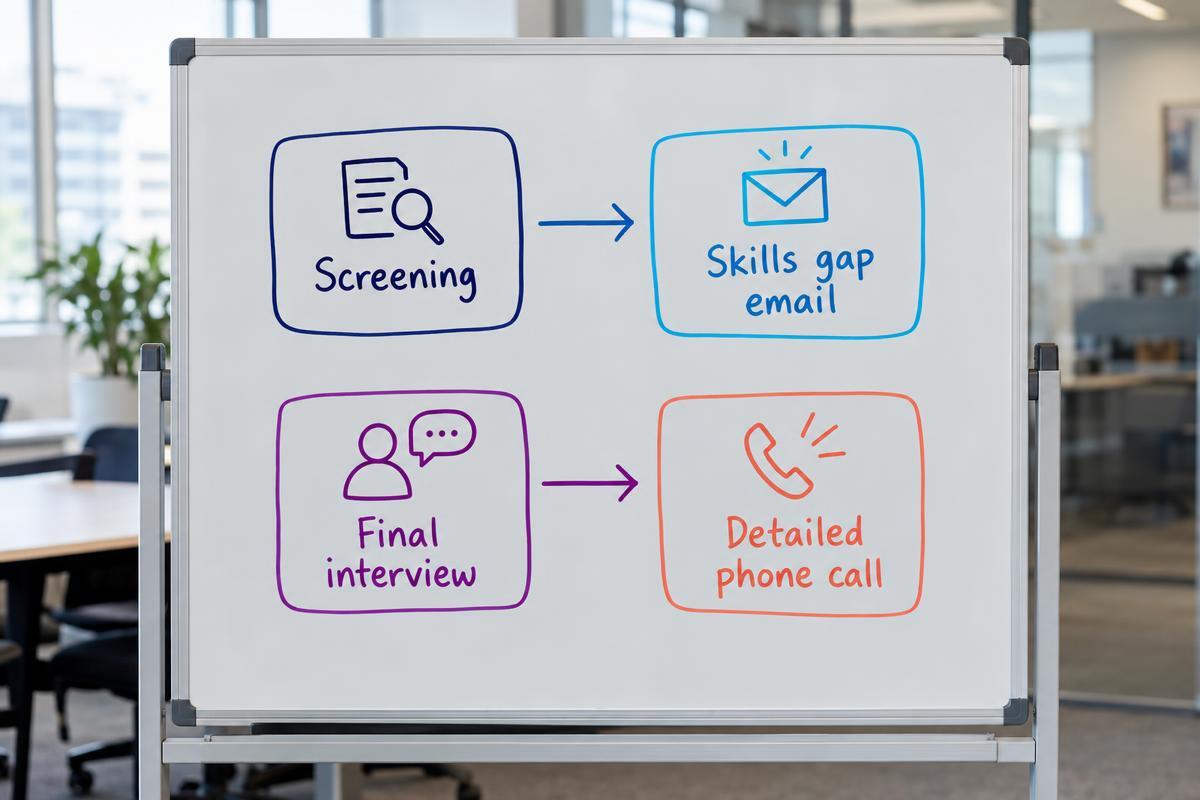
Good feedback is objective. It removes emotion and focuses entirely on the requirements of the role and the evidence gathered during the hiring process. Effective candidate feedback should be “specific, grounded in interview evidence, tied to the role, balanced between strengths and gaps, timely, and respectful” according to Otter AI.
Always tie your feedback back to the job description. If a candidate lacked a required technical skill, name the skill. If they did not provide enough detail in their behavioural interview answers, explain that the successful candidate provided more concrete examples of past performance.
Timeliness is just as important as the content. Do not wait weeks to send a rejection email. Provide an update as soon as the hiring decision is final. A fast rejection is always better than a slow maybe.
Never use "culture fit" as a reason for rejection without specific behavioural examples. Vague feedback about fit often masks unconscious bias and leaves candidates feeling confused and frustrated. If they did not align with your ways of working, point to a specific work personality trait or communication style required for the role.
Avoid the "feedback sandwich" method. Wrapping a piece of negative feedback between two insincere compliments is an outdated management tactic. Adults prefer the truth delivered respectfully over a compliment designed to soften a blow.
Finally, do not argue. Candidate feedback is a statement of your decision, not the opening of a negotiation. If a candidate replies aggressively or demands further justification, you are not obligated to continue the conversation. State the facts clearly and close the loop.
Writing rejection emails from scratch is inefficient. You need a baseline structure that you can customise with specific details. These interview feedback examples provide a starting point for different stages of the recruitment process.
This template works well when a candidate does not meet the baseline requirements during the initial resume review or phone screen.
Hi [Candidate Name],
Thank you for taking the time to speak with me about the [Job Title] role. We appreciate your interest in joining the team.
We have decided not to move forward with your application at this time. While your background in [Specific Skill/Industry] is strong, we are looking for a candidate with more direct experience in [Missing Requirement, e.g., managing enterprise-level software deployments].
We wish you the best in your job search.
Use this template when a candidate interviewed well but ultimately lacked a specific technical competency compared to the rest of the talent pool.
Hi [Candidate Name],
Thank you for coming in to meet with the team. We enjoyed learning about your experience at [Previous Company].
We have decided to offer the position to another candidate. The team was impressed by your communication skills, but the role requires advanced proficiency in [Specific Tool/Skill]. The successful candidate demonstrated a deeper technical knowledge in this specific area during the practical assessment.
Thank you again for your time, and we wish you success in your future endeavours.
If you are unsure about your current approach, you can use our free rejection email checker to see where your communication falls short.
Feedback is not just for rejections. Candidates who advance to the next round, or receive a job offer, also benefit from understanding exactly what they did well. A staggering 66% of candidates said a positive candidate experience influenced their decision to accept a job offer, according to the CareerPlug Candidate Experience Report.
Hi [Candidate Name],
Thank you for a great conversation yesterday. The team was highly impressed with your approach to [Specific Topic discussed in the interview].
We would like to invite you to a final round interview with our department head. This session will focus more heavily on your strategic planning experience, so please come prepared to discuss how you would approach [Specific Business Challenge].
Hi [Candidate Name],
We are thrilled to offer you the [Job Title] position. Throughout the interview process, you consistently demonstrated the exact problem-solving skills we need for this team. Your presentation on [Topic] was a standout moment for the hiring panel.
Please find your offer letter and contract details attached. We look forward to welcoming you aboard.
Delivering this level of detail at scale requires the right technology. Compono Hire helps you assess candidates objectively across skills and work personality. This gives your hiring managers concrete data to draw from when they need to explain exactly why a candidate did or did not progress.
To understand the difference between helpful and unhelpful feedback, compare these common responses.
| Bad Feedback Example | Good Feedback Example |
|---|---|
| "You were not a good culture fit for our team." | "The role requires a highly collaborative approach to problem-solving. During the scenario questions, your answers leaned toward independent work styles rather than team consensus." |
| "We decided to go in a different direction." | "We selected a candidate who had three more years of direct experience managing retail teams of this specific size." |
| "Your presentation was not quite what we wanted." | "Your presentation lacked the specific budget forecasting metrics we requested in the brief." |
The difference is always specificity. Good feedback points to a measurable fact, while bad feedback relies on vague feelings.
Managing candidate communication at scale does not have to mean sacrificing quality or resorting to generic rejections. Our platform gives your talent team the objective assessment data they need to make fair decisions and communicate them clearly.
You should provide basic feedback to every candidate you interview. For applicants rejected at the initial resume screening stage, a polite, automated template explaining that they did not meet the core requirements is sufficient. Once a candidate has invested time in a phone screen or face-to-face interview, they deserve specific, personalised feedback.
Feedback based entirely on objective job requirements, skills, and documented interview performance minimises legal risk. Trouble arises when feedback is based on subjective opinions, protected characteristics, or vague concepts like "culture fit" that cannot be backed up by data. Always stick to the facts of the assessment.
You should send feedback as soon as a definitive decision is made. For phone screens, aim for within 48 hours. For final round interviews, aim to provide feedback within three to five business days. Keeping candidates waiting damages your employer brand and increases their anxiety.
A CRM for executive search firms must map complex relationships and prove candidate fit. Discover how to choose the right platform to win retained...

Candidate management software for Brisbane teams: how to centralise recruitment, keep candidates warm, and pick a system that fits how you hire.

How to find the right hiring software providers in Geelong, improve candidate fit, and spend less time on recruitment admin.
 Compono