


 Mathan Allington
Insights Discovery cost: the complete 2026 pricing guide
 Mathan Allington
About the Insights Discovery cost for your team? Discover 2026 per-profile pricing, accreditation fees, and better alternatives for team engagement.
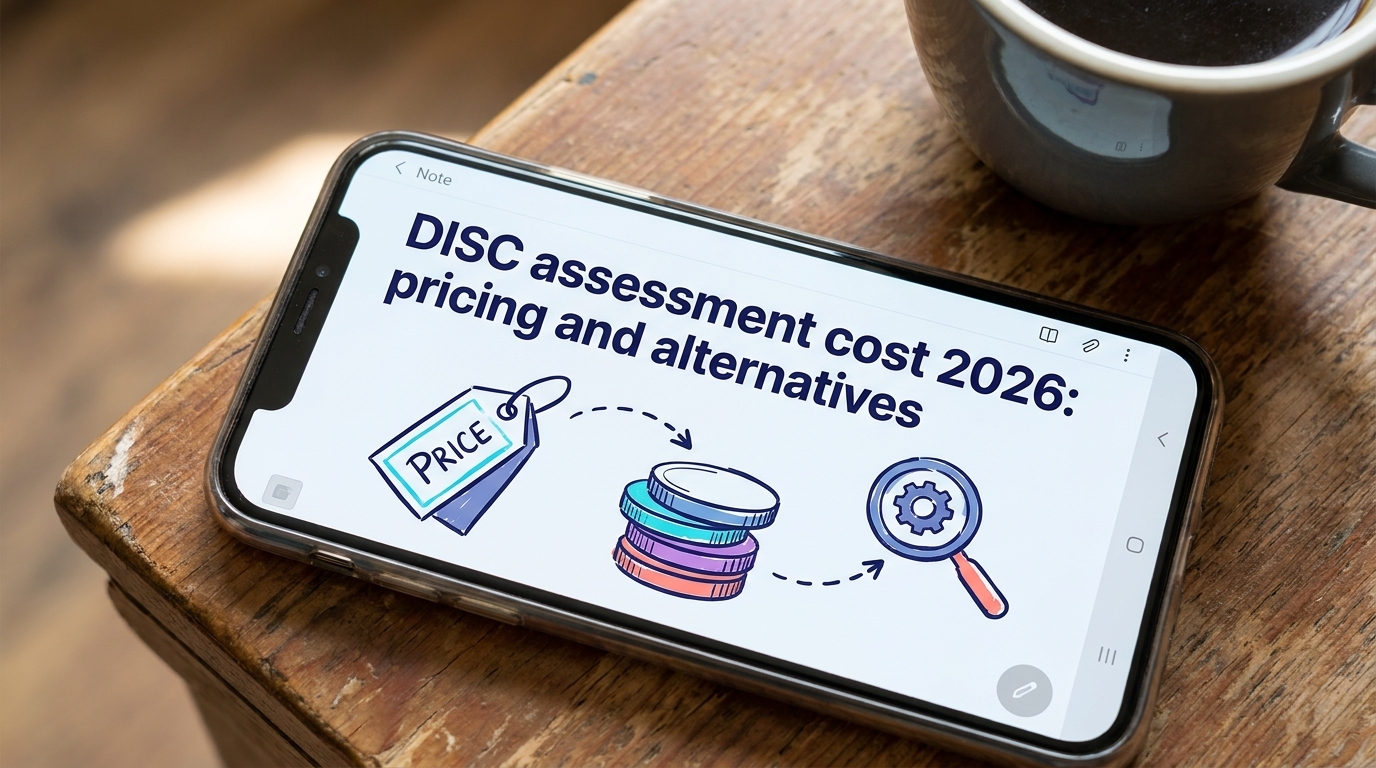
A DISC assessment typically costs between $69 and $150 per person for a professional-grade workplace profile, though volume discounts and platform subscriptions can lower the per-user price.
Last reviewed November 2026
Quick answer
- Price: Expect to pay $30 to $90 for standard individual reports, up to $210 for premium management profiles, and $2,000 or more for facilitator certification.
- Best for: Organisations looking for a basic, entry-level tool to improve team communication and self-awareness.
- Verdict: While DISC remains a popular starting point for team building, buyers must account for hidden administration fees, credit systems, and facilitator kits that drive the actual cost far higher than the advertised per-profile price.
Pricing for behavioural assessments is notoriously opaque. When you search for the cost of a DISC profile, you rarely find a simple dollar figure. Instead, you find a maze of certified partners, consulting markups, and complex credit systems that make budgeting for a company-wide rollout incredibly difficult.
Most traditional HR tech focuses entirely on process risk. It manages compliance, stores employee records, and tracks performance reviews. However, these systems completely ignore people insight risk. They cannot tell you why two highly skilled employees constantly clash, or why a top performer suddenly becomes disengaged. Tools like DISC attempt to bridge this gap by providing a basic framework for understanding human behaviour at work.
The challenge for HR leaders in 2026 is determining whether the price of these assessments matches the value they deliver. A basic profile might seem cheap at first glance, but the total cost of ownership skyrockets once you factor in administration portals, team reports, and mandatory training materials. In this guide, we break down exactly what you can expect to pay, how the pricing models work, and how to avoid the hidden fees that catch many organisations by surprise.
The price of a DISC assessment depends heavily on the vendor you choose and the depth of the report you require. According to recent industry data, a DISC assessment typically costs about $69, $150 per person in the United States; management and leadership versions generally cost more than workplace profiles.
If you are looking for a basic overview of an employee's communication style, you can find entry-level options at the lower end of the pricing spectrum. Research shows that individual DISC reports commonly range from $30 to $90, while premium reports can cost as much as $210. The premium options typically include detailed leadership coaching, conflict resolution strategies, and extensive management guides tailored to the individual's specific behavioural type.
It is important to note that you are rarely just buying a PDF report. You are buying into a set of tools. Vendors structure their pricing to encourage bulk purchases and long-term commitments. This means the price you pay for a single profile will look very different to the price you pay when rolling the tool out to a team of five hundred employees.
To understand the market, you need to compare the major providers side by side. Each vendor uses a different delivery model. Some sell directly to consumers, some use subscription platforms, and others rely entirely on a network of certified consultants.
| Vendor name | Pricing structure | Best for | Limits |
|---|---|---|---|
| Everything DiSC (Wiley) | $73.50, $90 per profile (via EPIC credits) | Corporate training workshops | Requires purchasing an EPIC admin account and separate facilitator kits. |
| Crystal | $99 per month for 5 reports | Sales and recruitment teams | Subscription model means you lose access to tools if you stop paying. |
| TTI Success Insights | Pricing on request (Consultant markup) | Executive coaching | Highly variable pricing depending on the external consultant you hire. |
| Compono Engage | Platform subscription based on headcount | Continuous culture measurement | Requires a commitment to ongoing engagement rather than a one-off workshop. |
Compono makes Compono Engage. We've included it and kept every entry's strengths and limits honest.
Understanding these different models is important for accurate budgeting. For example, Everything DiSC Workplace is a highly popular option, but its pricing scales based on volume. Everything DiSC Workplace is listed at $90 per person for 1–16 profiles, declining to $73.50 per person for orders of 134 or more.
Meanwhile, software-first approaches like Crystal’s subscription model starts at $99 per month for five reports, equivalent to about $19.80 per report when all five are used. This makes subscription tools appear cheaper upfront, but they require ongoing monthly payments to retain access to the data.
You might wonder why one DISC test costs $30 while another costs $200. The underlying psychological model is largely the same across most providers, focusing on Dominance, Influence, Steadiness, and Conscientiousness. The price difference comes down to the application, the technology, and the proprietary research layered on top of the basic framework.
The first major cost factor is the report's depth. A standard workplace report provides a high-level overview of an individual's communication preferences. A management report goes much deeper. It provides actionable advice on how the individual should delegate tasks, motivate different personality types, and handle insubordination. Professional-grade DISC profiles generally cost $59, $99 per person, while some Everything DiSC specialty profiles are priced at $150 each.
The second factor is the administrative technology. Vendors charge a premium for platforms that allow HR teams to manage invitations, track completion rates, and generate comparison reports between multiple team members. If you want the ability to run a group report that maps your entire leadership team on a single visual grid, you will pay extra for the software that generates it.
The third factor is validity and reliability testing. Reputable publishers spend hundreds of thousands of dollars on psychometric research to ensure their assessments are legally defensible and scientifically reliable. You are paying for the peace of mind that the results are consistent and accurate across different demographics.
Vendors segment their products by use case. This allows them to capture different segments of your HR budget, from general team building to executive development. Understanding these variations helps you avoid paying for premium features you do not actually need.
This is the most common entry point. It focuses on general communication, self-awareness, and basic conflict resolution. It is designed for employees at all levels of the business. You can expect to pay between $60 and $90 for this profile. It is ideal for departmental off-sites or general onboarding programs.
Designed specifically for people leaders, this profile focuses on delegation, motivation, and directing work. It often includes 360-degree feedback elements or compares the leader's style against their direct reports. Because the insights are highly tailored to leadership competencies, these reports typically cost between $120 and $150 each.
Sales-specific profiles teach representatives how to identify the behavioural style of their prospects and adapt their pitching style accordingly. They include customer mapping exercises and objection-handling strategies. These profiles usually sit in the middle of the pricing tier, costing around $100 to $130 per person.
Some vendors offer specialised profiles that focus entirely on how an individual responds to workplace tension. These reports highlight destructive tendencies and offer cognitive behavioural strategies for reframing negative thoughts during an argument. These specialty profiles are often priced similarly to the standard workplace reports, hovering around the $80 to $100 mark.
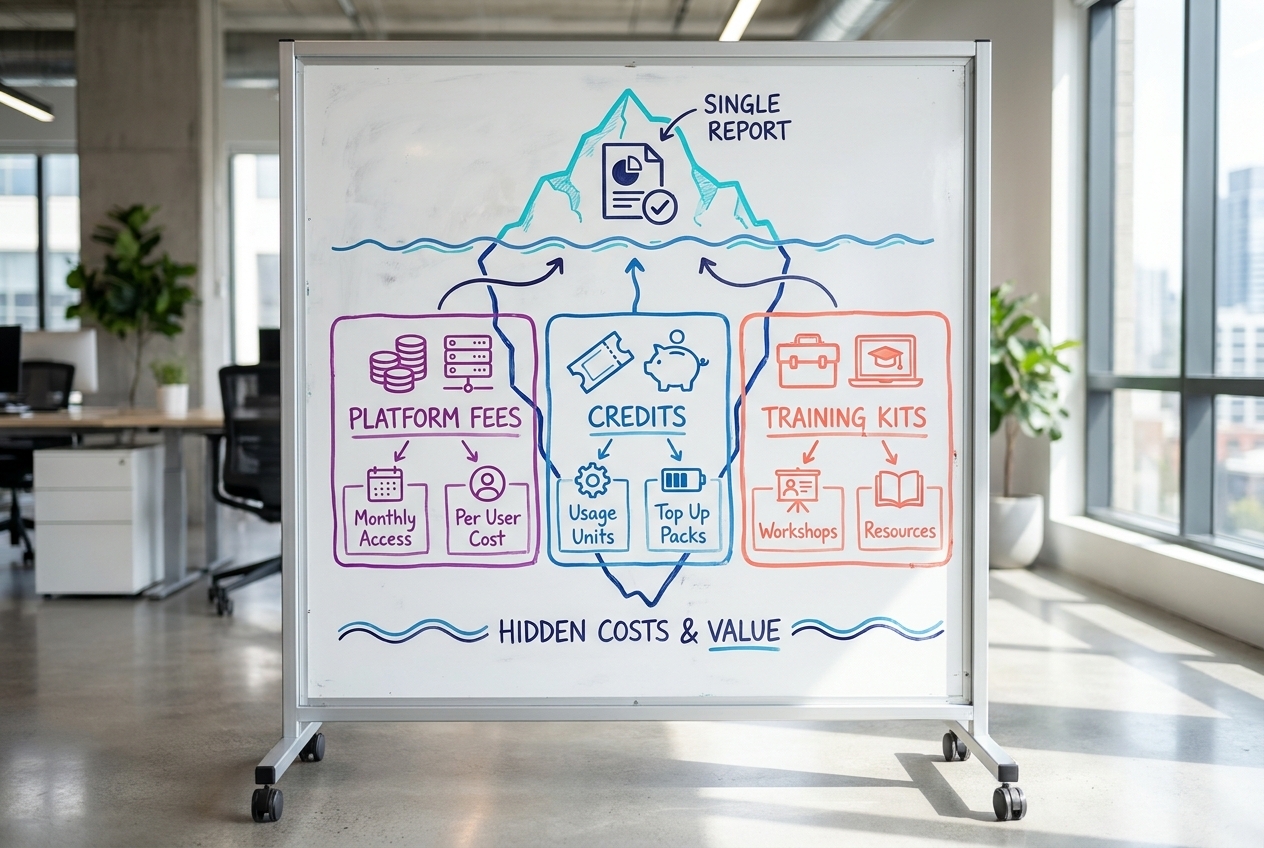
The biggest mistake HR leaders make when budgeting for behavioural assessments is looking only at the per-profile cost. The set of tools surrounding the assessment is where the true expenses hide. A 15-person team completing assessments priced at $25 each would incur $375 in direct assessment costs, excluding facilitation or workshop fees.
If you purchase through a major publisher, you will likely encounter a credit system. Instead of buying profiles directly, you buy an administrative account (often costing $200 or more to set up) and then purchase digital credits in bulk. A single profile might cost 15 credits. If a credit costs $5.40, your actual cost is $81 per person. This system obscures the true price and often leaves organisations with unused credits sitting in an account.
Facilitator kits are another major hidden expense. If you want to run the training internally, the vendor will require you to purchase a physical or digital kit containing slide decks, video modules, and scripted lesson plans. These kits routinely cost between $1,000 and $1,500. Without them, you are simply handing employees a PDF report with no context or team application.
Finally, consider the cost of expert facilitation. If you do not have an internal HR resource capable of delivering the workshop, you must hire an external consultant. Certified consultants often charge between $1,500 and $3,500 for a half-day team debrief, entirely separate from the cost of the assessments themselves.
As your organisation scales, relying on external consultants becomes prohibitively expensive. Many HR leaders choose to bring the capability in-house by getting officially certified in the assessment framework. Certification courses teach you the theory behind the model, how to interpret complex profiles, and how to work through the administrative software.
Certification is rarely cheap. A comprehensive certification program from a major publisher typically costs between $2,500 and $3,500 per person. This fee usually includes your own assessment, the training modules, the final exam, and a foundational facilitator kit. It requires a significant time investment, often spanning two weeks of virtual learning or several days of intense in-person workshops.
Is it necessary? If you only plan to run a single team-building day for ten people, certification is a waste of money. Hiring a consultant is far more cost-effective. However, if you plan to embed the language of the assessment into your company culture, use it during every onboarding cycle, and run internal conflict resolution sessions, certification pays for itself within the first year.
A quick search will reveal dozens of websites offering free DISC tests. It is tempting for budget-conscious managers to use these free tools for a quick Friday afternoon team-building exercise. However, in the world of psychometrics, you truly get what you pay for.
Free assessments are almost always ipsative tests designed for lead generation. They use overly simplistic questionnaires that force you to choose between highly polarised words. The resulting reports are generic, often reading like a horoscope rather than a professional psychological profile. They lack the nuance required to drive genuine behavioural change in a corporate environment.
Paid assessments use normative scoring and adaptive testing algorithms. If you answer a question in a way that suggests a blend of two different styles, the system adapts and asks clarifying questions to pinpoint your exact placement on the behavioural grid. Paid tools also offer reliable data privacy, ensuring your employees' psychological data is not sold to third-party marketers.
If your goal is a fun, five-minute conversation starter, a free test might suffice. If your goal is to resolve deep-seated team conflict, improve leadership capability, or fundamentally change how your departments communicate, investing in a validated, paid assessment is non-negotiable.
When rolling out an assessment to hundreds of employees, list prices become irrelevant. Publishers rely heavily on enterprise volume to drive revenue, meaning there is significant room for negotiation if you are purchasing at scale. Bulk purchasing is the single most effective way to lower your unit economics.
Enterprise pricing structures are entirely volume-based. Enterprise pricing commonly uses volume tiers, with reported discounts of 15–20% for 101–500 seats and 25–35% for 501–2,000 seats. To access these discounts, you usually have to commit to purchasing a bulk block of credits upfront, rather than paying as you go.
If you are an enterprise buyer, do not accept the first quote from a reseller. Because many vendors operate through a partner network, different consultancies will offer different profit margins. It pays to request quotes from multiple certified partners to find the best bulk rate for the credit blocks you require. Alternatively, look for software-as-a-service providers who offer flat-rate unlimited enterprise licensing, which removes the headache of tracking individual credits altogether.
A common mistake organisations make is trying to use their team-building assessment as a recruitment filter. They assume that because they need a confident, outgoing salesperson, they should screen out any candidate who does not score high in the Dominance or Influence quadrants. This is a dangerous and scientifically flawed approach to talent acquisition.
DISC is a self-reported measure of behavioural preference. It measures how a person prefers to act, not their cognitive ability, their emotional intelligence, or their actual competence in a role. Even the publishers themselves warn against using it for selection. TTI Success Insights states that DISC, when used alone, does not predict job performance and should not be used to screen candidates in or out.
Using the wrong tool for recruitment creates immense process risk. It introduces bias and exposes the organisation to legal challenges. If you need to evaluate candidates, you must use a dedicated hiring platform. You can read more about selecting the right tools in our DISC assessment hiring guide. Proper recruitment platforms use validated psychometrics specifically designed and legally defensible for selection, ensuring you measure actual capability rather than just a preference for a certain communication style.
While DISC has brand recognition, the behavioural science market has evolved significantly. Modern teams often find the four-quadrant model too rigid or simplistic for the complexities of hybrid work. If you are evaluating the cost of a rollout, you should also evaluate the alternatives available in 2026.
Many organisations are moving toward models built on the Big Five personality traits (OCEAN), which are widely considered the gold standard in academic psychology. You can explore the differences thoroughly in our DISC vs Big Five comparison guide. The Big Five offers a more nuanced, continuous scale of personality rather than boxing employees into specific acronyms.
Another alternative is the Work Personality framework. This approach maps individual preferences against eight specific work activities that drive high-performing teams, such as Advising, Pioneering, and Coordinating. It provides a highly practical lens for managers, showing exactly where an employee will naturally spend their energy and what tasks they might overlook. This action-oriented approach often yields a higher return on investment than simple communication models.
Selling a $10,000 enterprise assessment budget to a CFO requires more than a promise of better communication. You must build a business case grounded in financial reality. The return on investment for behavioural tools comes from reducing the massive costs associated with turnover, absenteeism, and toxic team changing.
When employees feel misunderstood or clash with their managers, they disengage. Disengagement is the first step toward voluntary turnover. By giving managers a framework to understand their team's working styles, you reduce friction. If you want to dive deeper into how this impacts the short answer, our guide on why culture is not working offers a comprehensive look at fixing disconnected teams.
The goal is to move from a one-off workshop event to continuous measurement. Traditional assessments are treated like an event: you pay for the profile, you run a two-hour workshop, and the report goes into a drawer. The true value is opened up when behavioural insights are integrated into your daily HR operations, informing how you assemble project teams, how you conduct performance reviews, and how you measure ongoing culture.
If you are tired of paying for standalone reports that gather dust after a workshop, it is time to look at a systemic solution. Compono Engage moves beyond one-off personality tests to provide continuous, data-driven insights into your team's culture and performance, helping you identify flight risks and engagement drops before they impact your bottom line.
Yes, provided you actually use the data. The cost is easily justified if the insights are used to resolve a major team conflict, improve a manager's delegation skills, or reduce turnover in a high-pressure department. It is not worth the cost if the reports are simply read once and forgotten.
Yes, many certified consultants and online resellers allow you to purchase a single profile. However, buying a single profile is usually the most expensive way to access the tool. The real value of the framework also relies on comparing your profile with your colleagues, which requires team-wide participation.
Free tests offer a high-level generalisation of your style, but they lack the scientific validity, reliability testing, and adaptive questioning of professional tools. They are suitable for personal curiosity but should never be used for formal team development or coaching within a business context.
Management profiles contain significantly more proprietary research and tailored advice. The publisher must map the individual's behavioural style against specific leadership competencies, generating a much longer and more complex report that provides actionable coaching advice for the leader.
It depends on the vendor. Publishers using a credit system typically do not charge an annual software fee, though your unused credits may have expiration dates. Modern software vendors often use a SaaS model, requiring a monthly or annual subscription to maintain access to the reporting platform and user data.
About the Insights Discovery cost for your team? Discover 2026 per-profile pricing, accreditation fees, and better alternatives for team engagement.

Discover the top CliftonStrengths alternatives for teams in 2026. Compare HIGH5, DiSC, Predictive Index, and Compono for actionable behavioural...

Culture Index alternatives? Compare the top behavioural assessment and hiring platforms for 2026, including pricing, features and candidate...
 Compono