


 Compono


Why we don't hire against your desired culture
 Justin Coutts
Discover why hiring against desired culture can backfire. Learn to benchmark candidates against current culture for a successful team dynamic.

Current culture is how your organisation actually works today. Desired culture is how your people want it to work. For your next hire, current culture tells you where someone will need to thrive on day one, and the gap between current and desired culture shows where a new hire could help you move.
Confuse the two and you'll either keep hiring the culture you're trying to change, or hire someone for a future that doesn't exist yet.
Quick answers:
- Current culture describes how your team operates now. Desired culture describes how your team wants to operate.
- Compono measures both across 12 culture dimensions, so you can see where current and desired culture line up and where they don't.
- Hiring only against current culture can quietly reinforce the very habits your strategy is trying to shift.
- Hiring only against desired culture can leave a new person isolated in a team that isn't ready for them.
- The practical answer is to benchmark candidates against current culture, then use the gap to desired culture to decide what a hire could help you add.
In Episode 8 of his Movember podcast series, talent leader Edan Haddock describes a pattern most HR leaders will recognise.
Your organisation is fairly risk averse. Processes are established, decisions are cautious and people stay inside the lines. Strategically, though, you want to become more innovative.
"If you only hire against your existing culture, what happens? You keep hiring people who thrive in the existing environment," Edan says. "And then leadership spends the next three years standing on stages telling everyone we need to be more innovative."
That's the contradiction. You're hiring for the culture you're supposedly trying to change.
Current culture is the lived reality: how decisions get made, how work gets done and what behaviour gets rewarded. In Compono, employees describe it by rating how their team works today.
Desired culture is where those same people want the team to be. Employees rate it alongside current culture, so you see both views from the same group at the same time.
Neither one is automatically right. Desired culture is an aspiration, and aspirations can be unrealistic or unevenly shared. Current culture is evidence of what people will experience when they walk in the door.
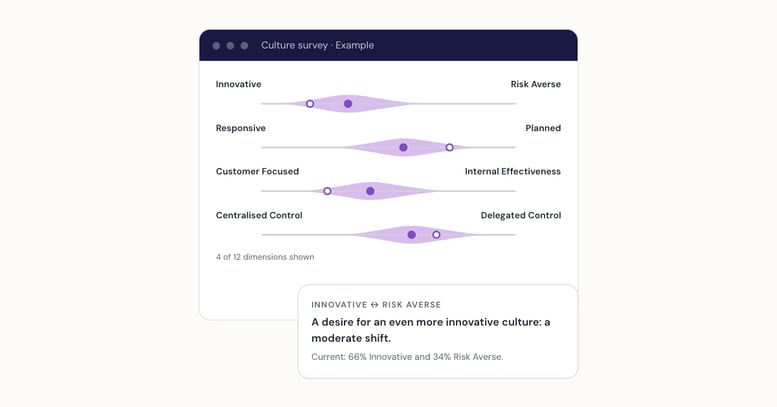
Compono Engage is a culture assessment platform that measures current and desired culture across 12 dimensions. Each dimension is a spectrum between two ways of working. Neither end is good or bad.
|
# |
Dimension |
|---|---|
|
1 |
Innovative vs Risk Averse |
|
2 |
Process Driven vs Outcomes Driven |
|
3 |
Task Centred vs People Centred |
|
4 |
Collectivist vs Individualist |
|
5 |
Centralised Control vs Delegated Control |
|
6 |
Hierarchical Structure vs Flat Structure |
|
7 |
Responsive vs Planned |
|
8 |
Conformity vs Individuality |
|
9 |
Accepting vs Questioning |
|
10 |
Cooperation vs Competition |
|
11 |
Customer Focused vs Internal Effectiveness |
|
12 |
Formal vs Informal |
For a deeper look at each one, read our guide to the 12 dimensions of organisational culture.
Compono's Justin Coutts gave Edan a concrete example using dimension 11.
Imagine a team that currently sits towards Internal Effectiveness. It's lean, cost-conscious and focused on running its own processes well. That's valuable. But the team's desired culture sits much closer to Customer Focused, where people are more empathetic and adaptive to what customers need.
Hire someone who perfectly matches the current culture and you may reinforce the problem. Another strong internal operator joins, settles in comfortably and the team stays where it is.
The more strategic decision, Justin suggested, might be someone who sits closer to the desired state. Someone who stretches the team, brings a different perspective and shifts the balance.
Edan calls this a better description of what we mean by culture add. Not "will this person fit our culture?" but "will this person help us build the culture we need?"

Culture data is easy to misread if it's flattened into a percentage. A team isn't "64% customer focused". Some people see it one way, some see it another, and how much they disagree matters.
That's why Compono shows each culture dimension as a distribution of responses, using violin plots rather than percentage bars. The shape tells you two things a single number can't:
A gap that most of the team feels is a strong hiring signal. A gap only a few people feel is probably a leadership conversation first.
Here's the part that's easy to get wrong. In Compono Hire, candidate benchmarks come from current culture, not desired culture.
That's deliberate. Current culture is the environment a new hire will actually work in from day one. If you benchmark against a future that hasn't arrived, you risk hiring someone who only thrives in an organisation you haven't built yet.
Desired culture plays a different role. It shows the gap a hire could help close. So the question becomes: on the dimensions where the gap is biggest, which candidates lean towards the desired end, and can they still work well in today's reality?
Edan is clear about the risk if you swing too far. If you bring different thinking into a team with no capacity to hear it, "that person becomes the outsider. They're the difficult one." They get invited in for being different, then slowly punished for it.
"Diversity without inclusion doesn't work. You can't hire difference, then demand conformity." Edan Haddock, Edan Haddock Total Talent
So before you hire for the gap, check whether the team is ready for it. That means agreement on where it wants to go, a manager who knows the new person will work differently, and an onboarding plan that makes room for that difference.
Compono Hire is an applicant tracking system (ATS) that brings culture data from Compono Engage into the hiring decision, so you can see both fit with today's team and the gap a candidate might help close. See how Compono Hire works.
Most teams know their desired culture far better than they know what their hiring actually signals today. Before your next role goes live, it's worth checking whether your job ad is attracting the people your current team can support, or only the people it already has.
The Culture-Candidate Checker reads your job ad or careers page and shows the culture it signals across four validated dimensions, plus the work personalities likely to thrive or struggle there.
Try for free: start the Culture-Candidate Checker It takes a few minutes, with no payment details and no sales call.
Current culture is how an organisation actually operates today. Desired culture is how its people want it to operate. The gap between them shows where change is wanted.
Both, in different ways. Benchmark candidates against current culture so they can thrive from day one, then use the gap to desired culture to decide what a hire should help add.
Ask employees to rate how the team works today and how they'd like it to work, across a consistent set of dimensions. Compono uses 12 dimensions, each measured as a spectrum.
Culture add means hiring someone who brings something the team is missing, rather than someone who simply feels familiar. It works best when the team is ready to support that difference.

Discover why hiring against desired culture can backfire. Learn to benchmark candidates against current culture for a successful team dynamic.

Run a free culture check on your own organisation with Compono's Culture-Candidate Checker®. See what your employer brand signals and which...

How to hire for culture fit without building a team of clones, when culture add matters more, and how to score values in a structured interview.
 Mathan Allington
 Compono