

.webp)

 Compono


Best culture assessment software for accounting firms
 Compono
The best culture assessment software for accounting firms, and how to measure firm culture in a way that improves retention.

Organisational culture isn't just a buzzword; it is the invisible 'glue' that binds your team together, influencing every decision, interaction, and outcome. In the fast-moving landscape of 2026, understanding this DNA through a rigorous culture assessment is no longer optional - it is the primary competitive advantage for high-performing Australian businesses.
We have all heard the saying that culture eats strategy for breakfast. But by 2026, we have realised that culture actually *is* the strategy. If your people don't feel empowered to innovate or if your internal processes are stifling productivity, even the most brilliant business plan will stall. The challenge for many HR leaders is that organisational culture often feels nebulous—something you 'feel' rather than something you can measure.

A formal culture assessment changes that. It takes the guesswork out of leadership by providing a clear, data-driven map of how your business actually functions. Without this map, you are essentially flying blind, making reactive changes to symptoms like high turnover or low engagement without ever addressing the root cause: the work environment itself.
When we talk about organisational culture, we are talking about 'the way we do things around here to meet our objectives.' It involves the shared values, beliefs, and systems that dictate behaviour. By using a structured assessment, you can identify the gaps between where your culture is today and where it needs to be to achieve your long-term goals.
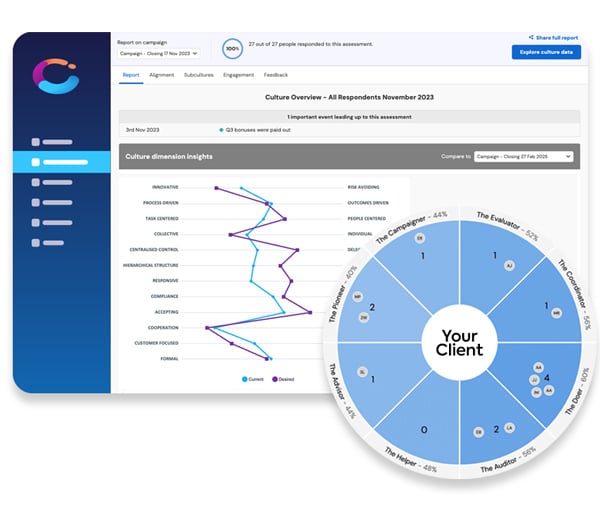
At Compono, we believe that you cannot manage what you cannot measure. This is why we developed Compono Engage, a platform built on the rigour of organisational psychology. Unlike generic pulse surveys that only measure 'mood', Compono Engage acts as a diagnostic tool for your company's personality.
We have bottled the expertise of corporate psychologists into a scientifically validated framework. Our methodology doesn't just ask employees if they are 'happy'; it asks them to evaluate the work environment across 12 distinct dimensions. This provides a holistic view of the organisational 'IS' (the current reality) and the 'HAS' (the systems and structures in place).
By focusing on actionable intelligence, Compono Engage allows you to see subcultures within different departments or locations. This is crucial because a sales team in Sydney might have a completely different cultural experience than an engineering team in Melbourne. Recognising these nuances is the first step toward genuine organisational alignment.
To truly understand your organisation, you need to look at it through multiple lenses. Our research has identified 12 core dimensions that define the modern workplace. Let’s take a deep dive into each one and why they are critical for your success in 2026.
This dimension measures whether your environment encourages creativity and experimentation or prioritises tried-and-tested methods. In a world of rapid digital disruption, an innovative culture allows your team to pivot quickly. Conversely, a risk-averse culture provides stability and consistency, which may be vital in highly regulated sectors like finance or healthcare.
Are you focused on *how* the work is done or the *results* achieved? Process-driven cultures ensure high quality and compliance, even if it takes longer. Outcomes-driven cultures prioritise hitting targets and may take shortcuts to get there. Finding the right balance here is essential for maintaining integrity while driving growth.
This dimension evaluates whether your business prioritises hitting milestones or the social and emotional needs of your employees. While a task-centred approach gets things done, a people-centred approach builds long-term loyalty and psychological safety. In 2026, the best businesses are those that integrate both, recognising that supported people perform better.
Does your culture celebrate 'the team' or the 'star player'? Collectivist cultures thrive on collaboration and shared rewards. Individualist cultures drive high performance through personal accountability and recognition. Misalignment here often leads to friction, especially in hybrid work models where individual output is more visible than team synergy.
This measures where the power lies. Is every decision made by the C-suite, or are frontline employees empowered to take action? Delegated control fosters agility and employee ownership, while centralised control ensures a unified strategic direction. As teams become more distributed, delegating control is often the key to preventing administrative bottlenecks.
How many layers of management sit between an entry-level staffer and the CEO? Hierarchical structures provide clear career paths and authority lines. Flat structures encourage open communication and faster decision-making. Most modern Australian businesses are trending towards flatter structures to improve transparency and responsiveness.
Does your team spend their day 'putting out fires' or following a long-term roadmap? A responsive culture is great for customer service and crisis management. A planned culture ensures that the business is moving towards its strategic objectives without being distracted by short-term noise. Total alignment requires knowing when to be which.
This dimension looks at how much personal freedom employees have. Conformity ensures that everyone follows the same rules and brand standards. Individuality allows for diverse expressions and unique problem-solving. In 2026, fostering individuality within a framework of shared values is the hallmark of an inclusive employer.
Do employees do what they are told, or are they encouraged to challenge the status quo? An accepting culture is efficient and orderly. A questioning culture is essential for identifying risks and avoiding groupthink. High-performing teams often score high on 'questioning' because they value intellectual honesty over blind obedience.
Is your office a place of mutual support or a race to the top? Cooperation builds strong internal networks and knowledge sharing. Internal competition can drive intense productivity but often at the cost of burnout and silos. A culture assessment helps you ensure that competition stays healthy and doesn't turn toxic.
Are you looking outward at the client or inward at your own efficiencies? Customer-focused teams are highly empathetic and adaptive. Internally effective teams are lean and cost-conscious. To thrive, you must ensure that your internal processes actually support the customer experience rather than hindering it.
This measures the 'vibe' and documentation of your business. Formal cultures rely on written policies and professional protocols. Informal cultures operate on unwritten rules and casual interactions. While informality can feel friendly, a lack of formality in a growing business can lead to confusion and lack of accountability.
Many culture assessment tools on the market rely on simple Likert scales (1-5 ratings) that are prone to 'central tendency bias' - where everyone just picks the middle option. Compono Engage uses a more sophisticated approach. We ask employees to evaluate their current reality against their desired work environment.
This gap analysis is where the magic happens. It isn't enough to know that your culture is 'formal'; you need to know if your employees want it to be formal to succeed in their roles. When there is a significant gap between the 'IS' and the 'SHOULD BE', you have found a cultural hotspot that is likely draining engagement and productivity.
Our methodology is grounded in academic research, ensuring high internal consistency. This means the 12 dimensions are not just random categories; they are statistically proven levers that impact organisational performance. By using Compono Engage, you are moving away from 'gut feel' and into the realm of evidence-based management.
You might be wondering, "This sounds great for HR, but what about the bottom line?" The reality is that cultural alignment is a leading indicator of financial performance. Research shows that organisations with a strong, aligned culture outperform their competitors by over 200%. Let's look at how these dimensions impact specific outcomes.
Retention and Turnover: Employees don't leave companies; they leave cultures that don't fit them. If an individual who values individuality and questioning is placed in a culture of conformity and accepting, they will eventually disengage. By using Compono Hire to match candidates to your cultural benchmarks from the start, you can reduce turnover by up to 59%.
Innovation and Agility: If your assessment shows a heavy lean towards 'Risk Averse' and 'Centralised Control', you will struggle to innovate. Identifying this allows leaders to deliberately create 'safe zones' for experimentation, shifting the needle on the dimensions that matter for future growth.
Profitability: Engaged teams are 21% more profitable. Engagement is the 'mood' of your culture. If your 12-dimension map shows a high level of misalignment, your 'mood' will be low. Fixing the underlying cultural friction is the most sustainable way to lift engagement and, by extension, your profit margins.
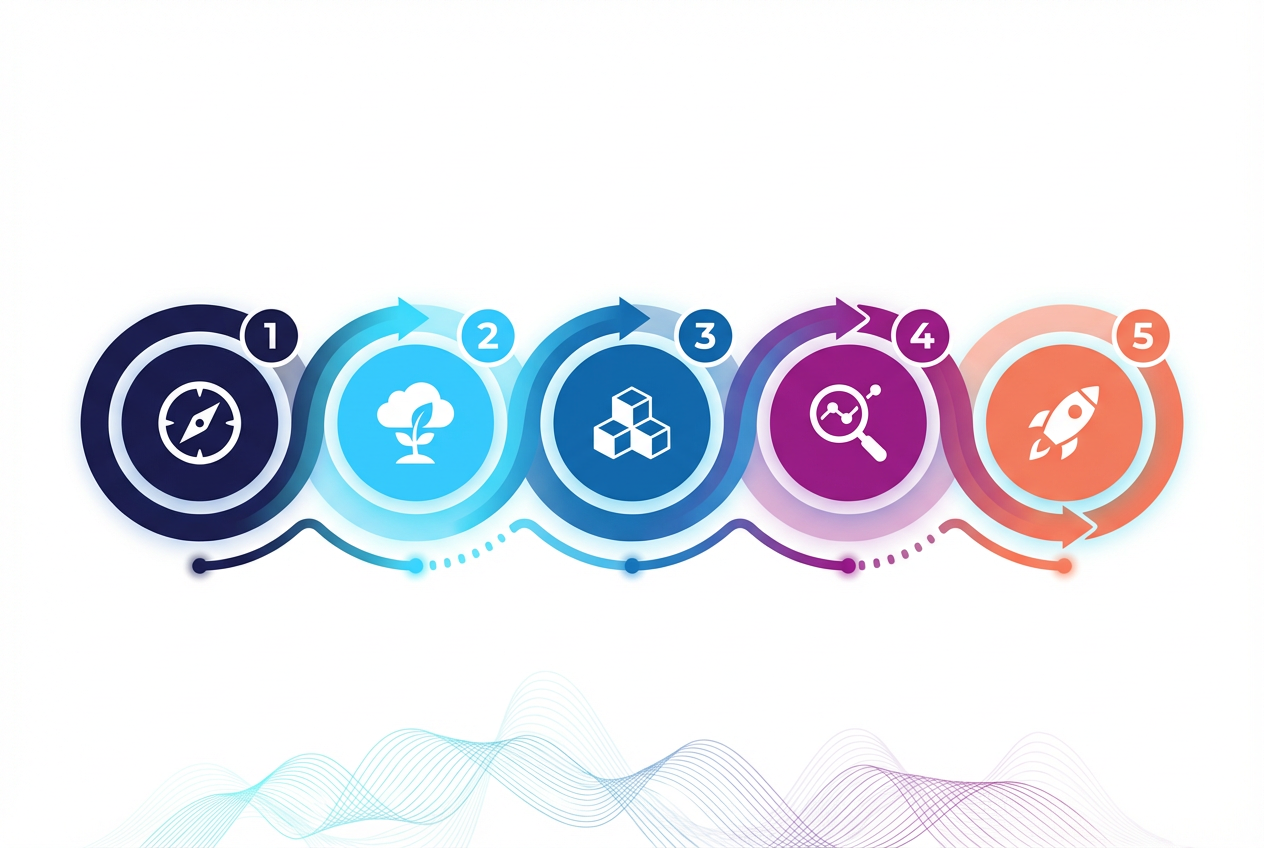
The biggest mistake companies make is treating a culture assessment as a 'one-and-done' event. Data without action is just a colourful chart. To drive real change, you need to use your Compono Engage results to build a roadmap.
Start by identifying your top three 'hotspots' - the areas with the largest gaps between current and desired states. If 'Delegated Control' is a major gap, your action plan might involve leadership coaching to help managers learn how to let go of the reins. If 'Cooperation' is low, you might look at how your reward systems are structured - are you accidentally incentivising competition?
Share the results transparently with your team. People are much more likely to buy into cultural change when they see that their feedback has been heard and quantified. Use the data to set measurable KPIs for your leadership team. In 2026, a manager's ability to maintain cultural alignment should be just as important as their ability to hit budget targets.
Once you have mapped your culture, you can use those insights to revolutionise your recruitment. Don't just hire for skills; hire for the cultural dimensions that drive success in your specific environment. If your culture is highly 'Planned' and 'Process Driven', a 'Pioneering' personality might find it suffocating.
This is where the Compono platform excels. By syncing your Compono Engage benchmarks with Compono Hire, you can automatically rank candidates based on how well they fit your unique DNA. This isn't about creating a workforce of clones; it's about ensuring that the people you bring in have the natural work preferences that will allow them to thrive in your specific atmosphere.
This holistic approach ensures that culture isn't just something you talk about in orientation; it's something that is reinforced at every stage of the employee journey, from the first interview to the final exit survey.
In the end, your organisational culture is either your greatest asset or your heaviest liability. As we move through 2026, the businesses that will survive and thrive are those that treat culture as a measurable, manageable, and strategic priority. By understanding the 12 dimensions that matter, you can stop guessing and start building a workplace that truly works.
Whether you are looking to improve retention, spark innovation, or simply make your office a better place to be, it all starts with an assessment. Are you ready to see what your culture actually looks like?

The best culture assessment software for accounting firms, and how to measure firm culture in a way that improves retention.
.png)
Discover the importance of safety culture in high-risk industries and learn five actionable steps to cultivate a winning safety culture within your...

Run a free culture check on your own organisation with Compono's Culture-Candidate Checker®. See what your employer brand signals and which...
 Rudy Crous
 Mathan Allington