


 Mathan Allington


Effective ways to improve quality of hire for modern teams
 Compono
Quality of hire improves when you measure more than the CV. How hiring data and work personality cut bias in shortlisting and reduce early turnover.

Asking a candidate's age in an Australian job interview is not strictly illegal, but using that information to make a hiring decision breaches federal anti-discrimination laws.
Last reviewed November 2026
Key takeaways
- Age is a protected attribute under the Fair Work Act and the Age Discrimination Act, making hiring decisions based on age unlawful.
- Employers can legally collect age information only for specific exceptions, such as junior award rates or liquor licensing requirements.
- Asking about retirement plans or career timelines creates a significant compliance risk and should be avoided.
- Structured interviewing helps teams focus on capability and organisational fit rather than demographic assumptions.
Ageism remains a persistent issue in modern recruitment. In a survey conducted by the Australian Human Rights Commission and the Australian HR Institute, one in three organisations said there was an age above which they were reluctant to recruit, and most identified age 50 as the threshold (Australian Human Rights Commission, 2023). This highlights a significant people insight risk. When hiring managers fixate on demographic details, they miss the behavioural traits and capabilities that actually predict success on the job.
Many traditional HR systems manage process risk by standardising application forms, but they fail to guide managers during the interview phase. Without a structured framework, interviewers often ask conversational questions that accidentally invite legal trouble. Understanding what you can and cannot ask is the foundation of a fair and effective hiring strategy.
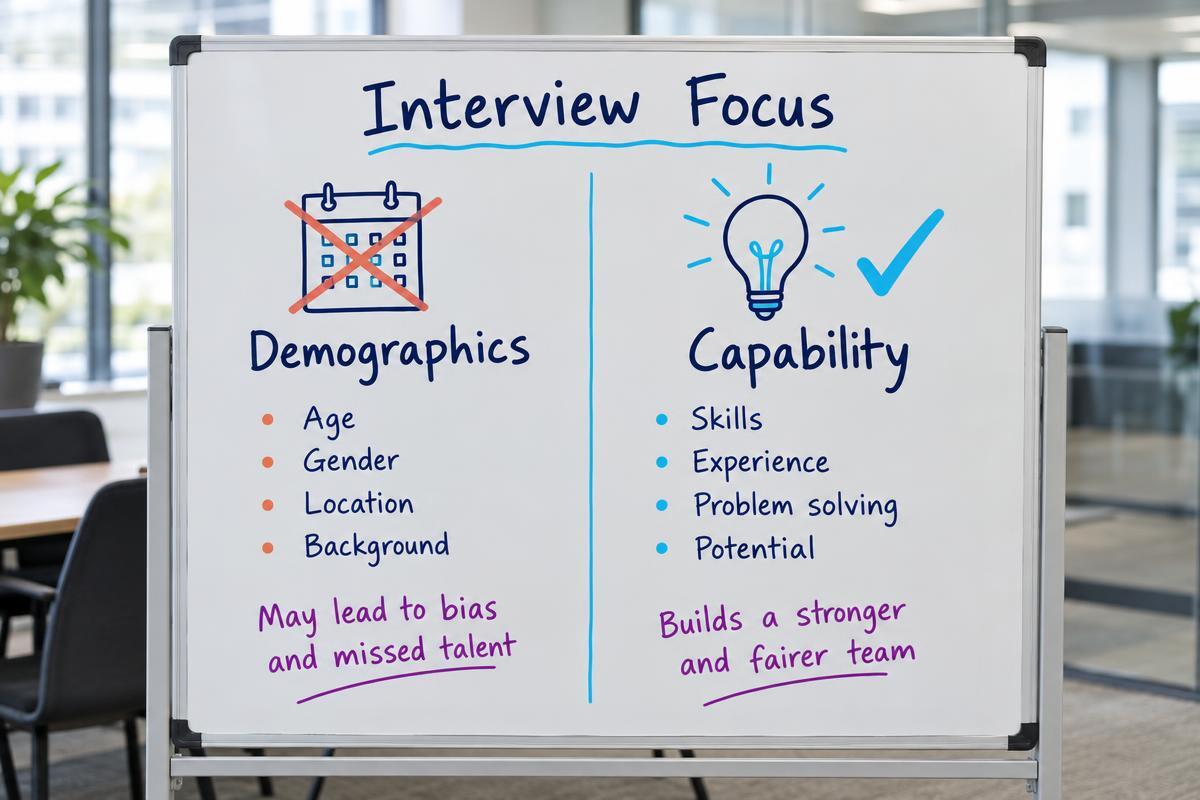
Age is a protected attribute under Australia's Age Discrimination Act 2004, which makes age discrimination in employment unlawful. The Fair Work Act 2009 also protects prospective employees from adverse action because of age. This means an employer cannot lawfully reject an applicant because they are perceived as too old or too young.
The risks go beyond obvious rejection. Australian anti-discrimination law can cover both direct discrimination, such as refusing to hire someone because they are too old, and indirect discrimination from neutral-looking requirements that disadvantage a particular age group without reasonable justification (Sprintlaw, 2024). For example, requiring a candidate to have "digital native" technology skills might indirectly discriminate against older workers if the specific software can be easily learned on the job.
To work through this safely, HR teams should review the interview questions you can't ask in Australia to ensure all hiring panels understand their compliance obligations.
There are rare exceptions where collecting a candidate's age is a necessary process requirement. These are known as inherent requirements of the job. If a role involves serving alcohol in a licensed venue, you must ensure the applicant is over 18 to comply with state laws. Similarly, if you are hiring junior staff paid under a modern award, you need their exact age to calculate the correct wage.
However, asking a candidate's age is not automatically unlawful, but using the answer to make a hiring decision can create discrimination risk, meaning employers are generally safer asking about skills, experience and ability to perform the role (SBAAS, 2023). If you must collect date of birth for payroll or compliance reasons, it is best practice to request this information during the onboarding phase rather than the interview stage.
Understanding the boundaries of compliance is similar to understanding the legality of culture fit hiring in Australia. The goal is always to assess a candidate's alignment with the role and the organisation without straying into personal attributes that have no bearing on performance.
Australian employers should avoid interview questions about age, retirement plans or assumptions about career stage unless the information is genuinely connected to an essential job requirement (The Drive Group, 2023). A common mistake is asking a mature candidate how long they plan to work before retiring. This immediately creates a legal risk.
Instead of relying on demographic assumptions, hiring managers should use structured behavioural questions. If you are concerned about a candidate's long-term commitment, ask them about their career goals over the next five years. If you want to know if they can handle a physically demanding role, ask them to describe their experience managing similar physical tasks in past positions.
Providing your team with a library of good interview questions and answers for Australian managers ensures that every candidate is evaluated on a level playing field.
Collecting demographic data is sometimes necessary, but it should never influence the selection process. Most platforms handle the process risk by capturing this data securely, but they do nothing to address the bias it creates. The best way to reduce bias is to shift the focus entirely to capability and culture.
Compono Hire is an applicant tracking system (ATS) that matches candidates to culture, not just keywords. By assessing a candidate's technical skills, qualifications, and work personality before the interview, Compono gives hiring managers a ranked view of who fits the role and the team. This moves the conversation away from demographic assumptions and toward the behavioural traits that drive performance. For more strategies on removing subjective judgments from your process, explore our bias-free hiring guide.
If you are on the other side of the desk and an interviewer asks your age, it is usually a result of poor training rather than malicious intent. You can handle the situation professionally by pivoting the conversation back to your capability.
A polite and effective response is to address the underlying concern without answering the specific question. For example, you might say, "If you are wondering about my ability to keep up in a fast-paced environment, my recent experience managing a high-volume team shows I have the energy and focus to excel in this role." This keeps the interview positive while subtly reminding the panel that your experience is the true measure of your fit.
Stop guessing from resumes and relying on unstructured conversational interviews that invite compliance risks. See how candidates stack up across the areas that actually matter, backed by behavioural science.
You can include a date of birth field on an application form, but it is highly recommended to make it optional or avoid it entirely unless required for a specific legal reason like a police check. Collecting it early increases the risk of unconscious bias influencing the shortlisting process.
It can be considered indirect discrimination. Requiring a minimum of 10 years of experience naturally excludes younger candidates. A safer approach is to ask for demonstrated competency in specific skills, rather than an arbitrary number of years.
Candidates often share personal information voluntarily. If this happens, do not write the information down in your interview notes. Acknowledge the comment politely and steer the conversation back to the candidate's skills and experience to ensure the disclosure does not influence your hiring decision.
If the role requires the applicant to be over 18 by law, you can simply ask, "Are you over 18 years of age and legally permitted to serve alcohol?" This confirms their eligibility for the role without asking for their specific age or date of birth.

Quality of hire improves when you measure more than the CV. How hiring data and work personality cut bias in shortlisting and reduce early turnover.

Competency based interview questions and answers, how to structure responses with the STAR method, and how to score candidates fairly.

The true cost per hire benchmark in Australia for 2026. Learn how to calculate your recruitment spend and reduce costs without losing talent quality.
 Mathan Allington