


 Mathan Allington


Recruitment Metrics Dashboard: Essential KPIs for 2026
 Compono
How to build a recruitment metrics dashboard that tracks time-to-fill, cost-per-hire and quality of hire, and what to do with the numbers.
The average cost per hire benchmark in Australia sits at roughly A$23,860, a figure that includes both direct recruitment expenses and the indirect costs of lost productivity.
Last reviewed October 2026
Key takeaways
- Australian employers spend an average of A$23,860 per hire when factoring in time and lost productivity.
- Direct external recruitment costs average A$10,500 for a professional role before onboarding expenses.
- Agency fees typically consume 15% to 20% of a new hire's first-year salary.
- The standard calculation formula divides total internal and external recruiting costs by your total number of hires.
- Replacing a bad hire adds massive hidden costs through wasted training time and team disruption.
Understanding what you spend to bring a new person into your business is the foundation of a sensible talent strategy. Many human resources teams track the price of a job advertisement or an agency invoice and stop there. This gives you an incomplete picture of your real recruitment spend.
True hiring costs span external vendor fees, internal staff time, compliance requirements and the drag on productivity while a seat sits empty. When you manage process risk by tracking approvals and applications, but ignore people insight risk by failing to assess whether the person actually fits the role, you end up paying these costs twice when the new starter leaves.
Local data gives a clear picture of what Australian organisations spend to recruit talent. Based on a survey by ELMO Software and AHRI, the average cost per hire in Australia reached A$23,860 for 2021 hiring activity.
If you look only at the immediate cash output, the number is lower but still significant. Data from The Recruitment Alternative shows the average direct recruitment cost for an Australian professional hire is approximately A$10,500, before indirect costs such as onboarding and productivity loss.
These averages mask a wide spread based on the seniority and scarcity of the talent you need. Market data from Expert360 indicates recruitment costs in Australia can range from A$5,000 to A$30,000 depending on role complexity, while first-year productivity losses may add A$15,000 to A$25,000.
The standard formula for calculating recruitment spend is simple. You take your total internal recruiting costs, add your total external recruiting costs, and divide that sum by the number of hires in a given period.
Internal costs cover the salaries of your internal talent acquisition team, the hours hiring managers spend reviewing resumes and interviewing, employee referral bonuses and fixed system costs. External costs include job board fees, background checks, external recruiters and marketing spend.
To give you a clearer picture, here is how a typical recruitment budget breaks down across these categories:
| Cost category | Common expenses included |
|---|---|
| Internal costs | HR salaries, hiring manager time, referral bonuses, internal applicant tracking systems |
| External costs | Agency fees, job advertisements, pre-employment testing, external background checks |
| Hidden costs | Lost productivity, vacant seat costs, extended training periods for bad hires |
You can run these numbers manually or use a cost per hire calculator to speed up the process. A consistent calculation method helps you track your efficiency over time and prove the value of your internal talent team.
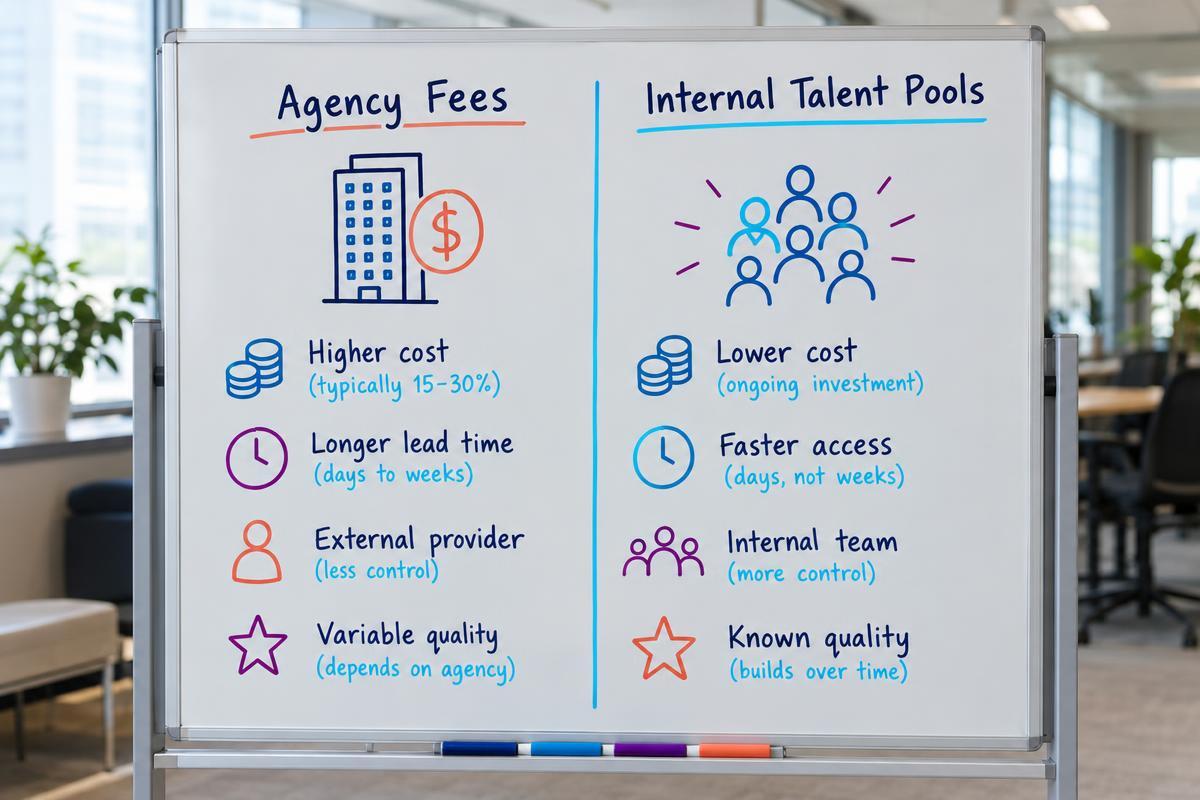
External agencies are a fast way to fill a role, but they carry a heavy premium. Industry tracking by 9cv9 shows Australian recruitment agencies commonly charge 15% to 20% of a candidate's first-year salary for permanent placements, with specialist and senior searches reaching 18% to 30% or more.
To put that in perspective, a practical example from The Recruitment Alternative shows that a professional earning A$80,000 can generate an agency recruitment fee of approximately A$12,000 to A$16,000 at standard Australian placement rates. When you build an internal talent function, you remove these external fees but increase your fixed internal costs.
You also need to account for local compliance and platform pricing. Advertising on SEEK or LinkedIn requires a dedicated budget. Furthermore, statutory requirements like the superannuation guarantee and state payroll tax increase the baseline cost of running an internal team, meaning your internal hiring operations are a significant investment.
Your hiring costs will look very different depending on where your business operates. Hiring a professional in the Sydney or Melbourne metropolitan areas often involves high competition and salary expectations, which drives up agency fees.
In contrast, recruiting for remote sites or fly-in fly-out (FIFO) roles in Western Australia or Queensland introduces entirely different expenses. You often have to factor in travel for interviews, relocation packages and higher baseline salaries to attract people to regional areas.
Remote work has flattened some of these geographic differences for knowledge workers. However, when a role requires an on-site presence, location remains a major factor in your total recruitment bill.
The most expensive part of recruitment is often the time you spend waiting. An empty seat means lost revenue, delayed projects and burnout for the team members picking up the slack. Tracking Australian time to hire benchmarks helps you measure this lost productivity.
Making the wrong choice is even worse. The financial impact of bad hires includes the salary paid during probation, the training time invested by managers, and the immediate need to spend your direct recruitment budget all over again.
Most HR software manages the process of getting someone into the business, but it tells you nothing about whether they will succeed. When you add behavioural science to your recruitment process, you reduce the risk of a new starter leaving because they clash with your culture.
The fastest way to lower your cost per hire is to reduce your reliance on external agencies and paid job boards. You can achieve this by building a warm talent pool of candidates who already know your brand.
When choosing an ATS in Australia, look for systems that do more than track resumes. Compono Hire is an applicant tracking system that matches candidates to your culture, not just their listed skills. This means you identify the right people faster and avoid paying to replace them three months later.
Centralising your hiring data also helps you identify where you waste money. When you know exactly which channels deliver your best people, you can stop spending your recruitment budget on job boards that only produce unqualified applications.
Compono Hire gives you the tools to build your own talent pools and match candidates to your culture, reducing your reliance on expensive external agencies. You get a complete view of your hiring metrics so you can make smarter decisions about your recruitment spend.
The average cost per hire in Australia is roughly A$23,860 when including both direct expenses and indirect productivity losses. Direct recruitment costs for a professional role average around A$10,500.
You calculate cost per hire by adding all internal recruiting costs (such as HR salaries and referral bonuses) to all external recruiting costs (such as agency fees and job board ads), then dividing that total by the number of hires made.
Recruitment agencies typically charge 15% to 20% of a candidate's first-year salary to cover their time, network access and the risk of the candidate not passing probation. For highly specialised roles, this fee can reach up to 30%.
Hidden recruitment costs include the time hiring managers spend reviewing applications and interviewing, the drop in team productivity while a role is vacant, and the training time invested in a new starter who leaves during probation.
Yes. Roles in highly regulated or specialised industries like mining, healthcare and technology typically carry higher recruitment costs due to talent scarcity and the need for extensive background checks.

How to build a recruitment metrics dashboard that tracks time-to-fill, cost-per-hire and quality of hire, and what to do with the numbers.

The true cost of Sapia AI in 2026, including volume minimums, hidden implementation fees, and the best alternatives for mid-market teams. Learn more.

A CRM for executive search firms must map complex relationships and prove candidate fit. Discover how to choose the right platform to win retained...
 Mathan Allington