

.webp)

 Mathan Allington
Does culture affect performance in modern teams
 Compono
How workplace culture drives bottom-line results, and what connects team behaviour to high performance, with evidence-based insights from Compono.

Team performance assessment tools measure three things: what each person on a team naturally does well, how the group works together day to day, and whether the culture around them supports the work. The useful ones explain why a team is underperforming and what to change. The weak ones report how people feel and stop there.
Last reviewed September 2026.
Every product in this category reads the team at one of four levels. The individual level covers work preferences and what motivates someone. The group level covers how the team communicates, splits the work, handles disagreement and reaches a call. The organisational level covers the culture people operate inside. The outcome level covers the lagging numbers: turnover, productivity, absence and overtime.
Buyers get caught when they purchase at one level and expect answers from another. A sentiment platform is a fine thermometer and a poor diagnosis. Reading a psychometric assessment on its own tells you who is in the room without telling you whether the room is working.
These are categories, not vendors. Most products on the market do one of these well and gesture at the others, so the honest question at the start of a search is which column you are actually trying to fill.
| Tool type | What it measures | Best used for | Where it falls short |
|---|---|---|---|
| Pulse and engagement surveys | How people feel about work right now | Tracking sentiment over time and spotting a sudden drop | Signals that something is wrong without saying what caused it |
| 360 degree feedback | How colleagues rate one person's behaviour | Developing an individual manager with specific examples | Slow to run, and the result depends heavily on who was asked |
| Work personality and psychometric assessment | Natural work preferences and how someone prefers to contribute | Designing team balance, hiring for the gap, reducing avoidable friction | Describes preference rather than skill or current performance |
| Culture measurement | How work actually gets done, and the distance to the culture the strategy needs | Explaining why the same problem keeps coming back | Requires leaders to be honest about the culture they are aiming for |
| Skills and capability mapping | What the team can do against what each role requires | Training plans, workforce planning and succession | Says nothing about how the people involved work together |
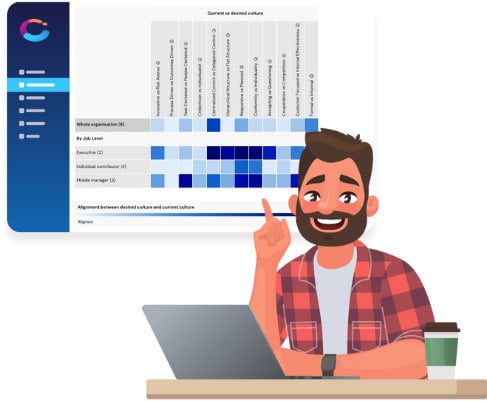
The categories are not rivals. A team that has never measured culture will learn more from a culture read than from another survey cycle, and a team that already knows its culture gap will learn more from mapping who is in the team. The difference between engagement surveys and culture measurement is the one most buyers underestimate.
Six questions separate a tool that changes a decision from one that generates a report nobody opens.
Between roughly 60 and 1,000 staff, the informal knowledge that held a small business together stops working. Nobody can hold the whole team map in their head any more, managers inherit teams they did not build, and the first sign of a design problem is usually a resignation.
Time cost matters more at this size than buyers expect. An illustrative example with made-up numbers: a 200-person company runs a 40-question survey that takes each employee 20 minutes. That is 4,000 minutes, or about 67 hours of working time per round, and about 133 hours if the survey runs twice a year. The output has to be worth three and a half working weeks, which is a fair test to put to any vendor.
Mid-sized buyers also tend to need coverage rather than depth. A short assessment everyone completes gives a truer team picture than a long one with 60% participation, because the missing 40% is exactly where the uncovered work activity hides. The cost of disengagement calculator is a quick way to size what the current state is costing before you spend anything on measuring it.
Potential assessment answers a different question from team effectiveness. Team effectiveness asks whether this group, as currently built, can deliver what it has been asked to deliver. Potential asks which individuals could handle a larger or different role later.
Most potential tools combine reasoning ability, work preference, motivation and current performance, then sit the result in a grid. The honest caveat is that potential is a prediction, and predictions built only on manager nomination reward visibility rather than capability. Validated assessment widens the field by surfacing people who do good work quietly.
Two traps are worth naming. Labelling someone as low potential tends to become self-fulfilling once it is written down. And potential for what matters: a strong individual contributor being moved into management because there is nowhere else to promote them is a design failure, not a development plan.
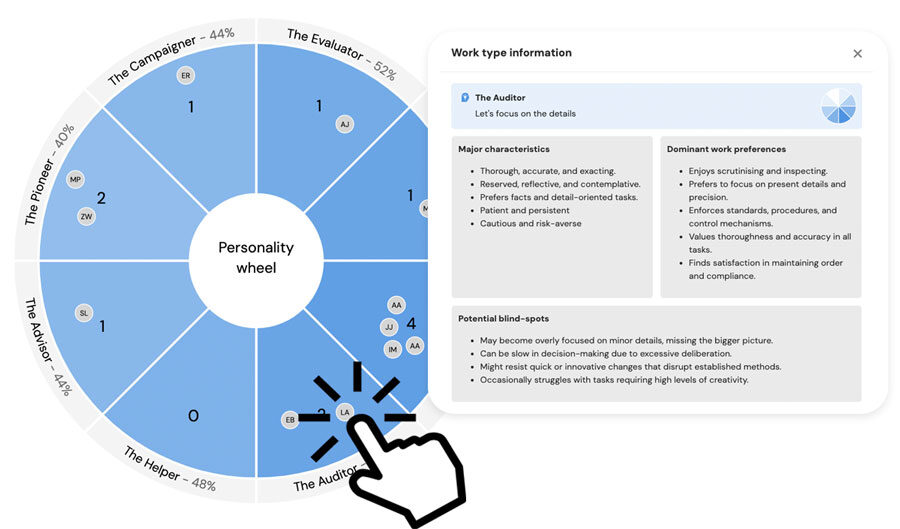
Compono's work personality research describes eight work activities that sit behind team performance: evaluating, coordinating, doing, auditing, helping, advising, pioneering and campaigning. Each maps to one of the eight work personality types, which are Doer, Auditor, Helper, Advisor, Pioneer, Campaigner, Evaluator and Coordinator.
A team does not need eight people, only all eight activities covered by the people it has. A group of Doers can be extraordinarily productive while working on the wrong thing, because nobody is pioneering the direction or evaluating whether the direction holds up. The value of mapping the team is that the gap becomes a hiring brief instead of a mystery. There is more detail on the mix in our guide to work personality types in high performing teams.
The most common failure is measuring sentiment repeatedly and treating the trend line as a finding. The second is running an assessment, filing the report, then hiring the next person on résumé alone, which quietly rebuilds the imbalance the assessment found. The third is treating a personality result as a fixed label rather than a description of preference, which is how a useful tool becomes an excuse for behaviour nobody should accept.
None of this is a reason to skip assessment. It is a reason to buy the level of tool that matches the decision you are trying to make, and to be clear before you start about what you will change once the results land.
Compono Engage maps work personality, culture and engagement together, so you can design a team for balance instead of guessing at it.
Talk to usMost measure one of four things: an individual's work preferences, how the group behaves together, the culture the team works inside, or the outcomes the team produces. A tool that only reads one level can describe a problem but rarely explains it. Reading work personality, culture and engagement together is what turns a score into a decision you can act on.
An engagement survey measures how people feel about their work at a point in time. Team assessment software asks whether the team is built to perform: whether the work activities a team needs are covered, whether the mix of personalities suits the job, and whether the culture supports the strategy. Engagement usually improves as a by-product of getting those right.
Work personality is stable, so it is measured once per person and refreshed when the team changes. Culture moves slowly and is usually read once or twice a year. Engagement moves fastest and suits shorter, more frequent checks. Running everything on the same quarterly cycle wastes people's time and produces noise.
They tend to pay back fastest between roughly 60 and 1,000 staff, which is where informal knowledge of who is good at what stops scaling and managers start guessing. Below that size a leader can usually hold the whole picture in their head. Above it, the question shifts from whether to assess to how to keep the data current.
They narrow the field rather than name the winner. Validated assessments of reasoning, work preference and motivation are better than manager nomination alone, because nomination rewards visibility. They still need to be read alongside performance evidence and a real conversation about what the person wants.
You can, but the result is weaker. Partial coverage hides the exact thing a team assessment is for, which is the activity nobody in the group is naturally drawn to. If participation is the obstacle, a short assessment that every person completes beats a long one that half the team abandons.

How workplace culture drives bottom-line results, and what connects team behaviour to high performance, with evidence-based insights from Compono.

How workplace personality tests help Australian managers read team dynamics, settle conflict sooner, and hire candidates who actually fit the role.

Why the Campaigner work personality matters for HR teams building culture, lifting engagement, and steering people through change.
 Mathan Allington