

.webp)

 Mathan Allington


1 min read
Behavioural Science in Hiring: What Actually Works in 2026
 Compono
If you want to know how behavioural science in hiring actually works, you have to accept one uncomfortable truth: almost everything we traditionally...
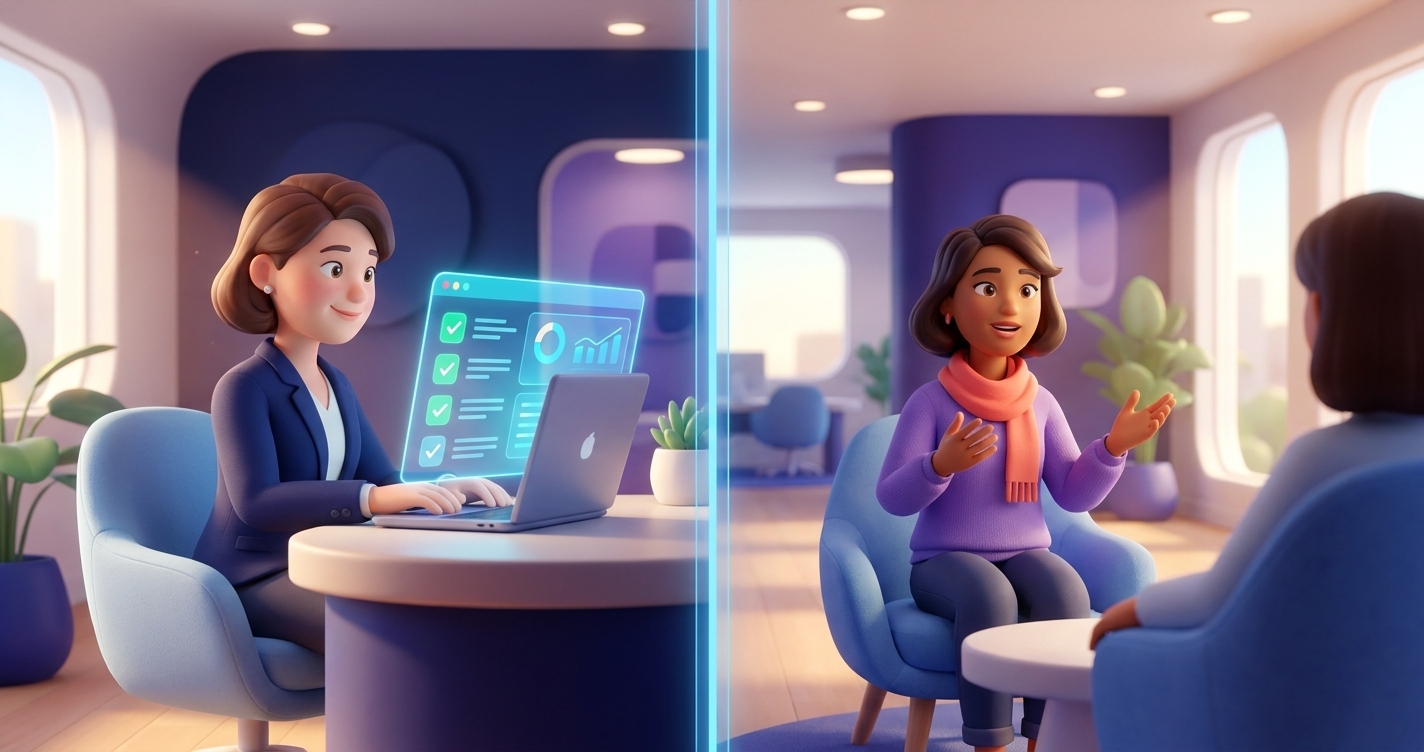
Structured interview software is a digital platform designed to standardise the hiring process by ensuring every candidate is asked the same questions in the same order and evaluated against a consistent scoring rubric.
Key takeaways
- Structured interview software replaces subjective hiring with data-driven, consistent candidate evaluation.
- Research shows structured interviews are significantly more predictive of job performance than unstructured conversations.
- Modern platforms automate scheduling, guide interviewers with scoring rubrics, and reduce unconscious bias.
- Implementing this software saves time and improves the candidate experience, even for those who are not hired.
We have all experienced the traditional, unstructured interview. A hiring manager walks into a room, or joins a video call, with a printed CV, skims it for the first time, and asks, "So, tell me about yourself." What follows is a meandering conversation that might uncover a shared love of golf or a mutual acquaintance, but rarely uncovers the candidate's actual ability to do the job.
This reliance on "gut feeling" is fundamentally flawed. When interviewers lack a structured framework, they fall back on unconscious biases, hiring people they like rather than people who will perform. The result is a fragmented hiring process, poor candidate experiences, and costly mis-hires that impact the entire business.
In 2026, talent acquisition teams are moving away from this ad hoc approach. By implementing structured interview software, organisations are bringing scientific rigour to their hiring decisions. This guide explores what this software actually does, the evidence behind its effectiveness, and how to choose the right platform for your team.
Structured interview software is not just a video conferencing tool or a basic applicant tracking system (ATS). It is a dedicated framework enforcer that guides hiring managers through a scientifically backed evaluation process.
At its core, the software mandates consistency. Before a candidate even applies, the hiring team uses the platform to define the core competencies required for the role. The software then helps generate a standardised set of interview questions designed specifically to test those competencies. When the interview takes place, the interviewer is presented with these exact questions, alongside a clear scoring rubric, often a five-point scale, detailing what a poor, average, and excellent answer looks like.
This means that whether a candidate is interviewed on a Monday morning by the CEO or a Friday afternoon by a team lead, they face the exact same evaluation criteria. The software captures these scores in real time, aggregating the data to provide an objective, side-by-side comparison of all candidates. It removes the guesswork and forces interviewers to justify their ratings with evidence, rather than relying on a vague feeling of "culture fit".

The shift towards structured interviewing is not just a passing HR trend, it is rooted in decades of behavioural science and organisational psychology. The data overwhelmingly shows that when you standardise the interview process, you make better hires.
Research indicates that structured interviews have a reported validity of about 0.51, versus roughly 0.20 to 0.30 for unstructured interviews, making them far more predictive of job performance. This means that a structured interview is more than twice as likely to accurately predict how well a candidate will actually perform in the role.
This predictive power is why industry leaders have championed the methodology for years. Laszlo Bock, former SVP People Ops at Google, noted: "Structured interviews are the only way to get an accurate handle on a candidate's ability to succeed." Google's own internal research, as reported in its re:Work guidance, found that implementing this methodology saved interviewers about 40 minutes per interview by removing the need to prepare questions from scratch.
standardisation creates a fairer process that candidates actually appreciate. Google's data also found that rejected candidates were 35% more satisfied after structured interviews than after unstructured interviews, highlighting the positive impact on employer brand. It is no surprise that one recruiting survey cited in 2026 found 72% of companies now use structured interviews to standardise candidate evaluation and reduce bias.
While the theory behind structured interviewing is sound, executing it manually via spreadsheets and printed documents is a logistical nightmare. Good structured interview software automates the heavy lifting, ensuring compliance without adding administrative burden.
First, it provides a solid question library. Instead of hiring managers frantically Googling "best interview questions for a project manager" five minutes before a call, the software suggests validated, competency-based questions. These questions are mapped directly to the skills required for the role, ensuring relevance and legality.
Second, it enforces the scoring rubric. During the interview, the software presents the interviewer with a digital scorecard. They cannot simply submit a "thumbs up" or "thumbs down", they must rate the candidate on specific criteria using predefined anchors. For example, if evaluating "conflict resolution", the software will explicitly define what a 1-star answer sounds like compared to a 5-star answer.
Finally, modern platforms centralise the feedback loop. Once all interviews are complete, the software aggregates the scores into a single dashboard. This allows hiring committees to hold debrief sessions based on hard data rather than relying on who can argue the loudest for their preferred candidate. If you want to learn more about how to avoid common hiring mistakes, standardising this feedback loop is the best place to start.
If you are evaluating structured interview software in 2026, the market is crowded with options. To separate the genuinely useful platforms from the overhyped tools, you need a rigorous buying checklist.
Integration capabilities:
The software must integrate smoothly with your existing HR tech stack. If it does not communicate with your ATS or calendar software, user adoption will plummet. Interviewers should be able to click a link in their calendar invite and instantly access the correct scorecard.
Customisable rubrics:
Every organisation has unique competencies and values. The platform must allow you to easily build and modify scoring rubrics that reflect your specific behavioural framework. Rigid, out-of-the-box scorecards will not serve a nuanced hiring strategy.
Anti-bias features: Look for platforms that actively mitigate bias. This might include features that hide candidate names or photos during the initial review stage, or prompts that remind interviewers to focus on the rubric if their scores seem inconsistent. Knowing how to choose an ATS that reduces hiring bias is critical for building diverse teams.
User experience (UX): Hiring managers are often time-poor and resistant to new administrative tasks. If the software requires a multi-day training program to understand, it will fail. The interface must be highly intuitive, allowing an interviewer to log in, see their questions, and submit their scores with minimal friction.
Artificial Intelligence is transforming recruitment, and structured interview software is no exception. However, it is crucial to understand where AI adds value and where it introduces risk.
AI is incredibly useful for preparation and analysis. Generative AI can help talent acquisition teams rapidly build competency models and generate tailored interview questions based on a job description. It can also transcribe interviews in real-time, allowing the interviewer to focus entirely on the candidate rather than furiously typing notes.
Where AI becomes problematic is in the actual scoring of candidates. While some platforms claim their AI can analyse a candidate's facial expressions, tone of voice, or word choice to predict performance, these claims are often scientifically dubious and fraught with algorithmic bias. AI struggles with neurodivergent candidates, non-native speakers, and cultural nuances.
In 2026, best practice dictates that AI should act as a co-pilot, not an autopilot. It should assist the human interviewer by organising data and suggesting follow-up questions, but the final evaluation and scoring must remain a distinctly human responsibility.
Many organisations attempt to run structured interviews using a patchwork of existing tools. They might use a shared spreadsheet for scoring, a generic survey tool for feedback, and a standard video conferencing app for the interview itself.
While this is better than a completely unstructured approach, it rarely scales. Spreadsheets are easily broken, version control becomes a nightmare, and compliance is almost impossible to enforce. Hiring managers often forget to fill out the survey, or they fill it out days later when their memory of the candidate has faded.
Dedicated structured interview software solves these problems by creating a closed-loop system. It forces compliance by making the scorecard a mandatory part of the interview workflow. When teams use Compono Hire, they find that having the assessment criteria, interview questions, and scoring rubrics housed in a single, purpose-built platform drastically improves completion rates and data accuracy.
The biggest hurdle to implementing structured interview software is not technical, it is cultural. Hiring managers are often fiercely protective of their personal interviewing styles. Telling a senior executive that they can no longer ask their favourite brain-teaser question can lead to significant pushback.
To roll out the software successfully, you must lead with the "why". Do not present it as a new administrative rule; present it as a tool that will save them time and help them build better teams. Share the data on validity and time savings. Show them how the software will eliminate the need for them to spend hours preparing questions.
Start with a pilot program. Select a single department, ideally one that hires frequently and values data, and run all their interviews through the new software. Gather their feedback, refine the rubrics, and use their success stories to champion the software to the rest of the business. When other managers see that the pilot team is making faster, higher-quality hires with less effort, adoption will follow naturally.
Moving from unstructured chats to a scientifically backed hiring process requires the right technology to enforce consistency without frustrating your hiring managers.
Related reading
An unstructured interview is conversational and free-flowing, with questions varying wildly from candidate to candidate based on the interviewer's mood or the flow of the chat. A structured interview requires every candidate for a specific role to be asked the exact same questions in the same order, and their answers are evaluated against a predefined scoring rubric.
Not if used correctly. While the core questions are scripted to ensure fairness, interviewers can still build rapport at the beginning of the call and ask natural follow-up questions to probe deeper into a candidate's answer. The software simply ensures that the foundational evaluation criteria remain consistent.
Initial setup requires an investment of time, as you need to define the core competencies for your roles and build the corresponding question banks. However, modern software often includes extensive libraries of pre-built, validated questions and rubrics that you can adapt quickly, significantly reducing the setup time.
Yes, most reputable platforms in 2026 are designed to integrate smoothly with major Applicant Tracking Systems. This ensures that candidate data flows automatically between systems, allowing interviewers to access scorecards directly from the ATS workflow.
Candidates appreciate fairness. In a structured interview, they feel they are being evaluated on their actual skills and experience rather than their ability to make small talk. It also provides a more professional, organised experience, which reflects positively on the employer's brand.

1 min read
If you want to know how behavioural science in hiring actually works, you have to accept one uncomfortable truth: almost everything we traditionally...
1 min read
Science-backed hiring means using objective data, validated psychological assessments and structured interviews to predict how a candidate will...

1 min read
Bias free hiring means designing your recruitment process so decisions rest on objective evidence instead of mental shortcuts. The core moves: audit...
 Mathan Allington