

.webp)

 Mathan Allington


Best applicant tracking system for cleaning companies in Australia
 Compono
How to choose an applicant tracking system for Australian cleaning companies, built for high volumes, turnover and reliable staff.

Last reviewed July 2026
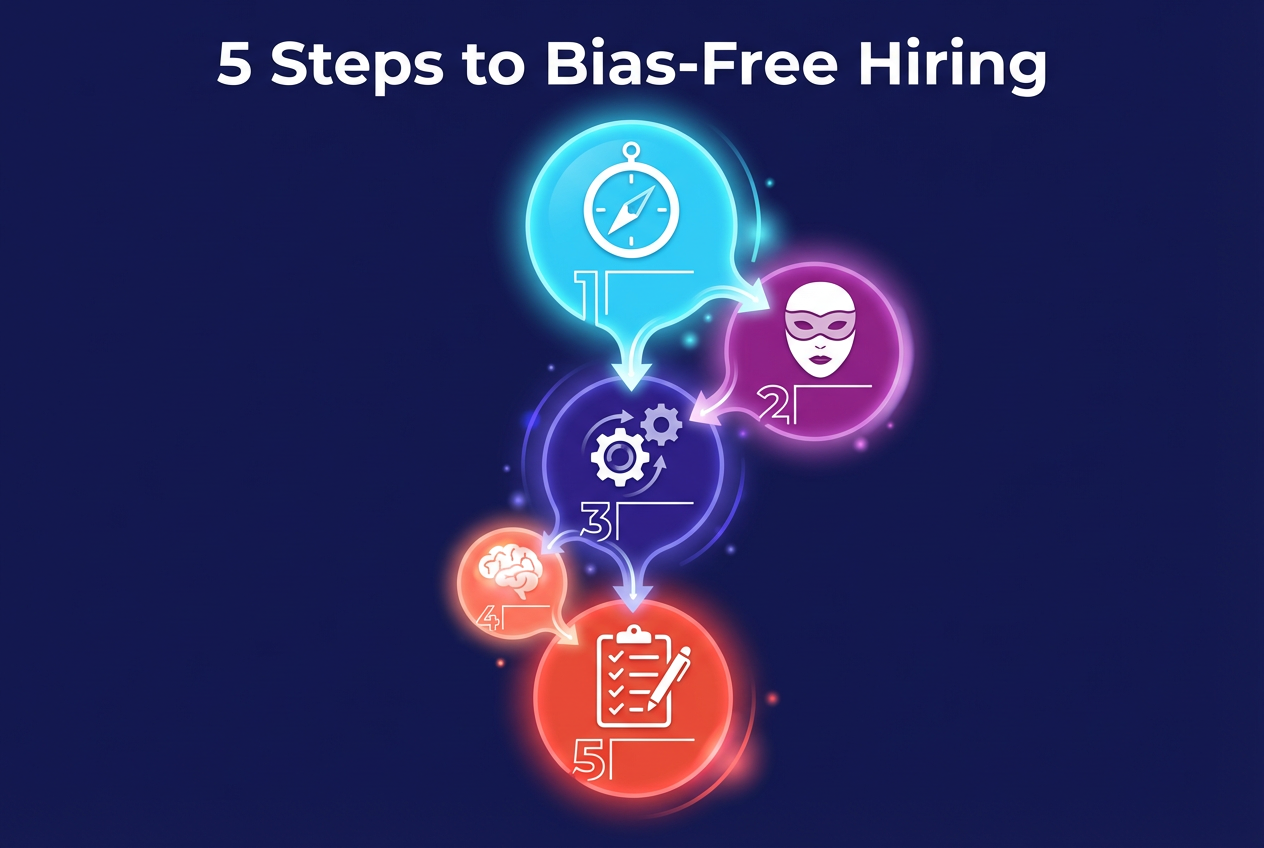
To choose an applicant tracking system (ATS) that reduces hiring bias, look for four capabilities: blind resume screening, structured interview scorecards, competency-based matching rather than keyword parsing, and validated psychometric assessment. Then test the vendor on algorithmic fairness, because an AI trained on biased hiring history automates that same bias at speed.
Unconscious bias creeps into every stage of the hiring funnel, from how a job description is worded to the snap judgements made in the first seven seconds of reading a resume. The business cost is real: diverse teams are 33% more likely to see better-than-average profits, and homogeneous teams pay for it in lost perspective.
A traditional ATS does not fix this, because it was built for administrative speed rather than decision quality. Keyword parsing is the worst offender. If the resume says 'Project Manager' five times, the candidate rises; if they called themselves a 'Delivery Lead', they may be filtered out entirely. That approach rewards candidates who game the system, and it penalises people from non-traditional backgrounds or those returning to work who do not use the exact jargon your system expects.
There is a second cost: the 'brilliant jerk'. The resume is flawless and every keyword matches, but the behaviours that let a team function are missing. Keyword systems wave these candidates through, and teams pay for it in turnover six months later.
Blind screening automatically strips identifying information (name, gender, age, even university names) from the initial review stage, so the first shortlist is built on skills and experience alone. By removing the visual and social cues that trigger snap judgements, it forces the process to start on merit.
When you evaluate this feature, ask at which stages identifying data is re-introduced and who controls that. A system that quietly reveals everything at stage two has only moved the bias, not reduced it.
Bias thrives in the 'chat' style of interviewing, where managers warm to shared hobbies and similar backgrounds. A good ATS provides interview templates and scorecards built from pre-defined selection criteria, so every candidate answers comparable questions and every answer is scored against the same standard. This makes it much harder for gut feel to quietly override the evidence.
Modern systems use a skills ontology, a map of how skills relate to each other across industries, to rank candidates on their ability to do the job rather than their ability to write a search-optimised CV. A system with this kind of matching recognises that 'arbitration' and 'dispute resolution' are closely related even though the keywords differ.
This matters for fairness because it levels the field for candidates with non-linear careers. The person who ran operations for a family business has competencies a keyword parser will never surface.
Any vendor can bolt a personality quiz onto a hiring workflow. That is not the same thing as a validated instrument. Before you trust an assessment to influence hiring decisions, ask who built it, whether it was validated by organisational psychologists, what outcomes it predicts, and when it was last re-validated. An unvalidated assessment does not reduce bias; it adds a new, less visible layer of it. Our guide to the good, the bad and the ugly of psychometric assessments covers what separates the two.
Compono Hire was built on this principle. It screens and ranks candidates on organisation fit measured against 12 validated dimensions of your actual work environment, alongside skills and qualifications. In validation work it predicts culture fit, which means the shortlist you defend to a hiring manager is built on evidence rather than keyword luck.
A vendor serious about reducing bias will answer these directly rather than telling you the system is 'smart':
Prove the value on decision quality, not just time saved. Four metrics tell the story:
Compono Hire screens and ranks every candidate on validated organisation fit, not keyword luck, so every shortlist is one you can defend.
Talk to usNo. Blind screening removes bias from the first shortlist by hiding details like name, age and university, but bias can re-enter at interview stage. That is why it works best paired with structured interviews and scorecards, so every candidate is evaluated against the same criteria all the way through.
Yes. An AI ranking model is only as fair as the data it learned from. If it was trained on the hiring history of an organisation that lacked diversity, it will automate that same pattern at speed. Ask vendors to explain how their algorithm works and what testing they have done for systemic bias before you buy.
Keyword matching ranks candidates on whether their resume contains the exact words in your job ad, which rewards people who game the system and filters out strong candidates who use different job titles. Competency matching uses a skills ontology to understand related capabilities, so someone with 'dispute resolution' experience still surfaces for an 'arbitration' role.
Validated ones can, because they give every candidate the same structured, evidence-based measure of how they work rather than leaving that judgement to gut feel. Unvalidated quizzes do the opposite, adding a hidden layer of bias. Ask whether the assessment was built and validated by organisational psychologists and what outcomes it actually predicts.

How to choose an applicant tracking system for Australian cleaning companies, built for high volumes, turnover and reliable staff.

How to choose hiring software in Australia: culture-fit assessment, objective scoring and candidate experience, with proof from Lyre's and The Coffee...

The best applicant tracking system for education in New Zealand, and how to simplify school recruitment and hire better staff.
 Mathan Allington