

 Mathan Allington
How to run a structured interview: a step-by-step guide
 Mathan Allington
To run a structured interview that reduces hiring bias and accurately predicts job performance. Discover how to build rubrics and score candidates...

The most effective phone screening questions for employers focus on verifying logistical fit, understanding career motivation, and checking baseline qualifications before committing to a full interview.
Last reviewed November 2026
Key takeaways
- A structured 15-minute phone screen saves hours of wasted interview time by filtering out clear logistical and cultural mismatches early.
- Employers must ask the exact same screening questions to every candidate to reduce bias and enable fair, objective scoring.
- Australian privacy and anti-discrimination laws make certain topics strictly off-limits during screening conversations.
- Standardised scoring rubrics turn subjective gut feelings into defensible hiring decisions that protect your organisation.
- Prompt communication after a phone screen prevents top talent from ghosting your recruitment process.
Most hiring managers treat the initial phone screen as a casual chat to see if they get along with a candidate. They pick up the phone, ask a few spontaneous questions, and trust their gut feeling. This approach creates massive problems for growing teams. Unstructured screening introduces bias, wastes time, and fails to measure the things that actually predict job success.
When you wing a phone screen, you run two distinct types of risk. The first is process risk. Without a clear agenda, a 15-minute check-in easily blows out to 45 minutes, creating a bottleneck that slows down your entire recruitment pipeline. The second is people insight risk. A casual conversation often masks deep misalignment in work motivation and culture fit. You end up pushing candidates through to panel interviews who look great on paper but clash with your team changing.
Research confirms that relying on unstructured methods leads to poor hiring outcomes. Structured interviews are more predictive of job performance than unstructured interviews, with reported validity coefficients of r=.43 versus r=.24, according to Ollama Research. If you want to build high-performing teams, you need to turn your initial phone calls into consistent, measurable evaluation points.
To master applicant screening, you must ask the same questions in the same order. This gives you a clear baseline to compare candidates fairly. A structured interview process begins at the very first point of contact.
A successful phone screen requires tight time management. If a candidate cannot clearly articulate their experience and requirements in a brief window, that tells you something valuable about their communication skills. Stick to a strict 15-minute agenda to keep the conversation focused and professional.
Start by introducing yourself and confirming the candidate still has time to speak. State the purpose of the call clearly. Tell them you will be asking a few standard questions, taking notes, and leaving time at the end for their questions. Setting these rules up front prevents candidates from launching into a 10-minute monologue about their entire career history.
This is where you ask your planned questions. Focus heavily on logistics, recent experience, and motivation. Do not dive deep into complex technical scenarios here. You only need to verify that what they wrote on their application matches reality, and that their expectations align with what the business can offer.
Give the candidate the floor. The questions they ask often reveal more about their priorities than the answers they give to your questions. A candidate who asks about team structure and strategic goals is demonstrating a different level of engagement than one who only asks about break times.
Wrap up by explaining the exact next steps in your hiring process. Tell them when they can expect to hear back from you. Transparency here is critical for maintaining a positive employer brand, even for candidates you decide not to progress.
Every phone screen should cover a baseline set of questions designed to weed out absolute dealbreakers. These questions handle the practical realities of the job.
Address compensation immediately. There is no point advancing a candidate through three rounds of interviews if their minimum requirement is thirty thousand dollars above your maximum budget. If they hesitate, offer your approved salary band and ask if they are comfortable proceeding within that range.
You need to know how quickly a candidate can start. If you are hiring to fill an urgent vacancy and the candidate has a three-month non-compete clause or notice period, you need to factor that into your planning. This question also opens up a conversation about any planned leave or upcoming holidays.
This question reveals work motivation and professionalism. You want to hear answers focused on growth, new challenges, or alignment with your company mission. If a candidate uses this time to complain extensively about their current manager or colleagues, you have identified a significant behavioural risk.
This checks whether the candidate has actually researched your organisation or simply clicked apply on fifty random job advertisements. A strong candidate will reference specific details from the job description and connect those details to their own skills.
This is a fast culture check. If your business operates in a loud, fast-paced office requiring constant collaboration, and the candidate states they need complete silence and isolation to function, you have a mismatch. You are looking for alignment with the reality of your daily operations.
Once you clear the basic logistics, you should ask one or two questions specific to the job family. These questions test whether the candidate possesses the baseline capability required for the role. A true behavioural interview comes later, but you can still test foundational knowledge on a screening call.
Technical candidates often look right on paper but struggle to explain their work simply. Ask them to describe a recent project where they solved a complex problem. You are listening for their ability to communicate technical concepts to a non-technical audience. You should also ask what programming languages or specific tools they use most often, verifying that their daily toolkit matches your tech stack.
Sales professionals should be able to quantify their success instantly. Ask them about their average deal size, their typical sales cycle length, and their quota attainment over the past year. A good sales candidate will know their numbers without hesitation. You can also ask how they typically handle objections from a hesitant prospect, which gives you a preview of their resilience.
When hiring leaders, you need to understand their management philosophy. Ask them to describe their approach to handling an underperforming team member. Their answer will show you whether they lean toward immediate punitive action or coaching and development. You should also ask what metrics they use to measure team success, ensuring their focus aligns with your business goals.
Remote work requires specific self-management skills. Ask candidates how they organise their day when working without direct supervision. You want to hear about structured routines, proactive communication habits, and clear boundaries. Ask them how they prefer to communicate with their team when working entirely online, testing their reliance on video calls versus asynchronous messaging.
Hiring managers often discard good candidates over minor awkwardness while ignoring massive behavioural warning signs. You need to distinguish between a fixable yellow flag and a permanent red flag during a brief phone call.
A yellow flag is a minor issue that warrants further investigation but should not automatically disqualify a candidate. Nervousness, stumbling over a specific answer, or having brief technical difficulties with their phone connection are all yellow flags. Some people simply interview poorly over the phone but perform brilliantly in person. You should note these issues and explore them in the next round.
A red flag is a hard stop. If a candidate is openly rude, speaks aggressively about former employers, or refuses to answer basic questions about their salary expectations, you should end the process. Inconsistencies in their employment timeline that they cannot explain clearly are also a major warning sign.
Candidate behaviour cuts both ways, and poor employer behaviour drives away top talent. 44% of candidates report having ghosted an employer during the hiring process, while 53% say a prospective employer ghosted them, according to a 2024 report from CareerPlug. If you spot a red flag, reject the candidate professionally. Never just leave them waiting.
Asking the wrong question on a phone screen exposes your business to severe legal risk. Australian employment law, including the Fair Work Act and the various anti-discrimination Acts enforced by the Australian Human Rights Commission (AHRC), explicitly prohibits employers from basing hiring decisions on protected attributes.
You cannot ask questions about a candidate's age, marital status, pregnancy plans, sexual orientation, physical or mental disability, or religious beliefs. Even casual small talk can cross this line. Asking a candidate "Do you have kids to pick up after school?" to gauge their availability is a major compliance failure. Instead, ask "Are you available to work between 9 AM and 5 PM, Monday to Friday?"
If a candidate volunteers protected information, do not write it down in your screening notes. Pivot the conversation back to the core requirements of the role. Your hiring decisions must remain defensible and based entirely on merit, skills, and objective culture fit. To ensure your team stays compliant, use a dedicated interview questions you can't ask in Australia: free checker to review your scripts before picking up the phone.
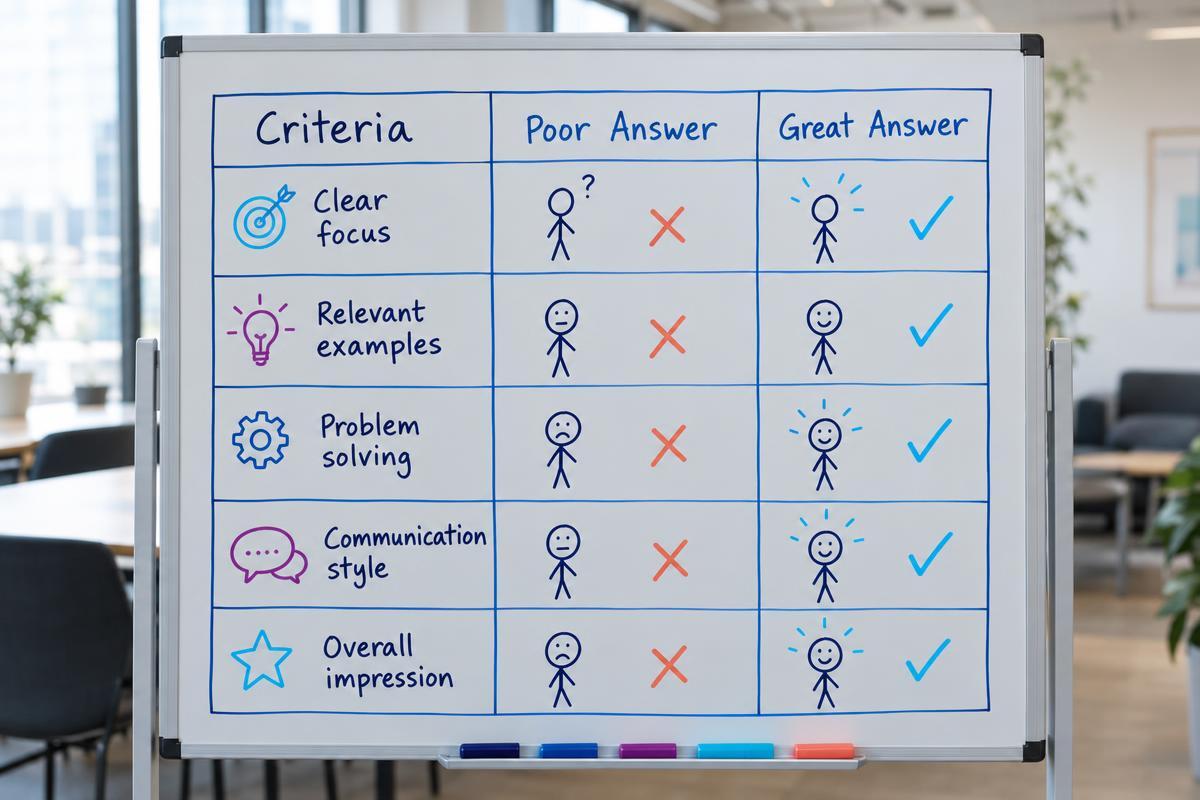
Taking random notes on a legal pad makes it impossible to compare five different candidates fairly. You need a structured scoring rubric to turn subjective conversations into clean, objective data.
Create a simple matrix for your screening calls. For every core question, define what a poor, acceptable, and excellent answer looks like. Score each answer on a scale of one to five. This forces hiring managers to justify their decisions based on evidence rather than a vague feeling of rapport.
Evidence shows that this approach works. 80% of positions in one HR technology case study used structured interview guides, and hiring-team members scored 80% of the candidate skills assessed, as noted by the National Library of Medicine. When you use data to drive your screening process, you reduce bias and hire better people.
| Screening Criteria | Score 1 (Poor) | Score 3 (Acceptable) | Score 5 (Excellent) |
|---|---|---|---|
| Career Motivation | Complains about current job, lacks clear career goals. | Wants career progression, expresses general interest in the industry. | Connects specific company goals to their own proven skill development. |
| Communication | Rambles, interrupts, fails to answer the actual question asked. | Answers clearly but requires occasional prompting for detail. | Concise, structured answers with relevant, specific examples. |
| Logistical Fit | Salary expectations exceed budget; requires immediate unavailable leave. | Salary matches budget; standard notice period required. | Salary matches budget; highly flexible start date; ready to move quickly. |
Using a framework like this helps you build interview scoring rubrics that protect your organisation. If an executive questions why a candidate was rejected, you have a clear, documented set of scores to point to. If you are evaluating technology to manage this, choosing an applicant tracking system that supports structured scorecards natively will save your HR team hours of administrative work.
The candidate experience does not end when you hang up the phone. How you handle the next 48 hours determines whether your best candidates stay in the pipeline or accept offers from your competitors.
Silence is the enemy of recruitment. 38% of candidates say they were ghosted by an employer in the past year, and most assume they have been ghosted after two weeks without communication, based on data from Criteria Corp. You cannot afford to let high-quality candidates sit in the dark while you organise internal calendars.
Set a strict service level agreement for your hiring managers. Every candidate who completes a phone screen must receive a definitive yes or no within two business days. If a candidate passes the screen, send them a formal interview invitation immediately. If they fail, send a polite, professional rejection email. Leaving candidates waiting damages your employer brand and ensures that top performers will ignore your future job advertisements.
Compono Hire is an ATS that gives you the tools to screen candidates objectively and efficiently. You can assess motivation and culture fit up front, generate science-backed shortlists, and build structured interview guides that help your hiring managers make defensible decisions.
A standard phone screen should take exactly 15 to 20 minutes. This provides enough time to verify logistics, test basic communication skills, and check primary qualifications without eating into the deeper time required for a full behavioural interview.
In most mid-market organisations, a recruiter or talent acquisition specialist conducts the initial phone screen. This ensures a consistent standard across the business and protects hiring managers' time, allowing them to focus only on candidates who have passed the baseline logistical and cultural checks.
A phone screen is a rapid filtering mechanism designed to eliminate candidates who do not meet basic logistical or technical requirements. A formal interview is a deeper, structured evaluation of a candidate's past behaviour, situational judgment, and comprehensive fit for the role and the team.
Yes, many modern hiring teams use AI voice agents or automated asynchronous screening tools to handle initial logistical questions. While AI can efficiently process high volumes of candidates and eliminate scheduling bottlenecks, human oversight remains critical for evaluating nuanced cultural alignment and complex motivations.
If a candidate is hesitant, offer them the approved salary band for the role and ask if they are comfortable proceeding on that basis. If they flatly refuse to discuss compensation or acknowledge the band, it is often a sign of misaligned expectations, and you should consider ending the process to save both parties time.

To run a structured interview that reduces hiring bias and accurately predicts job performance. Discover how to build rubrics and score candidates...

Practical candidate feedback examples and templates for every hiring outcome. Learn how to reject candidates respectfully and protect your employer...

Compare the best NDIS recruitment software in 2026. Learn how to automate worker screening, match candidates to participants, and hire better care...