

 Mathan Allington
Feedback from an interview examples for every candidate
 Mathan Allington
Copy-ready interview feedback examples for rejections, positive outcomes and second rounds, plus a simple structure for writing fair candidate...

The best second interview questions for employers move past a candidate's basic qualifications to reveal how they solve problems, collaborate with your team, and align with your workplace culture.
Last reviewed November 2026
Key takeaways
- The first interview verifies basic skills, while the second interview tests behavioural alignment and practical application.
- Structured interview scorecards prevent hiring bias and stop interviewers from relying on gut feeling.
- Effective second-round questions focus on past behaviour, conflict resolution, and cross-functional teamwork.
- Employers must avoid repeating first-round questions by assigning specific focus areas to different interview panel members.
The first interview proves a candidate can do the job. The second interview proves how they will do it and how well they fit into your existing team. Without structured second-round questions, hiring managers often end up repeating the first interview and falling back on gut feel.
Gut feel is a terrible predictor of job performance. When employers do not use a clear scoring rubric for the second round, they risk hiring people who look great on paper but clash with the culture in practice. The second interview is your final opportunity to gather evidence on behavioural alignment and technical depth before making an offer.
A poorly run second interview wastes time for both the employer and the candidate. In fact, 52% of job seekers said they had declined a job offer because of a poor candidate experience (CareerPlug, 2024). If your panel shows up unprepared and asks the same questions the recruiter asked last week, candidates notice.
The second round should serve a distinct purpose. This stage often involves executive stakeholders, peer team members, or cross-functional partners. Their goal is not to re-verify the candidate's employment history. Their goal is to understand how the candidate thinks under pressure and whether they share the organisation's core values.
To do this effectively, employers need structured recruitment processes. Structured interviews show a stronger relationship with later job performance than unstructured interviews, with reported validity coefficients of 0.51 versus 0.20 (OneHour Digital, 2024). By asking every candidate the same set of targeted questions, you remove bias and make decisions based on data.
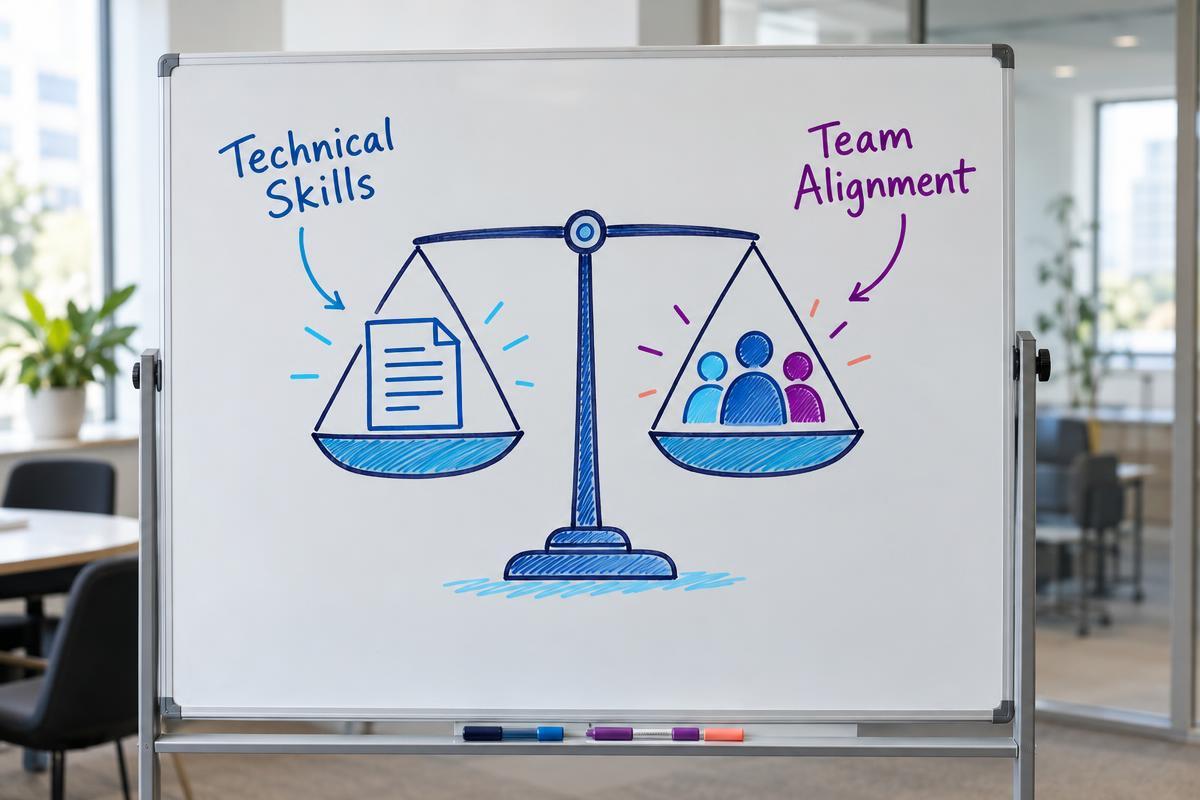
Before launching into new behavioural scenarios, the second interview is the right time to address unresolved items from the first round. The hiring manager should review the notes from the initial screen and identify any gaps in the candidate's answers.
Instead of repeating the question, frame it as a close look. For example, if a candidate briefly mentioned managing a difficult stakeholder in round one, the second-round interviewer should ask for specific details about the framework they used to gain alignment. This tests whether their initial answer was surface-level rehearsal or actual lived experience.
This is also the time to verify practical logistics. Confirming salary expectations, notice periods, and working arrangements during the second interview prevents nasty surprises at the offer stage. Be direct and clear about what the role requires to ensure both parties are fully aligned.
The core of the second interview should be behavioural and situational questions. You are looking for evidence of how they handle conflict, ambiguity, and failure. A simple scorecard helps interviewers rate responses objectively.
| Question category | Second interview question | What to score |
|---|---|---|
| Conflict resolution | Describe a time you disagreed with a colleague on a project direction. How did you resolve it? | Focus on the problem, not the person. Look for empathy and compromise. |
| Adaptability | Tell us about a time a major project changed scope at the last minute. What did you do? | Prioritisation skills and emotional regulation under stress. |
| Failure recovery | Walk me through a time a campaign or project you led failed. What was the post-mortem? | Accountability. Do they blame others or own the mistakes and share the lessons? |
| Cross-functional work | Give an example of when you had to rely on a team outside your authority to hit a deadline. | Influence without authority. Clear communication and relationship building. |
When candidates answer these questions, listen for the "we" versus the "I". High performers understand their individual contribution while acknowledging the team's effort. If a candidate takes sole credit for a massive team project, that is a warning sign.
Culture fit is often misunderstood as hiring people who you want to have a coffee with. Real culture fit means hiring people who naturally align with how your organisation communicates, makes decisions, and handles risk. Incorporating culture fit assessment in the hiring process requires asking questions that test these specific dimensions.
Rather than asking "are you a team player?", ask "what does your ideal Tuesday look like when working on a tight deadline?". Their answer reveals whether they prefer quiet, isolated deep work or highly collaborative, noisy war rooms. Neither is wrong, but one might completely clash with your current team changing.
Many modern teams use technology to baseline this fit before the interview even starts. Currently, 54% of organisations use pre-employment assessments to evaluate applicants’ knowledge, skills, and abilities, and 78% of those organisations say the assessments improve hiring quality (OneHour Digital, 2024).
Compono Hire is an applicant tracking system that matches candidates to your culture using behavioural science, giving you a ranked view of who fits the team before you begin interviewing. For example, The Coffee Club maintains one hiring standard across 400 outlets by using structured tools that rank candidates on fit early in the process.
As the interview gets more conversational in the second round, the risk of non-compliant questions increases. Interviewers trying to build rapport might accidentally ask about family planning, medical history, or carer responsibilities. These questions are not just poor practice; they invite legal risk under the Fair Work Act and federal anti-discrimination laws.
Candidates are acutely aware of these boundaries. Research shows 64% of candidates say asking inappropriate or personal questions is an interviewer’s biggest mistake (Criteria Corp, 2024). Your panel must stick to the agreed script and focus entirely on job-related competencies.
If you are unsure about your script, check what is illegal or risky under Australian employment law. By using a standard set of second interview questions for employers, you ensure every candidate is treated fairly. This focus on process discipline goes a long way toward reducing bias in interviews and protecting your employer brand.
Compono Hire is an applicant tracking system (ATS) that matches candidates to culture, not just keywords. By assessing motivation and culture fit up front with pre-employment assessments, you get science-backed shortlists that you can defend to executives, driving 8%+ lower turnover.
A second interview panel is most effective with two to three people. This usually includes the hiring manager, a cross-functional peer, or a senior leader. Keeping the panel small prevents overwhelming the candidate while still gathering multiple objective viewpoints.
If the role requires specific technical output, the second interview is the standard time to present a case study or practical task. Ensure the task reflects real work they will do in the role, rather than generic puzzles, and keep the time commitment reasonable.
Most second interviews run for 45 to 60 minutes. This allows enough time to dig deeply into behavioural examples, review any practical tasks, and give the candidate time to ask their own detailed questions about the team and company strategy.
Be honest. If a candidate asks a highly specific question about future company strategy or an unfamiliar technical constraint, admit that you do not have the exact answer right now. Promise to find out and follow up via email. Candidates appreciate transparency much more than a guessed response.

Copy-ready interview feedback examples for rejections, positive outcomes and second rounds, plus a simple structure for writing fair candidate...
Interviewer calibration aligns your hiring panel on exactly how to score candidates. Learn how to prevent bias, track drift, and build structured...

Learn proven strategies for crafting great interview questions to enhance recruitment success.
 Compono