

.webp)

 Mathan Allington


Most common work personality by industry 2026
 Compono
Which work personalities show up most in different industries, and what that pattern means when you hire or build a team.

Personality diversity in teams is the strategic alignment of varied behavioural traits, cognitive styles, and work preferences to enhance problem-solving, creativity, and overall organisational performance.
Key takeaways
- Personality diversity in teams prevents groupthink and drives innovation by combining different perspectives and problem-solving approaches.
- Research shows that moderate personality diversity outperforms both extreme homogeneity and extreme diversity on complex, ambiguous tasks.
- Understanding individual work personalities helps leaders tailor their management style, adapt communication, and resolve conflicts constructively.
- Building a diverse team requires assessing candidates across multiple dimensions, including organisation fit, skills, and qualifications, rather than relying on gut feeling.
- Successful collaboration relies on recognising that friction between different personality types, when managed well, is a catalyst for high performance.
It is a common trap in modern recruitment: we tend to hire people who look, think, and act just like us. When building a new department or scaling a business, the temptation to surround ourselves with like-minded individuals is strong. It feels comfortable. It makes initial communication smooth. But this comfort comes at a steep cost.
When everyone in a room shares the same blind spots, critical flaws in strategy go unnoticed. Sameness breeds stagnation, and teams built on homogeneity often struggle to innovate or adapt when faced with unexpected challenges. This is why personality diversity in teams has become a critical focus for HR leaders and business managers in 2026. Rather than seeking out clones, today's most successful organisations are intentionally designing teams that blend visionary thinkers with meticulous detail-orientated executors, and empathetic collaborators with objective analysts.
However, simply throwing different personalities into a room does not automatically generate success. Without the right framework, diverse teams can fracture under the weight of miscommunication and conflicting priorities. To open up the true potential of your workforce, you need to understand the science behind team dynamics, champion the different roles people play, and learn how to capitalise on their differences.
The conversation around workplace diversity has traditionally focused on demographic factors, but cognitive and behavioural diversity are equally crucial for performance. When we look at the data, the impact of personality on team outcomes is undeniable.
In a meta-analysis of 527 teams, higher average Agreeableness was linked to better team performance, and higher average Conscientiousness showed a similar positive relationship. These traits help form a baseline of reliability and cooperation. However, the same analysis revealed that extreme variation in Conscientiousness and Agreeableness within a single team can actually relate negatively to performance. If half your team is highly organised and the other half is entirely chaotic, the friction can derail productivity.
So, does this mean teams should be identical? Not at all. Research summarised in the team personality literature says personality diversity helps most on complex, creative, or ambiguous tasks, where different perspectives improve problem-solving. Routine, repetitive tasks might benefit from a highly uniform group of rule-followers, but modern business problems are rarely routine.
The literature notes a fascinating "diversity-performance curve," where moderate personality diversity can outperform both highly homogeneous and maximally diverse teams on complex tasks. It is about finding the sweet spot, enough similarity to ensure cohesion, but enough difference to spark innovation and rigorous debate.

To effectively manage personality diversity in teams, you first need a language to describe it. At Compono, we use a work personality framework that maps the natural work preferences of individuals into eight distinct types. By identifying these types, managers can balance the work activities that need to be done with their people's natural inclinations.
Here is a breakdown of the eight core personalities you might find in your team:
The Campaigner: Enthusiastic, visionary, and future-focused. Campaigners are the big-picture thinkers who inspire others and sell the dream. They thrive on variety and networking but may overlook the finer details.
The Evaluator: Logical, analytical, and results-driven. Evaluators bring unmatched objectivity to risk assessment. They prefer data-driven decision-making and are not afraid to ask the tough questions, though they can sometimes be perceived as overly critical.
The Coordinator: Organised, structured, and dependable. Coordinators set priorities, implement targets, and enforce deadlines. They are the backbone of a smoothly operating workplace, though they may struggle with spontaneous changes.
The Doer: Practical, hands-on, and efficient. Doers are focused on the present moment and getting tasks over the line. They value clear instructions and stability, making them incredibly reliable executors.
The Auditor: Methodical, cautious, and detail-orientated. Auditors enjoy scrutinising data and enforcing standards. They are essential for quality control, even if their need for excessive deliberation can sometimes slow down fast-paced projects.
The Helper: Empathetic, supportive, and harmony-seeking. Helpers are driven by personal values and excel at building inclusive, collaborative environments. They are the glue that holds teams together, though they may shy away from necessary conflict.
The Advisor: Flexible, open-minded, and collaborative. Advisors are excellent mediators who adapt easily to changing circumstances. They promote harmony and ensure everyone's voice is heard, but they can sometimes over-compromise.
The Pioneer: Imaginative, innovative, and spontaneous. Pioneers are the risk-takers who provide out-of-the-box solutions. They love brainstorming and exploring new approaches, but they may struggle with follow-through and strict deadlines.
When you embrace personality diversity in teams, you equip your organisation with a multi-tool for problem-solving. Imagine a scenario where a business needs to launch a completely new product line in an untested market. This is a highly complex, ambiguous task.
If you assign this task to a team composed entirely of Coordinators and Auditors, they will undoubtedly create a flawless project plan and catch every potential compliance risk. However, they might lack the visionary spark needed to disrupt the market. Conversely, a team of only Pioneers and Campaigners will generate a hundred brilliant ideas and hype up the market, but they might fail to deliver the product on time or within budget.
A diverse team capitalises on these differences. The Pioneer dreams up the innovative product. The Campaigner builds the narrative to sell it to stakeholders. The Evaluator analyses the market data to ensure it is viable. The Coordinator builds the project timeline. The Doer executes the daily tasks. The Auditor double-checks the quality. The Helper ensures the team does not burn out during the final push, and the Advisor mediates any disagreements along the way.
This whole-of-business approach ensures that all bases are covered. It transforms individual blind spots into collective strengths, proving that personality diversity in teams is not just an HR buzzword, it is a structural necessity for modern business success.
Of course, putting different personalities together is only half the battle. The real challenge of personality diversity in teams is managing the inevitable friction that arises when opposing work styles collide. A visionary who wants to move fast will naturally frustrate a detail-orientated person who wants to move carefully.
Leaders must learn to facilitate these interactions constructively. For example, consider the dynamic between a Campaigner and an Auditor. The Campaigner is open and fast-paced, while the Auditor is reserved and methodical. To manage this conflict, a leader should help the Campaigner slow down and communicate their ideas step-by-step, while encouraging the Auditor to engage earlier in the discussion and share their detailed feedback proactively.
Similarly, conflict between an Evaluator and a Helper requires careful mediation. The Evaluator is blunt and results-focused, while the Helper seeks harmony and avoids confrontation. A good manager will help the Evaluator acknowledge the emotional aspects of decisions and soften their approach, while equiping the Helper to voice their concerns more assertively.
Effective leaders also know how to adapt their own leadership style to the personalities in the room. A Directive leadership style, providing clear instructions and tight structure, works wonders for Doers and Coordinators who crave clarity. However, applying that same rigid structure to a Pioneer or a Campaigner will stifle their creativity. For them, a Democratic or Non-Directive approach that allows for autonomy and brainstorming is far more effective.
To truly reap the benefits of personality diversity in teams, organisations must move beyond theory and embed these concepts into their daily operations. Here are several best practices for HR leaders and managers to follow:
Assess before you hire:
You cannot manage what you do not measure. Use evidence-based assessments to understand the natural work preferences of your candidates. However, it is vital to remember that personality is just one piece of the puzzle. When using a platform like Compono Hire, candidates are assessed across three critical dimensions: Organisation Fit, Skills, and Qualifications. This ensures you are not just hiring for a personality type, but for whole-of-business capability.
Map your current team:
Before adding a new member to a team, map the existing personalities. Are you heavy on big-picture thinkers but lacking in practical executors? Identify the gaps and hire intentionally to balance the scales.
Create psychological safety: Diversity of thought only works if people feel safe expressing their dissenting opinions. Encourage Helpers to speak up, and teach Evaluators to deliver their critiques constructively. Celebrate the friction that leads to better ideas.
Tailor your communication: Do not use a one-size-fits-all approach to management. Give your Doers clear, actionable tasks. Give your Pioneers the freedom to explore. Give your Auditors the time they need to review the details. When you speak their language, engagement naturally rises.
Focus on a shared purpose: The easiest way to unite a diverse group of personalities is to align them behind a common goal. When everyone understands how their unique contribution drives the overall strategy, petty conflicts diminish, and collaboration takes over.
The modern workplace is too complex for any single type of thinker to navigate alone. The challenges we face in 2026 require agility, deep analytical rigour, empathetic leadership, and flawless execution. No single individual possesses all these traits in equal measure, which is why we rely on teams.
By intentionally curating personality diversity in teams, you are building a resilient, adaptable workforce. You are ensuring that every problem is viewed from multiple angles, that risks are mitigated before they become crises, and that innovation is grounded in practical reality. It requires effort, patience, and a willingness to manage the occasional clash of styles, but the payoff, a high-performing, deeply engaged team, is well worth the investment.
Key insights
- Homogeneous teams are prone to groupthink and blind spots; diversity of thought is essential for navigating complex business challenges.
- The most effective teams strike a balance, combining moderate personality diversity with a shared sense of purpose to maximise performance.
- Understanding the eight distinct work personalities allows leaders to assign tasks that align with their employees' natural strengths and motivations.
- Managing the friction between contrasting personalities, such as a visionary Pioneer and a structured Coordinator, is a core competency for modern managers.
- Building diverse teams requires whole-of-business assessment tools that evaluate candidates on organisation fit, skills, and qualifications, rather than relying on intuition.
Four questions, about two minutes, one of eight work personality types. Free.
Related reading
It refers to the intentional blending of different behavioural traits, cognitive styles, and work preferences within a single group. Instead of having a team where everyone thinks and acts the same way, a personality-diverse team includes a mix of analytical thinkers, creative visionaries, empathetic collaborators, and practical executors.
Hiring people who mirror your own personality creates a homogeneous team with shared blind spots. While it might feel comfortable initially, it often leads to groupthink, a lack of innovation, and an inability to view complex problems from multiple perspectives.
It can. Research suggests a "diversity-performance curve" where moderate diversity is optimal. If a team is too diverse, especially in foundational traits like conscientiousness, the extreme differences in work styles can lead to constant friction and a breakdown in communication.
The key is to understand the underlying motivations of each type. For example, if a detail-orientated person is clashing with a fast-paced visionary, the manager should help the visionary break their ideas into structured steps, while giving the detail-orientated person the time they need to review the specifics without feeling rushed.
Yes, by using structured, evidence-based assessments. However, it is important to assess candidates holistically. Modern platforms evaluate candidates across organisation fit, skills, and qualifications, ensuring you build a team that is not only diverse in thought but also highly capable of executing the role.
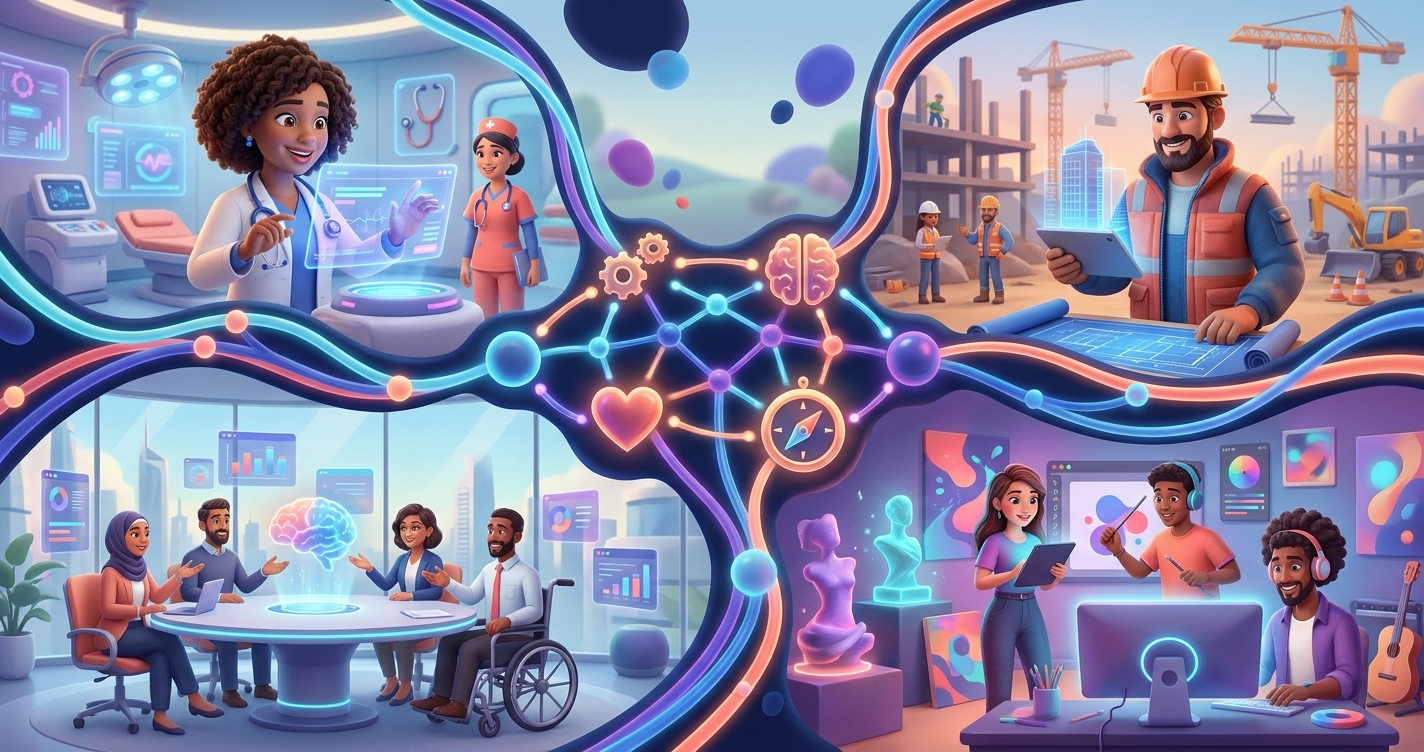
Which work personalities show up most in different industries, and what that pattern means when you hire or build a team.

How the Big Five personality traits show up at work, what a workplace Big Five assessment measures, and how leaders use profiles to hire and build...

Work personality data by job function, and how matching behavioural traits to role requirements drives team performance and retention.
 Mathan Allington