

.webp)

 Compono


Why Personality Diversity in Teams is Your Secret Weapon in 2026
 Mathan Allington
How personality diversity in teams drives new thinking and performance, and how to manage different work personalities in one group.
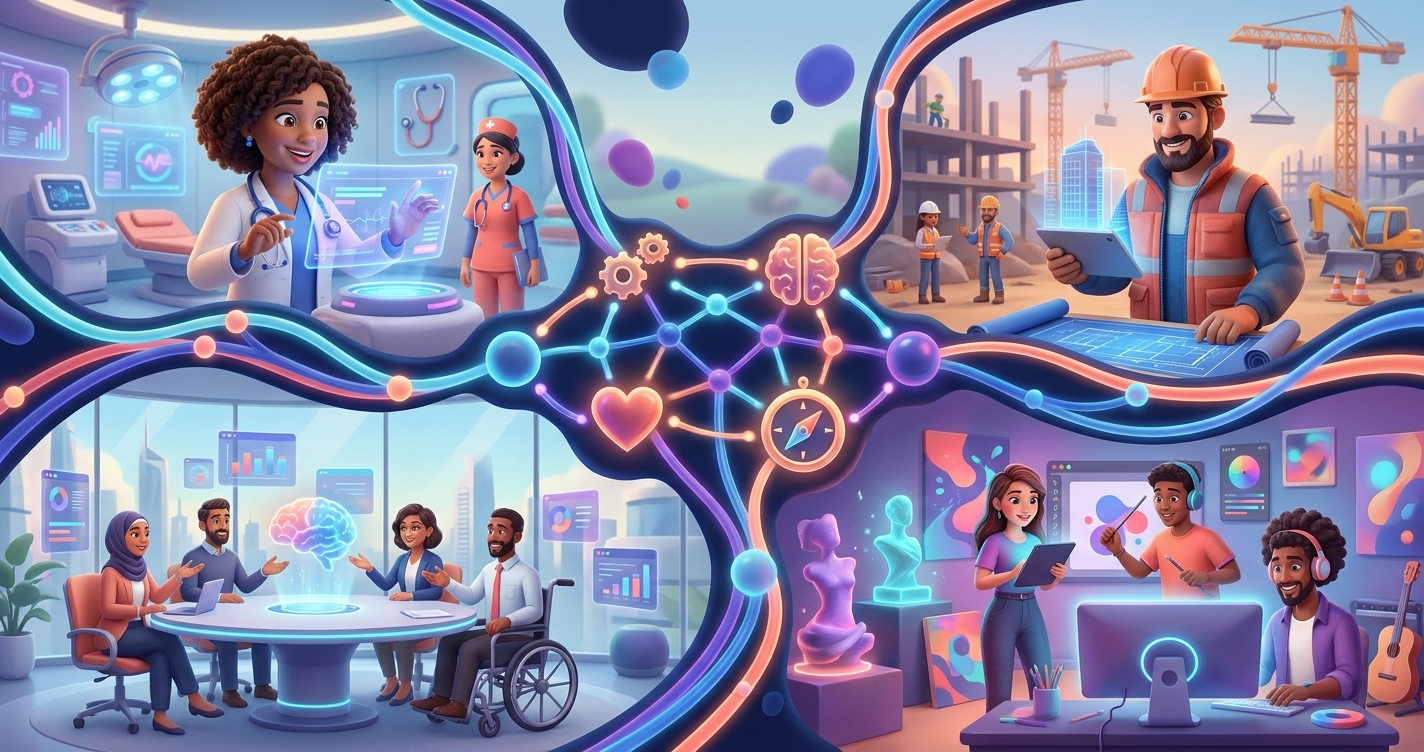
The most common work personality by industry depends heavily on the core demands of the sector, with analytical "Auditors" dominating finance, empathetic "Helpers" leading healthcare, and practical "Doers" driving construction and logistics.
Every sector naturally attracts people whose behavioural preferences align with the daily realities of the job. Understanding these patterns helps leaders identify why certain teams thrive, why friction occurs, and how to balance natural tendencies with the diverse thinking required for complex problem-solving.
Key takeaways
- Conscientiousness is the most universally valuable trait across all sectors, but specific industries demand distinct work personalities to function effectively.
- Finance and accounting rely heavily on methodical, detail-oriented professionals who enforce standards and minimise risk.
- Healthcare and social assistance attract empathetic, supportive individuals who prioritise team harmony and patient care.
- Creative and technology sectors require imaginative, big-picture thinkers who challenge established methods and drive innovation.
- While specific personalities dominate certain industries, complex problems require a diversity of thinking styles to avoid collective blind spots.
Skills dictate what a candidate can do on paper. Natural work preferences dictate how they will actually behave when they sit at their desk on a Tuesday morning. When you look closely at different sectors, clear patterns emerge in the types of people who naturally gravitate toward them. These patterns are not accidental. They are a direct response to what the environment rewards and requires on a daily basis.
Understanding the most common work personality by industry gives business leaders a distinct advantage. It highlights the natural strengths of your workforce. It also reveals the likely blind spots your organisation faces when everyone thinks the same way.
Before examining specific industry preferences, we need to acknowledge the baseline traits that predict performance across the board. Some behaviours are universally valuable regardless of whether you operate a hospital, a construction firm, or a marketing agency.
General reliability, organisation, and a focus on task completion form the foundation of professional success. Conscientiousness correlates with job success at 0.22–0.30 on the predictive validity scale, outperforming any other single personality trait across virtually all roles and industries. People who show up, meet deadlines, and follow through on commitments are valuable everywhere.
These baseline traits also influence how individuals feel about their own career progression. Research indicates that neuroticism, conscientiousness, and extraversion are the strongest predictors of career satisfaction among the Big Five traits. However, while conscientiousness gets you in the door, the specific way you prefer to communicate, solve problems, and collaborate will dictate which industry feels like home.

At Compono, we map natural work preferences using eight distinct profiles. A work personality represents the specific types of work activities a person is most motivated to engage in, and conversely, what they are likely to avoid or forget to do.
These eight profiles, the Doer, the Auditor, the Helper, the Advisor, the Pioneer, the Campaigner, the Evaluator, and the Coordinator, provide a practical framework for understanding industry concentrations. By looking at the core demands of major sectors, we can see exactly which personalities naturally rise to the top.
The healthcare and social assistance sectors are built on human connection, care, and sustainable support systems. These environments require high emotional intelligence, patience, and a deep commitment to the well-being of others.
The most common work personality here is The Helper. Helpers are empathetic, supportive, and highly perceptive of other people's feelings. They are driven by personal values and find immense satisfaction in roles that allow them to actively contribute to team and patient well-being.
In a hospital ward or a social work setting, the Helper's natural inclination to promote harmony and support others quietly without seeking praise is invaluable. They excel at understanding and managing team emotions, which improves cohesion in highly stressful environments.
The challenge for Helpers in healthcare is their tendency to avoid necessary confrontation. They might prioritise relationships over task completion or struggle to enforce strict boundaries. Under pressure, they can become overly accommodating, which occasionally leads to burnout in a sector that already demands heavy emotional labour.
The financial sector, along with auditing and quality assurance, operates on precision. Mistakes in these industries carry severe consequences, ranging from regulatory fines to catastrophic structural failures. The environment rewards accuracy, compliance, and a methodical approach to risk.
This sector is heavily populated by The Auditor. Auditors are reserved, reflective, and exacting. They prefer fact-based, detail-oriented tasks and enforce standards, procedures, and control mechanisms naturally.
When a financial controller needs to reconcile complex accounts or a compliance officer must review regulatory submissions, the Auditor's patient and persistent nature shines. They find genuine satisfaction in maintaining order and ensuring compliance. They are cautious and risk-averse, which is exactly what you want when managing large sums of money or critical safety data.
The blind spot for Auditors in finance is their resistance to rapid change. They can become so focused on minor details that they miss the broader strategic picture. When an accounting firm needs to adopt new automation technology, Auditors may hesitate to make decisions without exhaustive information, slowing down necessary modernisation.
Industries built on physical output, supply chain movement, and tangible results require practical execution. Construction sites and manufacturing plants do not have the luxury of endless theoretical debate. They need people who focus on the present moment and get things done efficiently.
The dominant personality in these sectors is The Doer. Doers are practical, task-oriented, and highly dependable. They are results-driven powerhouses who communicate directly and straightforwardly.
A site manager or logistics coordinator with a Doer personality thrives on favoured routines and values the certainty of meeting deadlines. They prefer clear, concrete tasks and uphold a strong commitment to quality and accuracy. If a supply chain breaks down, a Doer will focus immediately on the practical steps needed to fix the immediate problem rather than philosophising about the root cause.
Doers can struggle when projects require them to step back and plan long-term strategies. They tend to stick to familiar methods and can become overly rigid when unpredictable situations arise. If a manufacturing process requires a complete innovative overhaul, the Doer may resist the change because it disrupts their established, reliable routine.
The technology and creative sectors are defined by disruption, innovation, and continuous evolution. These industries reward those who can look past current limitations and imagine entirely new ways of working.
In these fields, you will frequently find The Pioneer. Pioneers are imaginative, adaptable, and future-focused. They thrive on creative expression, out-of-the-box thinking, and exploring new possibilities.
This aligns perfectly with industry research. In creative and leadership roles, traits like emotional intelligence, openness to experience, and cognitive flexibility become equally crucial predictors of success compared to conscientiousness. A software architect or a UX designer needs the freedom to experiment. Pioneers provide this energy, keeping the team open to unconventional approaches and brainstorming sessions.
The risk for Pioneers in tech is their aversion to structure. They can get lost in ideas and lose focus on practical implementation. They might avoid committing to a final product design because they want to keep their options open. Under stress, they can become scattered, moving from task to task without completing the necessary documentation or testing.
The commercial side of business relies on persuasion, networking, and enthusiasm. Marketing and sales professionals must attract audiences, build relationships, and sell a vision of the future.
This environment is the natural habitat of The Campaigner. Campaigners are vibrant, energetic, and highly people-oriented. They are big-picture thinkers who love the thrill of the chase and prefer variety over routine.
Whether pitching a new advertising campaign or closing a major enterprise software deal, Campaigners use their verbal persuasion and dynamic approach to influence others. They bring an endless supply of energy to the team and naturally motivate those around them to push for bigger goals.
However, Campaigners can dominate discussions and overshadow quieter voices. They may overcommit to clients because they focus on future possibilities while neglecting the present reality of what the delivery team can actually achieve. They need structured feedback to ensure their enthusiasm translates into measurable results.
Professional services, legal practice, and management consulting require a highly objective, analytical mindset. Professionals in these fields must dissect complex arguments, evaluate risks, and provide logical recommendations devoid of emotional bias.
These industries attract The Evaluator. Evaluators are logical, critical, and realistic. They are objective risk evaluators who thrive on data-backed decisions and strategic problem-solving.
When a corporate attorney reviews a merger agreement or a management consultant diagnoses an organisational failure, the Evaluator's ability to identify risks and set efficient action steps is highly effective. They approach conflict head-on with direct, logical arguments and prioritise resolving issues efficiently.
The blind spot for Evaluators is their tendency to focus heavily on logic at the expense of emotional concerns. They can be perceived as overly critical or blunt. In a consulting engagement, they might deliver a perfectly logical strategy that fails because they dismissed the client's emotional resistance to the change.
Operations and project management exist to bring order to chaos. These functions require individuals who can map out workflows, enforce deadlines, and ensure that multiple moving parts align perfectly to deliver a final outcome.
The most common personality here is The Coordinator. Coordinators are organised, prepared, and dependable. They set priorities, implement targets, and revel in the creation of procedures and systems.
A project manager with a Coordinator profile keeps the team focused on set goals. They are rational, decisive, and value efficiency above all else. When a complex project threatens to derail, the Coordinator provides the structural backbone necessary to get things back on track.
Coordinators can struggle with flexibility. They may stick too rigidly to rules and processes, enforcing structure even when a situation requires a more spontaneous approach. If plans change without consultation, they can become frustrated and overly controlling.
Sectors focused on human development, organisational culture, and learning require immense adaptability. Professionals in these spaces must mediate conflict, facilitate growth, and guide others through complex interpersonal challenges.
These fields naturally draw The Advisor. Advisors are flexible, empathetic, and open-minded. They promote harmony with understanding and ensure that everyone's voice is heard during collaborative processes.
An HR business partner or a corporate trainer uses their Advisor traits to adapt easily to different situations. They prefer to guide rather than control, offering support and building an inclusive environment where employees feel safe to share their ideas.
The challenge for Advisors is their tendency to over-compromise. They may spend too much time exploring options to maintain harmony, which delays critical decisions. In situations requiring urgent action, their desire to accommodate everyone can hinder progress.
While specific personalities naturally dominate certain sectors, filling a company entirely with one personality type creates dangerous blind spots. A finance team composed entirely of Auditors will have perfect compliance but zero innovation. A marketing team made exclusively of Campaigners will generate brilliant ideas but fail to execute them.
Complex business environments demand diversity of thought. A 2024 meta-analysis of over 600 studies found that personality diversity has a stronger positive impact on performance in complex or creativity-driven tasks than in routine tasks.
When you mix analytical Evaluators with imaginative Pioneers, you get grounded innovation. When you pair practical Doers with structured Coordinators, you get flawless execution. Uniform teams only make better decisions in rare, stable, and predictable environments, whereas diverse teams thrive in complex settings. Leaders must intentionally hire for personality gaps, not just cultural similarities, to build resilient teams.
The rise of remote and hybrid work has subtly altered which personality traits predict success across all industries. Working away from a traditional office removes external structure, requiring employees to self-manage their time and emotional state.
For remote work, conscientiousness and emotional stability are the primary soft skills explaining heterogeneity in individual employee productivity. An employee who lacks the discipline to self-regulate will struggle in a remote environment, regardless of their specific industry expertise.
Interestingly, the desire to work remotely is also tied to specific traits. Both conscientiousness and openness to experience are positively associated with the willingness to work from home in the post-pandemic period. This means leaders managing distributed teams must pay careful attention to how different personalities handle isolation, communication, and self-directed work.
You cannot balance a team if you do not know who is on it. Forward-thinking leaders use behavioural insights to map their current workforce and identify missing elements before they hire.
Using a system like Compono Hire allows leaders to assess candidates for their natural work preferences during the recruitment phase. Instead of guessing how someone will behave based on an interview, you can select the work personality your team actually needs to balance existing gaps, automatically scoring candidates based on their alignment with the role's true demands.
Key insights
- Industry demands naturally attract specific work personalities, creating predictable behavioural patterns within sectors like finance, healthcare, and technology.
- Understanding these default profiles allows leaders to predict how teams will handle stress, communicate, and resolve conflict.
- Relying exclusively on the dominant personality type of your industry creates severe organisational blind spots and limits innovation.
- High-performing teams intentionally mix practical execution, analytical thinking, and creative exploration to solve complex problems.
- Remote work environments require a higher baseline of emotional stability and conscientiousness, regardless of the employee's specific industry role.
Four questions, about two minutes, one of eight work personality types. Free.
Related reading
Conscientiousness is the most common and universally valuable trait across all workplaces. It indicates a person's reliability, organisation, and ability to follow through on tasks, which correlates strongly with job success in almost every industry.
Industries reward specific behaviours on a daily basis. Finance rewards meticulous attention to detail, so it attracts analytical people. Healthcare rewards empathy and care, so it attracts supportive people. People naturally gravitate toward environments that validate and use their default communication and working styles.
Yes. People are highly adaptable and can learn to operate effectively in environments that contrast with their natural preferences. However, working against your default personality requires more energy and can lead to faster burnout if you do not have strategies to manage the cognitive load.
Personality diversity ensures a team looks at a problem from multiple angles. While uniform teams might agree quickly, they often share the same blind spots. Diverse teams combine practical execution, creative thinking, and analytical risk assessment, which leads to better outcomes in complex situations.
Managers can use validated psychometric assessments designed specifically for the workplace. These tools map individual preferences against core work activities, giving leaders a clear visual representation of their team's strengths and identifying where they might be lacking certain behavioural approaches.

How personality diversity in teams drives new thinking and performance, and how to manage different work personalities in one group.

How predicting team dynamics helps leaders build cohesive teams using work personality and behavioural fit.

Experience on a CV tells you little about fit. How work personality and role alignment show who is likely to do well in a specific role.
 Compono