


 Mathan Allington


Is it illegal to ask if a candidate is pregnant
 Mathan Allington
Learn why asking about pregnancy in job interviews violates Australian law, how candidates can respond, and what employers should ask instead.
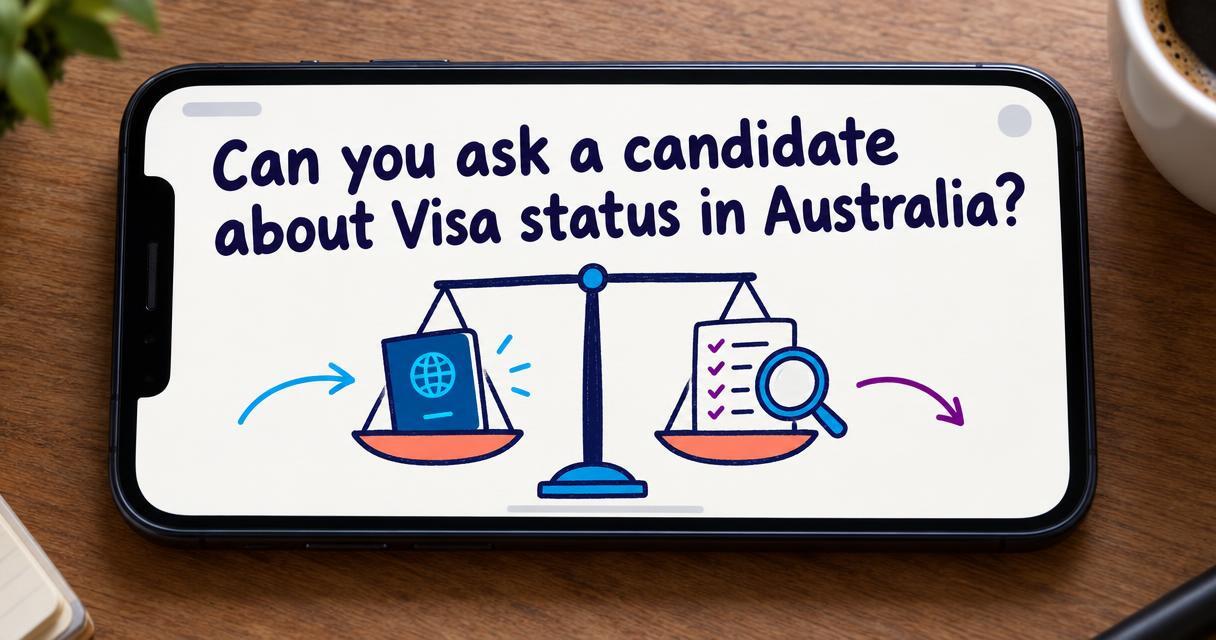
Yes, you can ask a candidate about their visa status in Australia, but you must ask if they have the legal right to work rather than asking about their specific nationality or citizenship.
Last reviewed November 2026
Key takeaways
- Asking candidates where they are from or what passport they hold breaches Australian anti-discrimination laws.
- Employers carry a strict legal duty to confirm every new hire has valid work rights before their first day.
- The compliant approach is to ask all applicants if they hold the right to work in Australia for the role's required hours.
- You can use the government VEVO system to verify a candidate's specific visa conditions with their written permission.
Hiring teams face a delicate balancing act when assessing candidates. Under the Migration Act, your business faces severe financial penalties if you hire someone without valid work rights. Under the Fair Work Act, you face equally severe penalties if you discriminate against someone based on where they were born.
This creates a grey area during interviews. Managers need to confirm a person can legally do the job, but asking the wrong question in the wrong way creates legal risk. When you understand how to phrase these questions correctly, you protect the business from process risk while treating every candidate fairly.
The tension in recruitment comes from two different sets of laws. On one side, Australian employers must check that a prospective employee is either an Australian citizen or holds a valid visa with work permission. You cannot take a candidate's word for it, and you cannot skip the check just because a candidate has a local accent.
On the other side, Australian workplace guidance says discrimination against job applicants during recruitment is unlawful, including discrimination based on national extraction, such as place of birth or ancestry. You cannot single out candidates who look or sound foreign and demand to see their visas while letting other candidates pass without checks.
Many untrained managers stumble here. They ask conversational questions about a candidate's background that accidentally breach the Fair Work Act. To see where the line is drawn on other risky topics, you can use our free checker for interview questions you can't ask in Australia.
The golden rule for visa status is to focus entirely on the legal right to work. A recruitment agency or employer cannot ask an applicant where they were born, what their nationality is, or what specific visa they hold as an opening question. You must ask a standard, operational question that applies to every single person who applies for the role.
Here is how the phrasing changes in practice:
| Unlawful or risky phrasing | Compliant phrasing |
|---|---|
| "Are you an Australian citizen?" | "Do you have the legal right to work in Australia?" |
| "What visa are you on?" | "Are there any conditions on your right to work?" |
| "Where were you born?" | "Can you provide proof of your right to work in Australia?" |
The law expects you to gather facts about employment eligibility, not personal background. A safer recruitment question is whether every candidate has the right to work in Australia for the hours and duration required by the role, followed by a VEVO check where necessary. When you standardise this question across all candidates, you eliminate the risk of bias.
Once a candidate confirms they have the right to work, you need to verify it. Only Australian citizens, permanent residents, and New Zealand citizens holding a Special Category visa have no work conditions attached to their status in Australia. Everyone else has a visa that might carry restrictions on how many hours they can work or what jobs they can do.
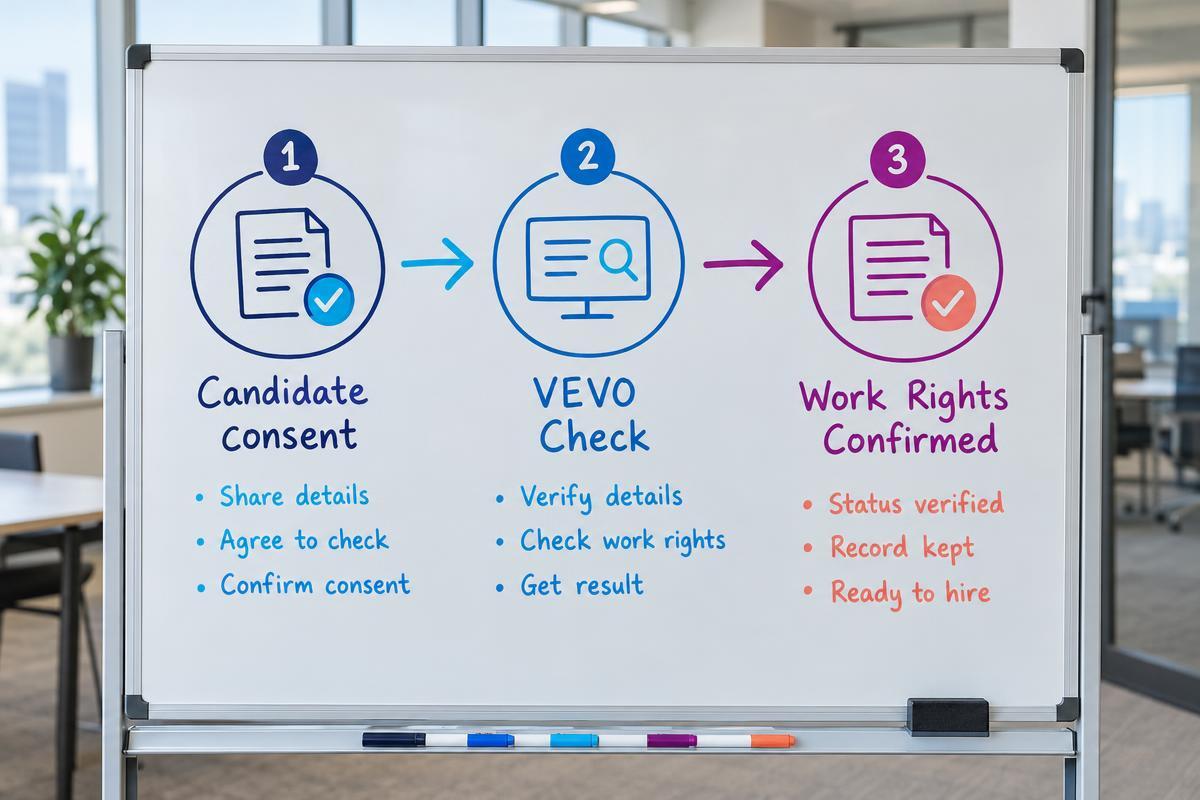
To check these conditions, the Department of Home Affairs’ VEVO system lets organisations check a visa holder’s current work rights, including whether work is unlimited, restricted, or prohibited. The Visa Entitlement Verification Online (VEVO) system is free and provides an instant result.
There is a catch regarding privacy. Employers can check a candidate’s work rights through VEVO only with the visa holder’s permission. You must ask the candidate for their passport details, their ImmiCard, or their grant number, and secure their written consent before running the search. Many businesses build this consent step directly into their applicant tracking system in Australia during the final offer stage.
If a candidate holds a temporary visa, you need to understand their specific work conditions before they start. The two most common restricted visas in the Australian workforce are student visas (subclass 500) and working holiday visas (subclasses 417 and 462).
Student visas typically restrict the holder to 48 hours of work per fortnight while their course is in session. Working holiday visas usually restrict the holder to working for a single employer for no more than six months. If you roster a student for 50 hours in a fortnight, or keep a working holiday maker on staff for seven months, you breach the Migration Act.
You also need to treat these employees correctly under Australian employment law. According to the government, migrant workers including working holiday makers and international students have the same workplace rights and entitlements as other workers in Australia. This means they receive the same minimum wage, penalty rates, and leave entitlements as citizens. National workplace laws protect workers regardless of immigration status, meaning recruitment and employment protections apply to migrant workers and visa holders.
The easiest way to stay out of trouble is to remove the human element from the initial right-to-work check. Do not leave it up to hiring managers to remember what they can and cannot ask during an interview. Instead, build a mandatory right-to-work question into your initial application form.
When every single applicant must answer "Do you have the legal right to work in Australia?" by selecting "Yes, citizen/permanent resident", "Yes, temporary visa", or "No", you collect the data you need without breaching anti-discrimination rules. You can then use your good interview questions to assess their actual capability and culture fit, knowing the compliance check is already logged.
Compono Hire is an applicant tracking system (ATS) that matches candidates to your culture while keeping your screening process compliant. You can set standard right-to-work questions as mandatory steps for every job posting. This manages your process risk perfectly, leaving you free to focus on the people insight risk: understanding who the candidate is, what drives them, and whether they will thrive in your team.
Our applicant tracking system helps you build structured, defensible interview processes that manage both process risk and people insight risk.
No, you should not ask for proof of citizenship specifically, as this can be viewed as discriminatory. Instead, ask for proof of the right to work in Australia. A candidate can choose to prove this by showing an Australian passport, an Australian birth certificate, or a foreign passport with a valid visa.
You need to check the right-to-work status of every candidate you intend to hire. If you only check the status of people who look or sound foreign, you breach anti-discrimination laws. The safest approach is to make right-to-work verification a standard condition of employment for everyone.
If you hire an illegal worker, or someone working in breach of their visa conditions, your business faces significant financial penalties under the Migration Act. Directors and officers of the company can also face personal liability. This is why conducting a VEVO check with the candidate's permission is a necessary step in the hiring process.
The best time to ask a broad "Do you have the right to work in Australia?" question is during the initial application stage. The best time to conduct a detailed VEVO check is at the final stages of recruitment, usually right before making a formal job offer, to confirm the details are correct.
Learn why asking about pregnancy in job interviews violates Australian law, how candidates can respond, and what employers should ask instead.

Asking about age in a job interview carries legal risks under Australian law. Discover the exceptions, compliance rules, and what to ask candidates.
Learn what Australian employers can legally ask about disability during a job interview, the difference between general inquiries and inherent.