1 min read
Your Culture is Talking. Are You Listening?
How would you describe your company’s culture? Collaborative, innovative, fast-paced? Now, how confident are you that your job ads and website...
Voice or text coaching built on psychology. For you, your team, or the candidates you place.
A coach that actually gets you.
Get 10 minutes free, then $15 a month. Cancel anytime.
Get Started ≫4 min read
Mathan Allington
Updated on July 7, 2026
Workplace culture is the set of shared values, assumptions and behaviours that determine how work actually gets done in your organisation. It is built from measurable components (trust, communication, shared purpose, development and flexibility), which means it can be measured, managed and improved like any other driver of business performance.
Last reviewed July 2026
Also called organisational or corporate culture, workplace culture is your company's personality. Some of it is visible: communication styles, meeting habits, how decisions get announced and who gets recognised. The deeper layer is invisible: the unwritten rules and shared assumptions about what success looks like. That invisible layer usually shapes employee experience more than anything in the handbook.
Culture reaches from hiring decisions through to how performance gets reviewed and who stays. It determines whether people feel respected and valued or are counting the minutes until they can leave, and the distance between those two states shows up directly in business results.
Companies with healthy cultures have been found to grow revenue at more than twice the rate of those with weak ones, and replacing a single employee can cost anywhere from 50% to 200% of their annual salary. Retention alone justifies the investment: employees stay markedly longer where they feel culturally aligned, and many job seekers will decline an offer from a company whose culture looks poor, even at a higher salary.
Culture compounds quietly. Engaged people in positive cultures are more productive, contribute more ideas and give customers a better experience. A weak culture undermines good strategy just as quietly, one small interaction at a time.
People do their best thinking where they can admit mistakes, ask questions, challenge decisions and propose alternatives without fear of blame. Leaders set this tone by acknowledging their own errors and responding constructively to criticism. Conflict handled as problem-solving rather than fault-finding strengthens relationships instead of eroding them.
Transparency and genuine two-way feedback keep problems from festering. Line of sight matters just as much: when people understand how their role connects to the organisation's mission, motivation stops depending on perks. Purpose is what holds teams together when conditions get hard.
Mentoring, formal training, stretch projects and honest career conversations tell employees you are invested in their future. When someone can see a path forward inside your organisation, they have far less reason to look outside it.
Cultures that respect life outside work get repaid in focus during it. Flexible scheduling and genuine boundaries around after-hours contact prevent the slow burnout that drains performance long before anyone resigns, and real support for mental health tells people the organisation cares about more than their output.
Organisational psychology research describes four recurring culture types, each suited to different conditions.
Most successful organisations blend elements. A customer-focused business might pair market-style results discipline with clan-style collaboration. The point is choosing the elements that support your strategy, rather than copying another company's culture.
Leadership behaviour cascades. When leaders' daily decisions match the stated values, people believe the values. When toxic behaviour is tolerated, everyone concludes the values are decoration. Swift, fair action when behaviour crosses the line does more for culture than any poster on a wall.
Culture also has to be taught deliberately: during onboarding, in team meetings, and by recognising the people who embody the values. Hiring plays its part too, provided fit is defined as values alignment rather than sameness. Diversity of thought strengthens a culture; cloning weakens it.
You cannot improve what you do not measure. Annual engagement surveys give you a baseline, but single-question pulse checks miss the mechanics underneath: trust, communication effectiveness, adaptability, recognition, inclusion and leadership style all move somewhat independently, and a single score hides which one is slipping.
Harder measures matter too. Track retention among high performers, watch where turnover clusters, and treat falling engagement as the early warning it is. It is also your best signal for predicting employee turnover.
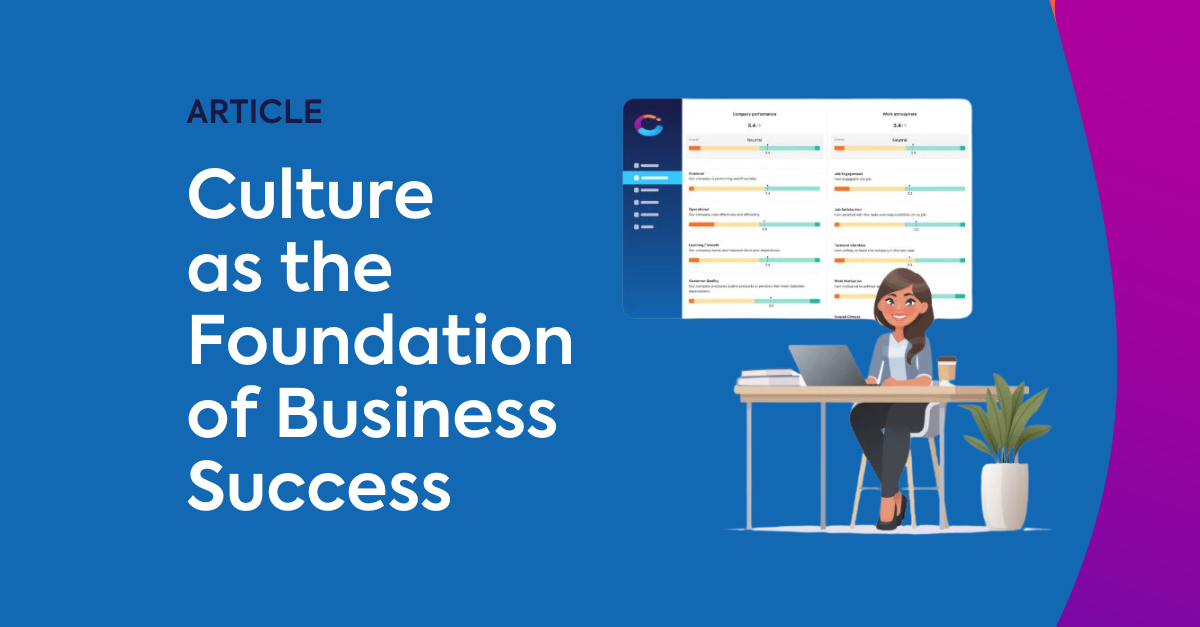
Purpose-built diagnostics go deeper. Compono Engage uses a 12-dimension culture model built by organisational psychologists, measuring the culture you actually have against the one you want, so interventions target root causes rather than symptoms.
Strong culture never happens by accident. It takes intentional design, consistent leadership behaviour, regular measurement and honest correction, and the return (in engagement, retention, productivity and competitive position) is one of the largest available to any leadership team.
Compono Engage maps your culture across 12 dimensions, so you can manage it with data instead of instinct.
Talk to usWorkplace culture is the shared set of values, assumptions and behaviours that shape how work gets done in an organisation. It includes visible habits like communication styles and meeting norms, plus the unwritten rules about what really gets rewarded.
Research describes four recurring types: clan (collaborative and relationship-driven), adhocracy (experimental and entrepreneurial), market (competitive and results-focused) and hierarchy (structured and process-driven). Most organisations blend elements of more than one.
Combine engagement surveys with hard measures like retention among high performers, then go deeper with a validated multi-dimension diagnostic covering areas such as trust, communication, recognition and leadership style. Measuring on a regular cadence matters more than any single snapshot.
There is no fixed timeline. Visible shifts can appear within months when leaders change their daily behaviour, but embedding new norms across an organisation takes sustained effort over a year or more, with regular measurement to confirm the direction of travel.

Compono Hire helps you predict job-fit and team-fit using behavioural science, so you can shortlist with confidence.
Request a demoBuilt for mid-market hiring teams.

Voice-first coaching that adapts to your personality. Get actionable steps you can take this week.
Start freeBuilt by Compono. Not therapy — practical behaviour change.
1 min read
How would you describe your company’s culture? Collaborative, innovative, fast-paced? Now, how confident are you that your job ads and website...
1 min read
Innovation and collaboration are linked because innovation is almost never a solo act. New ideas come from people with different perspectives working...
1 min read
As your organisation grows, hiring the right people becomes one of the most critical factors for success. Yet, many businesses struggle with the...