.webp)

 Rudy Crous

This is Part 1 of 2 of the 'Training Assessments & Competence Frameworks'
Click here for more in the series.
Most organisations invest heavily in training. They build courses, assign learning modules, run workshops, assess people, and report on completion. On the surface, this looks like a structured approach to capability development.
But in many cases, the system is weaker than it appears.
Most training and assessment models do not properly connect three critical things: the competence framework, the learning content, and the assessment evidence. They may record that a person completed a course. They may show that someone passed a quiz. They may even issue a certificate.
But they often cannot prove that the learning covered the right competencies, that the assessment measured those competencies properly, or that the final result is valid and reliable.
That is a serious problem.
A competence framework defines what a person needs to know, do, and demonstrate in a role. Learning content is supposed to build that capability. Assessments are supposed to provide evidence that the capability has been achieved.
When these three elements are disconnected, the organisation is relying on assumption rather than evidence.
A learner may complete training, but the training may not cover the full competence framework. A learner may pass an assessment, but the assessment may only test recall rather than real capability. A manager may receive a result, but have little confidence that the result reflects true readiness for the role.
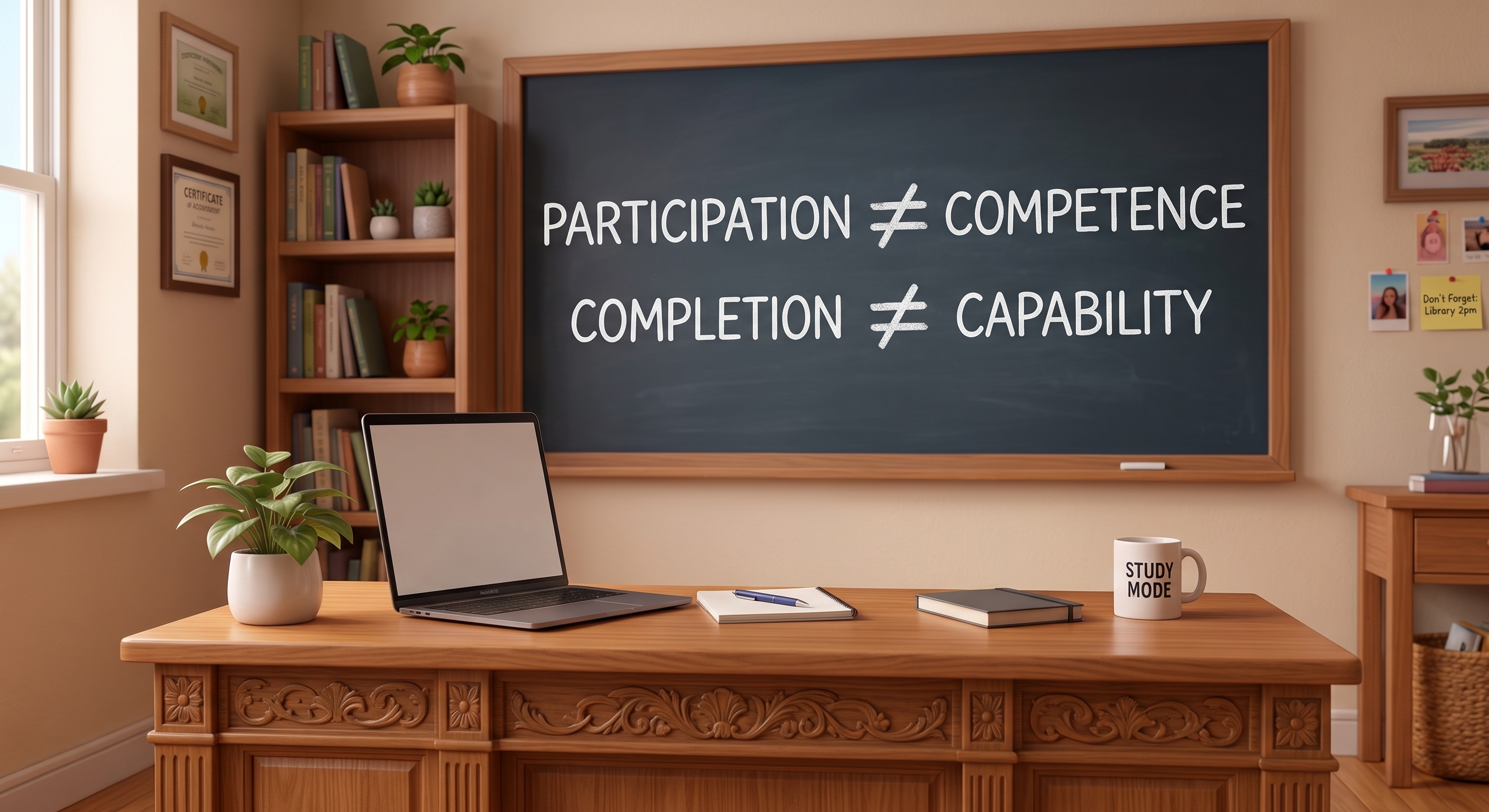
This is where many learning and compliance systems fall short. They measure participation, not competence. They track completion, not capability. They report outcomes, but cannot always defend how those outcomes were reached.
Tracking assessments against learning and competence frameworks solves this problem.
It creates a clear line of sight from the required capability, to the content delivered, to the assessment evidence captured. This allows organisations to answer the questions that matter:
- Does the learning content cover the required competencies?
- Does the assessment actually measure what matters?
- Is the learner being assessed against the right role, level, or standard?
- Can the result be trusted if challenged, audited, or used to make a decision?
This is not just an administrative issue. It is a validity issue.
Validity means an assessment measures what it is intended to measure. Reliability means the result can be trusted consistently across people, teams, and contexts. Both depend on strong alignment between the competence framework, the learning pathway, and the assessment method.
For regulated industries, this level of traceability is essential. It supports compliance, audit readiness, and defensible decision-making. For corporate capability development, it helps leaders understand whether people are genuinely ready for the work they are expected to perform.
It also creates a better development experience for individuals. When assessment results are mapped back to specific competencies and learning content, people can see where they are strong and where they need further education, training, or support. Instead of generic learning pathways, they receive targeted development based on actual evidence.
This is the difference between a training system and a capability system.
A training system tells you who completed the course.
A capability system tells you who is competent, where the gaps are, what evidence supports that conclusion, and what needs to happen next.
That is why connecting assessments, learning, and competence frameworks is so important. It moves organisations beyond completion tracking and towards trusted evidence of capability.
People are not just trained. They are assessed properly.
Results are not just recorded. They are defensible.
And organisations are not just compliant. They are confident that their people are genuinely prepared for the work they need to do.
In our next article, we will look at how organisations can take a step back and review their existing training and assessment programs. The aim is not to rebuild everything from scratch, but to check whether the current system is aligned, evidence-based, and capable of producing valid and reliable results.
Rudy Crous is a corporate psychologist and the co-founder and CEO of Compono, a people and culture platform that brings hiring, engagement, learning and credentialling together in one place, adding behavioural science to the processes most HR tools only track.