

.webp)

 Rudy Crous

This is Part 2 of 2 of the 'Training Assessments & Competence Frameworks'
Click here for more in the series.
Many organisations already have training programs, learning pathways, assessments, compliance modules, and certification processes in place.
The challenge is not always a lack of training. In many cases, the challenge is knowing whether the training and assessment system can actually be trusted.
As organisational psychologists, we would encourage organisations to step back and ask a simple question:
Are we measuring real competence, or are we just tracking completion?
That question is important because a person can complete a course without becoming competent. They can pass a quiz without being ready for the role. They can receive a certificate without the organisation having strong evidence that they can apply the required knowledge, skill, judgement, or behaviour in practice.
The good news is that organisations do not always need to start again. Often, the first step is to review what already exists and test whether the learning, assessment, and competence framework are properly connected.
Here is a simple process.
1. Start with the competence framework
Before reviewing the training or assessment, go back to the framework.
Ask:
What must a person know, do, and demonstrate to be considered competent?
This should be clearly defined by role, level, task, or standard. If the competence framework is vague, outdated, or disconnected from the real work, everything built on top of it will be weaker.
A strong framework should describe the actual capability required, not just broad topics or generic learning outcomes.
2. Map the learning content to the framework
Next, review whether the learning actually teaches the required competencies.
For each competency, ask:
- Is this covered in the learning material?
- Is it covered deeply enough?
- Is it practical enough?
- Does the learner get enough opportunity to understand, practise, and apply it?
This step often reveals hidden gaps. Organisations may assume a competency has been covered because it appears in a course title or module heading. But when the content is reviewed properly, the competency may only be mentioned briefly, explained poorly, or not developed to the required level.
3. Map the assessment to the framework
Then review the assessment itself.
For each competency, ask:
- Is this actually being assessed?
- Is the assessment method appropriate?
- Are we testing knowledge, skill, behaviour, judgement, or application?
- Is the assessment strong enough to support the decision we are making?
This is where many systems fall down. The assessment may test memory, while the framework requires applied competence. Or the assessment may cover only part of the role, while the result implies that the person is fully competent.
A multiple-choice quiz may be appropriate for some types of knowledge. But it may not be enough to assess practical judgement, behavioural application, role readiness, or competence in complex workplace situations.
4. Check the connection between learning and assessment
Once the learning and assessment have been mapped to the framework, compare them to each other.
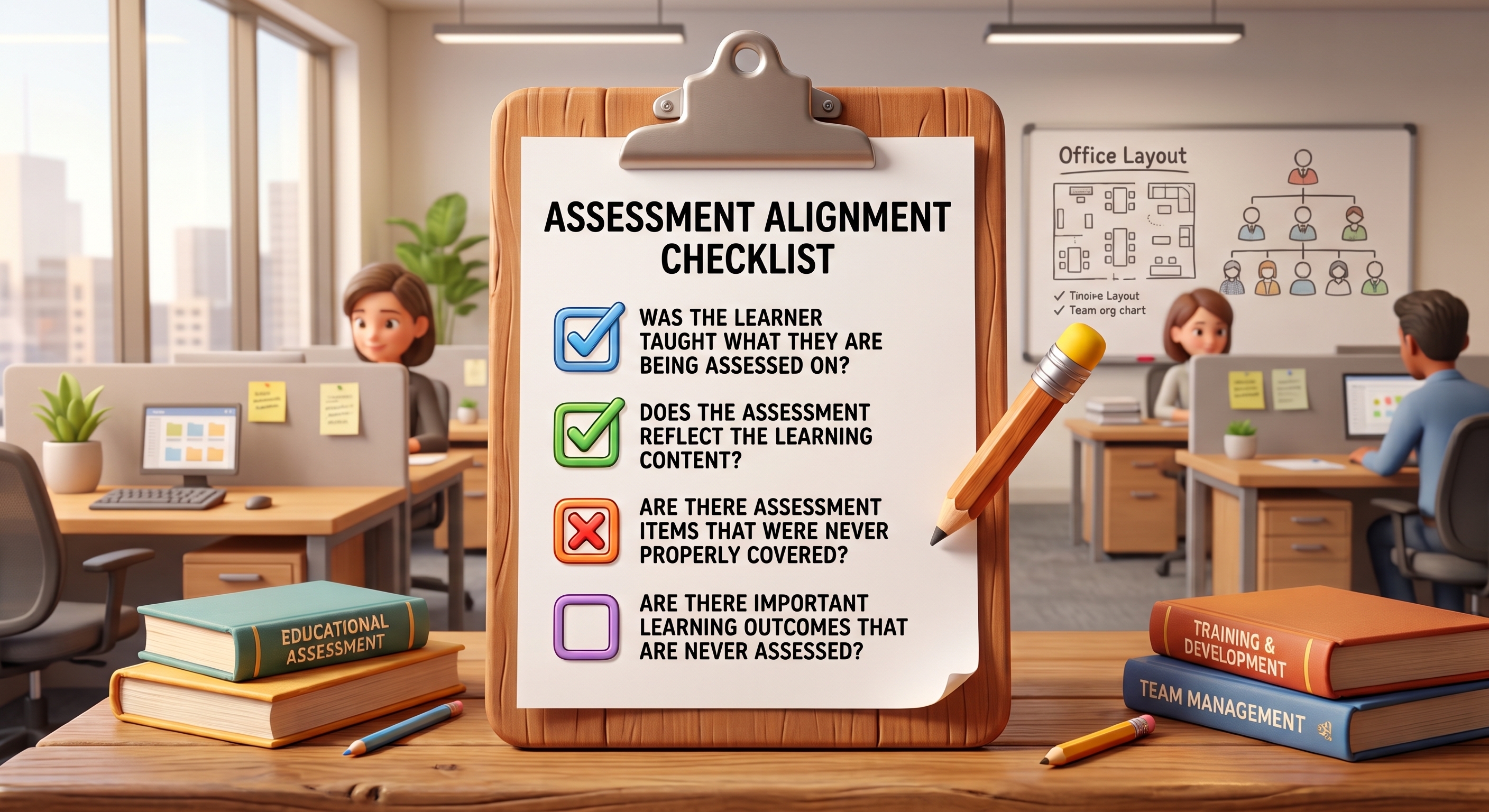
Ask:
- Was the learner taught what they are being assessed on?
- Does the assessment reflect the learning content?
- Are there assessment items that were never properly covered?
- Are there important learning outcomes that are never assessed?
Good practice requires alignment in both directions. The learning should prepare the person for the assessment. The assessment should provide evidence against the competence framework. The competence framework should anchor both.
When this connection is missing, results become harder to trust.
5. Review the quality of the evidence
A pass mark is not enough.
Organisations should examine the evidence behind the result.
Ask:
- What evidence proves this person is competent?
- Is the evidence strong, observable, and relevant?
- Would we be comfortable defending this result in an audit, incident review, performance discussion, or regulatory setting?
This is the shift from “they completed the course” to “we have defensible evidence of competence.”
For high-stakes roles, regulated environments, safety-critical work, or compliance-heavy industries, this distinction matters. Completion data may show that a process occurred. Evidence shows whether the person was genuinely ready.
6. Look for patterns in the results
Assessment data should not just sit in a report.
It should be used to improve the system.
Ask:
- Where are people consistently struggling?
- Which competencies are showing the biggest gaps?
- Are certain teams, roles, or locations less prepared than others?
- Do the results suggest a training issue, an assessment issue, or a workplace performance issue?
This turns assessment into a feedback loop. It helps organisations improve learning content, refine assessments, identify capability gaps, and target further development where it is needed most.
7. Document the system
Finally, document the links between framework, learning, assessment, and evidence.
For each program, organisations should be able to show:
- This is the competency being targeted.
- This is where it is taught.
- This is how it is assessed.
- This is the evidence collected.
- This is how the result is interpreted.
- This is what happens when a gap is identified.
- This documentation creates confidence. It also makes the system easier to improve, audit, scale, and defend.
The key question
The simplest question for any organisation is this:
Can we prove that our training and assessment process genuinely measures competence, or are we just tracking completion?
That question will quickly reveal whether the organisation has a training system, or a true capability system.
A training system tells you who attended, completed, and passed.
A capability system tells you who is competent, where the gaps are, what evidence supports the result, and what needs to happen next.
That is the standard organisations should be working towards.
Rudy Crous is a corporate psychologist and the co-founder and CEO of Compono, a people and culture platform that brings hiring, engagement, learning and credentialling together in one place, adding behavioural science to the processes most HR tools only track.

