

.webp)

 Justin Coutts
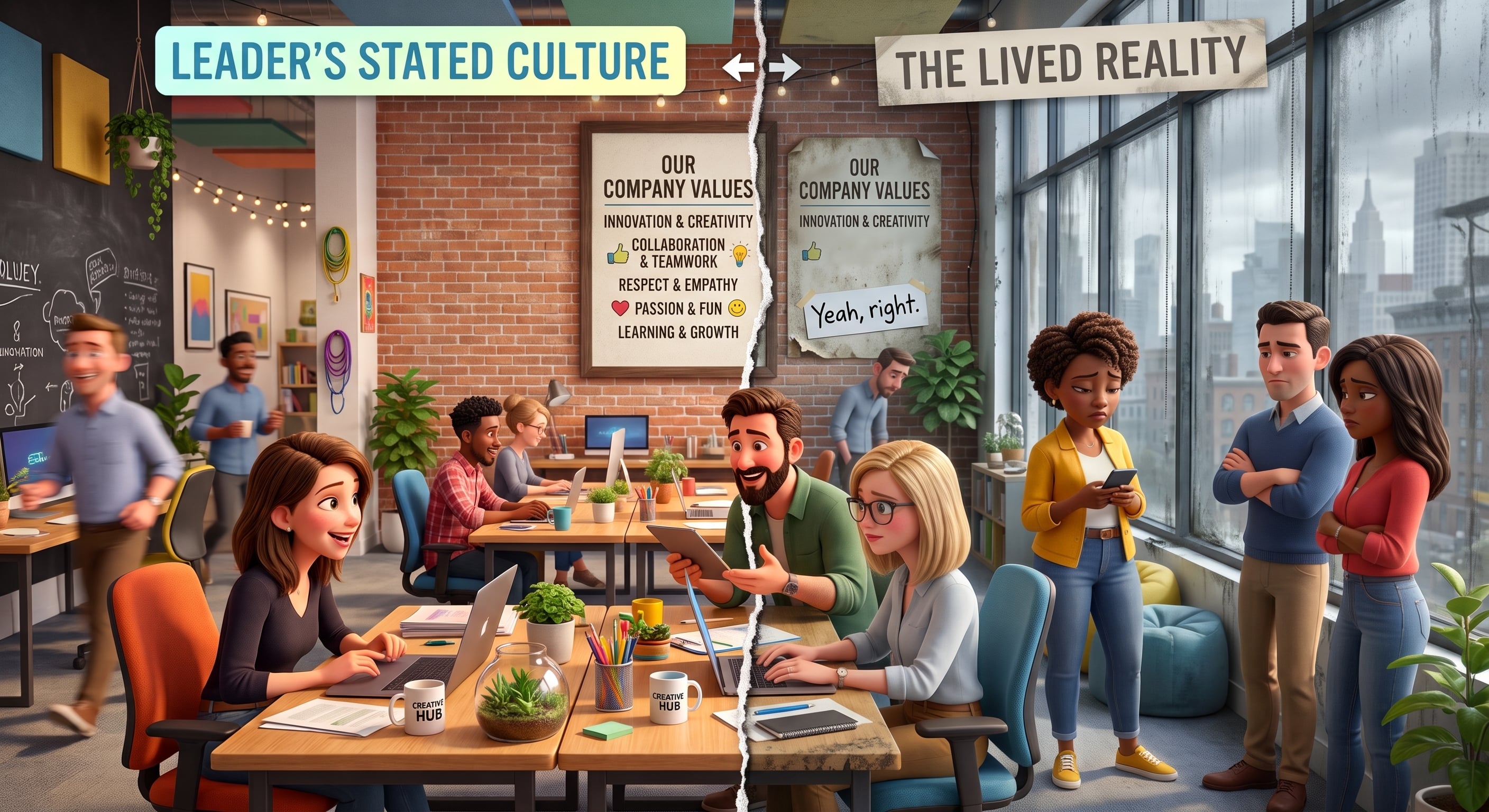
For years, recruitment has sold clients a deep read on their culture. Most of the time, we couldn't back it up. Not because recruiters are lazy or dishonest. Because the method the whole industry runs on hands you a feeling and lets you mistake it for insight.
I'd have argued with you about that a few years ago. Then I'd have walked you through a client's office to prove my point.
I can still picture the office. A review platform business, well known in their space, and I was there to fill a few go-to-market roles for them. The general manager walked me through, we grabbed a coffee, and I did the thing I always did. I looked around. Open plan, people talking across desks, a big wall with the company values painted on it, someone laughing near the window. Good energy. You could feel it.
By the time I left, ninety minutes later, I was certain I understood their culture. I went back to my desk and started calling candidates, painting them the picture. Fast-paced, collaborative, you'll love it there, I get exactly what they're after. I said it with total conviction, because I believed it. That was my whole method, and I was good at it. Get in the room. Meet the people. Read the room. Go and find the person who fits the room.

It took me years and a career change to see that what I'd done in that meeting was form a first impression and then sell it as insight. And I wasn't the exception. It's what most of us were doing, and for a long time there wasn't a better way to do it.
The old way earned its place, for a while
The method wasn't stupid. For a long time it was the best available option.
The recruiter who actually turned up, met the team, walked the floor and had the coffee genuinely knew more than the one working off a phone call and a job spec. That was real. In a market where everyone's competing on network and speed, an hour in someone's office was a differentiator. Clients felt understood. Candidates got a warmer, richer brief. It worked often enough that nobody had much reason to question it.
The visit isn't worthless. The problem is what we convinced ourselves it added up to. Think about what you're actually seeing when you're standing in that office.
You're seeing the people who happened to be at their desks that morning, and the version of the place that gets switched on when there's a visitor. You're hearing the leadership's story about the culture, not the version the new hire will live three desks from anyone senior on a random Tuesday. And that wall of painted values isn't culture. It's the culture the company wishes it had. Sometimes the two line up. Often they don't, and you'd have no way of knowing from where you're sitting.
The worst part, and I say this as someone who did it, is how sure you feel afterwards. You've been in the building. You've shaken the hands. The confidence feels earned. It isn't, really, but it feels that way, and that feeling is exactly what you carry into every conversation with a candidate.
Why the industry keeps doing it
If the method is this shaky, the fair question is why it survived so long. The answer is in the incentives, and none of us were immune to them.
Look at how it actually plays out. The recruiter who strides in, gets a feel for the place and then speaks about the culture with authority wins the client's trust and closes the candidate. The one who says "honestly, I can't tell you much about the culture yet, I'd need to actually measure it" sounds like an amateur. So the whole industry quietly rewards confidence over accuracy. We select for the recruiter who's sure, not the recruiter who's right, and most of the time nobody checks the difference, because by the time a bad match unravels, everyone's moved on to the next role.
There's local data that puts numbers on the gap. Gartner's Global Talent Monitor, tracking Australian workers into late 2024, found perceptions of workplace culture had slid to a three-year low, with barely one in five employees calling themselves highly engaged. PwC's 2025 survey of the Australian workforce adds a telling detail: senior executives consistently feel more confident about how the organisation is travelling than the people below them, and that confidence keeps weakening the further down the hierarchy you go. So the culture a leader describes in a meeting and the culture their people are living day to day have quietly drifted apart, and the recruiter standing in reception for ninety minutes has no way of knowing which one they're being shown.
The deeper problem is that most leaders can't describe their own culture with any precision, let alone measure it. Sociologist Lauren Rivera's research on hiring found that 82% of managers rated cultural fit as one of the most important things they hired for, yet only half could clearly say what their culture actually was, and just a third had any real tool for measuring fit. So the thing everyone agrees matters most is the thing almost nobody can define. Values and purpose statements don't make a culture. Consistent behaviour does. And consistent behaviour is exactly what a ninety-minute visit can't show you.
And the gap is expensive. Robert Half's Australian research found that 65% of HR managers here have hired someone who didn't meet expectations, and 86% of business leaders say a bad hire hurts more now than it did a year ago. When those employers were asked why the hires went wrong, the most common answer, ahead of everything else, was over-weighting cultural fit at the expense of the skills the role needed. The thing our industry sells hardest is the thing most often blamed for the miss. Depending on seniority, a bad hire runs from roughly a third of salary to well over the full amount once you count lost productivity and the drag on the team. These aren't freak events. They're the predictable output of a system that matches people to places on a feeling.
Being on the inside didn't fix it
For a while I assumed the answer was just getting closer to the business. Go internal, live inside the culture, and you'd finally see it clearly.
So I did. In 2023 I moved into an internal talent role at a big logistics and manufacturing business, handling the corporate and white-collar hiring and some of the operational driver recruitment too. I had access an agency recruiter could only dream of. I was in the leadership meetings. I watched teams work day after day. I could corner any manager and ask them anything.
And I still couldn't have told you, with a straight face and any real evidence, what the culture of any given team actually was.
Because everyone described it differently. The GM had one version, the team leaders another, the people doing the work a third that had the least in common with the poster on the wall. There was no shared language for it and nothing to measure it against, so every hire was still a gut call, just with more raw material feeding the gut. Being inside gives you more to go on. It doesn't give you anything you could defend in front of a sceptical board. I found that genuinely frustrating, and I didn't have a name for why.
When it finally clicked
The shift didn't come from a book or a lightbulb moment. It came from getting the job I'm in now and actually working inside the problem.
For the first time I had the language and the tools to see what I'd been fumbling at for years. Culture isn't the mood of a room or the words on the wall. It's how work actually gets done. Who makes the decisions, what behaviour gets rewarded, what gets quietly tolerated. That's what I'd been trying to read off a coffee, and it was never going to show itself in ninety minutes.
I also learned that engagement and culture aren't the same thing, though most people treat them as one. Engagement is sentiment, how people feel about the place. It tells you something is off, but not why or what to fix. A team can post decent engagement scores and still be quietly failing, because the work isn't designed to fit the people doing it.
The part that really got me was team design. So much of performance comes down to the mix of personalities in a team and whether it fits the work in front of them. Wrong mix, and it doesn't matter how good everyone is on their own, the team underperforms and nobody can say why. Right mix, and ordinary people outperform a room full of stars. I'd spent years matching people to a job description and a vibe, when the thing that decided whether they'd succeed was how they fit the work and the people already there.
Sitting with all of that, I had two reactions that didn't sit well together. One was relief, this was the thing I'd been missing my whole career. The other was a wince, because I'd spent years confidently selling an understanding of culture I didn't really have.
I've mostly made my peace with the wince. The industry didn't fail me and I didn't fail my clients, not exactly. The tools to do this properly weren't in reach, and now they are. That changes what "good" is allowed to mean.
From recruiter to something more like an architect
The word architect is easy to throw around, so I'll be specific. An architect doesn't walk onto a site and give you a feeling about the building. They survey the ground, understand the constraints, work out what the structure actually needs to hold, and hand you a plan somebody else can build from. That's the shift I'm describing. Same instinct for people and fit that good recruiters have always had, but with a foundation underneath it.

In practice a few things change.
You show up to a client with a read on their culture, an actual one, not an impression you formed over a flat white. You can point to where they are now and where they've told you they want to be, and talk honestly about the distance between the two. That's a completely different conversation to "great space you've got here."
You stop taking the job spec at face value. You look at the team that already exists, work out what kind of work is genuinely missing from it, and define the role against that gap instead of against a wishlist someone typed up in a hurry. Maybe they think they want another closer and what the team's actually crying out for is someone who brings order. You can see that now.
And you change what you hand over. A CV and a warm endorsement isn't the deliverable anymore. You give them a real picture of how the person works, where they'll click with the team and where the friction is likely to show up. The relationship doesn't stop the moment the contract's signed either. Whether the person is still there and thriving in a year becomes something you can measure, instead of the quiet thing everyone hopes about and nobody tracks.
None of this kills the human part of recruitment. If anything it frees it up. Sourcing and screening and keyword-matching are already being eaten by tools that do it faster and cheaper than any junior. What's left, the judgement, the reading of people, the advice, is the valuable part. But judgement with nothing underneath it is just an opinion, and opinions are getting cheaper by the month.
Where this leaves everyone
Two things are happening to the recruitment market at once and they're pulling in opposite directions.
The bottom is being commoditised fast. Anything transactional is going to a machine. At the same time the top is opening up, because the clients with genuinely hard hiring problems are done paying premium fees for handshake-and-coffee insight. They want a method they can trust. They'll pay properly for it, they'll stay with the partner who brings it, and it's the kind of work AI can't touch, because it's human judgement sitting on top of real data.
The firms that make this shift are going to own that top end. The ones that don't will get squeezed into the middle and then out of it, and I don't think that takes as long as people want to believe.
If you run an internal talent function, the same shift changes what you should expect from the outside. When a partner comes to you claiming they just get your culture, you're allowed to ask them how they know. What did they measure. What can they show you. That question is going to separate the partners who can show their working from the ones who can't, pretty quickly.
I think about that office sometimes
That review platform, the values on the wall, the GM I was so sure I'd figured out after ninety minutes and a coffee.
If I walked back in there today with the tools I have now, I know I'd find things I completely missed. The daylight between the values on the wall and the way the place actually ran. The team leads running on empty. Maybe even that the role I was so busy filling wasn't quite the role they needed.
I couldn't see any of it from where I stood. Nobody in the industry could, back then. That's not an excuse, it's just where we were.
We're not there anymore. The shift is coming for all of us, and the only real questions left are how fast you move and what you want your firm to look like on the other side of it.
Justin Coutts is Head of Talent Solutions at Compono, an Australian people and culture platform that combines hiring, culture and learning with people insight. He spent years in agency recruitment across technology and SaaS, then moved into internal talent leadership, before ending up on the side of this argument he now can't unsee.

