


8 min read
Recruitment trends 2027: 7 hiring shifts for Australia and NZ
 Mathan Allington
October 26, 2026
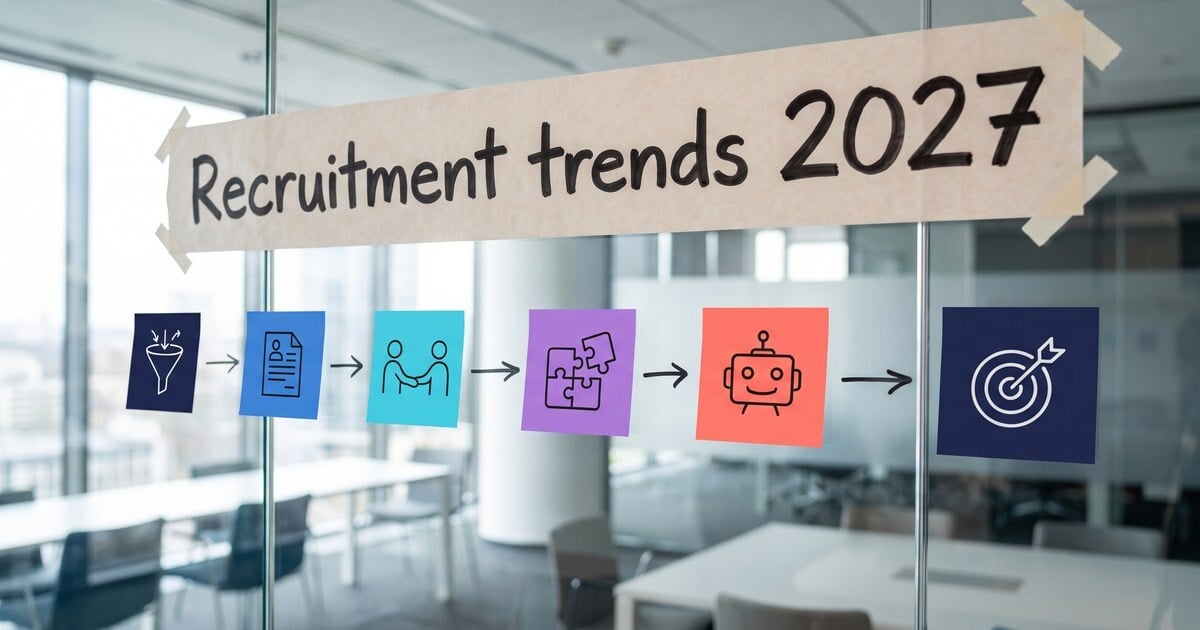
The recruitment trends shaping Australian and New Zealand hiring in 2027 all come back to matching. Employers are getting more applicants per role but few suitable ones, candidates in a cooler market are choosier, AI sits on both sides of the desk, transparency rules are arriving, structured interviews have won the science argument, and your best next hire may already work for you.
Last reviewed October 2026. Written for HR and talent leaders in Australia and New Zealand planning their 2027 hiring.
In short
- Applications per job ad are at record highs in Australia, but only about five applicants per vacancy are suitable, so 2027 hiring is won on matching rather than reach.
- Vacancies are almost a third below their 2022 peak and fewer people are changing jobs, so good candidates are harder to land.
- Candidates use AI to apply and employers use it to screen, which so far buys speed rather than better decisions.
- From 10 December 2026, organisations covered by the Privacy Act must describe automated decisions, including AI that screens job applications, in their privacy policies.
- Updated selection research ranks structured interviews as the most valid common predictor of job performance; years of experience predict very little.
- Dropping degree requirements has barely changed who gets hired; measuring skills and 'fit' directly is what changes the result.
- With job mobility low, internal candidates become one of the most reliable hiring channels for 2027.
Australian hiring spent 2022 and 2023 worrying about scarcity. Jobs and Skills Australia's Recruitment Insights Report for September 2026 shows recruitment difficulty fell from a peak of 75% of recruiting employers in July 2022 to 48% in September 2026. The pressure has moved from finding candidates to choosing between them. It's one of the wider HR trends for 2027 across Australia and New Zealand.
Applicant tracking systems (ATS) handle process risk well: posting, tracking, scheduling and compliance. Few handle people insight risk, the risk of hiring someone who looks right on paper and doesn't work out in the role or the team. Bad hires aren't bad luck. They happen when speed is optimised but fit isn't understood, and 2027 asks for both.
1. Matching matters more than applicant volume
Australian applications per job ad are higher than at any point on record, according to SEEK's July 2026 Employment Report, after seven straight monthly increases while job ads fell. That volume isn't turning into hires. Jobs and Skills Australia's Occupation Shortage Report for the March quarter 2026 found employers received 21.5 applicants per vacancy on average. Of those, 8.3 were qualified and only 5.2 were suitable, and the national fill rate fell to 68.2%. Advertising harder mostly adds applicants who were never going to be right.
Our take: Plenty of recruitment software was built for the talent shortage, chasing reach. The constraint now is picking out the five people in twenty-one who will do well in the role and the team, and that takes evidence about fit that a bigger funnel can't supply. That's the gap candidate matching closes. In 2027, report suitable applicants per vacancy alongside volume.
2. A cooler market makes good candidates harder to land
The ABS's Job Vacancies release for August 2026 counted 325,000 vacancies, 31.2% below the May 2022 peak, and Labour Force data for September 2026 put unemployment at 4.7%. In New Zealand, Stats NZ reported unemployment of 5.6% for the June 2026 quarter.
That doesn't hand employers the advantage, because the people you most want to hire are mostly staying put. The ABS Job Mobility survey found 7.2% of employed Australians changed jobs in the year to February 2026, down from 7.7%. Those who do move are weighing their options. Globally, Gartner research published in June 2026 found 48% of candidates accepted their most recent job offer in the December quarter of 2025, down from 85% two years earlier.
Our take: A softer market tempts employers to add interview rounds, assuming candidates will wait. The ones you most want won't, so speed still counts, as long as it's speed to the right person. Before adding another round, put a number on the delay with the time to hire calculator and the cost of vacancy calculator.
3. AI is on both sides of the hiring desk
Candidates are already applying with AI. A Gartner survey released in July 2025 found 39% of candidates used AI during the application process, and 29% of those used it to generate answers to assessment questions. In Australia, AHRI's December quarter 2025 Work Outlook found 49% of employers use no AI anywhere in recruitment or selection.
Where AI is in use, it mostly buys speed. In SHRM's State of AI in HR 2026, 89% of HR professionals reported greater efficiency and 24% reported better identification of top candidates. What it doesn't buy is a better experience for candidates. An unexplained screen followed by silence is fast for the employer and opaque for the person applying.
Our take: When both sides automate, CVs converge and stop telling you much about the person. Banning AI won't fix that, and neither will adding more of it. Move the decision onto evidence that is hard to fake, like how someone works and how they'd fit the team, and keep a person accountable for the final call, as Rudy Crous argues in AI can get you shortlisted, but a human still decides.
4. Transparency about AI in hiring becomes a requirement
From December, Australian privacy law reaches into hiring software. The Office of the Australian Information Commissioner (OAIC) confirms that from 10 December 2026, entities covered by the Privacy Act must explain in their privacy policy where a computer program makes or informs decisions that could significantly affect someone's rights or interests. The OAIC's issues paper on the obligation gives an AI system that screens and ranks job applications as an example.
The Australian Public Service has gone further. Agencies were to implement the APSC's principles for agency use of AI in recruitment by 1 June 2026, which state that "AI tools must not make the final decision in recruitment outcomes" and that recruitment decisions "must be explainable and defensible". For multinationals, the EU AI Act's high-risk rules, which cover AI that filters applications and evaluates candidates, apply from 2 December 2027.
Our take: Few hiring systems can tell you why a candidate ranked where they did. "Explainable and defensible" is a good test for any employer: if you can't explain a shortlist to a rejected candidate or a regulator, you're carrying people insight risk with a compliance cost attached. Before December, map every point where software ranks, filters or scores applicants and check your privacy policy describes it. This is general information, so get professional advice on how the obligation applies to you.
5. Structured interviews win the science argument
The validity table most HR teams learned dates from 1998. In a 2023 article in Industrial and Organizational Psychology, Sackett, Zhang, Berry and Lievens ranked structured interviews as the strongest common predictor of job performance, with an operational validity of 0.42. Unstructured interviews fell to 0.19. Cognitive ability tests dropped to 0.31 (0.23 on 21st-century studies alone), and years of job experience sits at 0.07.
The revision mostly re-reads the same studies with a corrected statistical adjustment. The authors also stress the spread: structured interviews are better described as 0.42 plus or minus 0.24, so how well you run them decides the result.
Our take: The most accurate method on the list costs little more than the interviews you already run, and plenty of organisations still run it loosely. A structured interview means the same job-relevant questions for every candidate, agreed scoring anchors, and scores recorded before the panel discusses anyone. We'd put it first on any 2027 hiring plan, starting with an interview scoring rubric.
6. Skills and 'fit' move beyond the CV
Skills-based hiring is announced more often than practised. Research from Harvard Business School and the Burning Glass Institute, published in February 2025, found fewer than 1 in 700 hires in 2023 benefited from employers dropping degree requirements. A March 2026 follow-up from the Burning Glass Institute and OneTen found companies that remove degree requirements see only a 2 percentage point increase in hires with non-degree credentials. Both studies are American; the lesson travels.
Fit has a similar problem. AHRI's March quarter 2026 Work Outlook found 69% of Australian organisations deliberately exclude people with certain attributes or circumstances during recruitment. AHRI didn't ask why, but when 'fit' is left to a hiring manager's instinct, it can drift into exactly that kind of exclusion.
Our take: Rewording an ad changes nothing if the shortlist is still built from CVs. Skills-based hiring works when you measure skills and work style directly. Culture fit holds up only when it's defined against how your teams actually work and assessed the same way for everyone, which also lowers your legal risk (see is culture fit hiring legal in Australia).
7. Your next hire may already work for you
With fewer Australians changing jobs, your strongest candidate is often already on the payroll. The 2026 LinkedIn Talent Report found 72% of talent professionals say internal mobility is more important than ever. In the US, practice lags: SHRM's 2026 recruiting benchmarking found 97% of non-executive roles were filled externally, up from 93%.
Our take: Most organisations say they want to promote from within, then advertise externally by default because they can't see who internally could do the job. Treat current employees as your first candidate pool in 2027, assess them the same way you'd assess external applicants, and compare the options with the reskill vs rehire calculator.
Recruitment trends 2027 at a glance
| Trend | What changes in 2027 | What to do first |
|---|---|---|
| Matching over volume | More applicants, few suitable | Track suitable applicants per vacancy |
| Cooler market | Fewer movers, lower offer acceptance | Cut rounds that add delay but no evidence |
| AI on both sides | CVs converge, trust drops | Base decisions on evidence that's hard to fake |
| Transparency rules | Privacy policies must cover automated decisions | Map where software ranks or filters people |
| Structured interviews | Science backs structure over instinct | Use one scoring rubric per role |
| Skills and fit | Degree rules matter less than measurement | Assess work style and fit directly |
| Internal mobility | Your best candidates are staying put | Assess internal people first |
What this means for hiring in 2027
Each of these trends rewards knowing which candidate will do well in the role and the team, and being able to show why. Faster processes don't fix a shortlist built on guesswork. Build the hiring work into your 2027 HR plan before the year starts. Go beyond the process, understand your people and make hiring decisions you can defend. The Coffee Club used Compono Hire to build a consistent hiring process across 400 outlets.
For a number to take to your leadership team, start with the cost of a bad hire calculator. Compono Hire is an ATS that matches candidates to your culture and team, not just keywords, so you can fill roles faster and with the right people. See how it works.
Hire faster, and hire the right people
An applicant tracking system with culture and team fit matching built in, so every shortlist is one you can defend.
Talk to usFrequently asked questions
What are the biggest recruitment trends for 2027?
The biggest recruitment trends for 2027 in Australia and New Zealand are the shift from applicant volume to matching, choosier candidates in a cooler market, AI on both sides of hiring, transparency rules for automated decisions, structured interviews, skills and fit assessed beyond the CV, and internal mobility as a hiring channel.
Is it easier to hire in Australia now that the job market has cooled?
Finding applicants is easier; hiring well isn't. SEEK reports record applications per job ad, yet Jobs and Skills Australia found only 5.2 suitable applicants per vacancy in the March quarter 2026, with about one vacancy in three unfilled. Fewer people are changing jobs, so strong candidates remain hard to land.
Do Australian employers have to disclose that they use AI in recruitment?
From 10 December 2026, organisations covered by the Privacy Act must explain in their privacy policy where a computer program makes or informs decisions that significantly affect individuals, and the OAIC gives AI that screens and ranks job applications as an example. APS agencies also follow the APSC's principles for AI in recruitment. Get professional advice on how this applies to you.
What is the most accurate way to assess job candidates?
Updated research by Sackett and colleagues (2023) ranks structured interviews as the most valid common selection method, at an operational validity of 0.42, ahead of cognitive ability tests. Unstructured interviews score 0.19 and years of experience 0.07. Results depend heavily on how well the interview is run.
How can HR reduce bad hires in 2027?
Decide on evidence rather than CVs and instinct. Define what success looks like in the role and team, assess work style and fit the same way for every candidate, run structured interviews with a scoring rubric, and keep a person accountable for the final decision. Track early turnover alongside time to hire.
Better hiring decisions, before the interview
Compono Hire helps you predict job-fit and team-fit using behavioural science, so you can shortlist with confidence.
Request a demoBuilt for mid-market hiring teams.
Practise your next tough conversation
Voice-first coaching that adapts to your personality. Get actionable steps you can take this week.
Start freeBuilt by Compono. Not therapy — practical behaviour change.