


7 min read
HR trends 2027: 8 shifts Australian and NZ HR leaders should plan for
 Mathan Allington
October 26, 2026
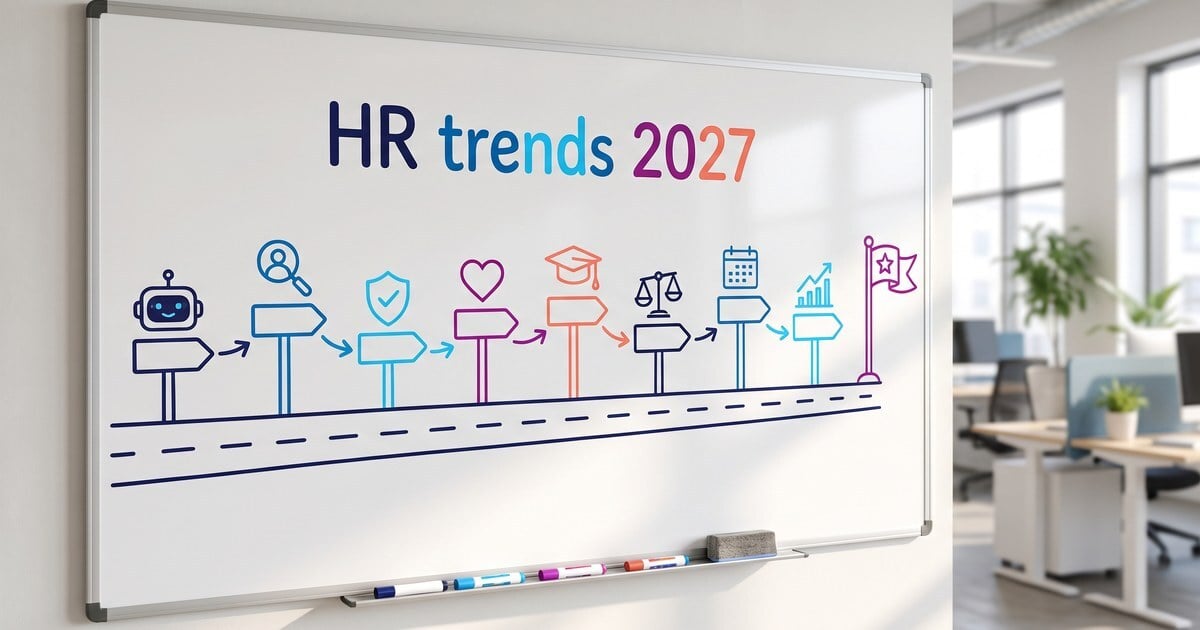
The HR trends that will shape Australian and New Zealand workplaces in 2027 are a retention market, matching over applicant volume, AI governance, manager capability, joined-up capability planning, psychosocial risk, a heavier compliance calendar and HR tech built for people insight. Under all of them, HR will be judged less on process speed and more on decisions that hold up.
Last reviewed October 2026. Written for HR leaders in Australia and New Zealand planning for 2027.
In short
- Australians are changing jobs less often, so 2027 rewards keeping and growing the people you have.
- Applicant volume is high and suitability is low, so matching people to roles is worth more than extra applications.
- AI in HR is moving from pilots to governance, and teams that measure decision quality will get more from it than teams that only count time saved.
- Manager engagement is falling globally, which makes manager capability the most valuable people investment for 2027.
- Most Australian organisations have a training plan and a workforce plan, but few have joined them up.
- Workplace stress is high in Australia, and psychosocial risk duties mean HR needs to know where pressure sits before it becomes a claim.
- The compliance calendar keeps filling up, from Payday Super and gender equality targets in Australia to Employment Relations Act changes in New Zealand.
- HR tech buying is shifting from adding systems of record to asking what the stack tells you about people.
Planning for 2027 starts in a different market. The hiring boom is over, AI is everywhere in HR conversations but thin in HR results, and regulators on both sides of the Tasman keep adding dated obligations. The work your systems already handle (payroll, super, reporting, compliance) is getting heavier. The work they were never built for, like knowing who will thrive in a role, is where most of the 2027 gains sit.
We call these process risk and people insight risk. Most HR tech only handles the first, and every trend below raises the stakes on one or both.
1. A retention market replaces the hiring race
Australians are moving jobs less. The ABS Job Mobility release for the year to February 2026 put the job mobility rate at 7.2%, down from 7.7% a year earlier. AHRI's Quarterly Australian Work Outlook for the March quarter 2026 found 59% of organisations planned to hire, down from 71% the quarter before and the lowest level since the survey began in 2023. In New Zealand, Gallup's 2026 country data shows job market optimism fell 21 points to 44%.
Low turnover looks good on a dashboard, but it can hide people who stay because leaving feels risky rather than because the work is good.
Our take: A quiet turnover number will be the most misleading figure HR reports in 2027. Exit data only describes the people who left. In a market where fewer people leave, you need to understand what drives the ones who stay and who is ready for more. Run stay interviews before you design another exit survey.
2. Matching beats volume in hiring
Jobs and Skills Australia's Occupation Shortage Report for the March quarter 2026 found employers received 21.5 applicants per vacancy. SEEK's July 2026 Employment Report says applications per job ad are at their highest level on record.
More applications mean more screening, and only about one in four applicants was suitable. Our recruitment trends for 2027 cover what that means for hiring.
Our take: Hiring in 2027 has a filtering problem, and keyword screening makes it worse because it reads the CV and misses how someone works. Assess fit at the first stage, and use candidate matching that ranks people on it, so 21 applicants become a shortlist you can defend.
3. AI moves from pilots to governance and measurement
AHRI's December quarter 2025 Work Outlook found 93% of Australian organisations use AI in some capacity and 68% have formal AI policies or guidelines. Evidence of value is thinner: SHRM's State of AI in HR 2026 (1,908 HR professionals) found 89% reported greater efficiency from AI and only 24% better identification of top candidates. SHRM also found 56% of HR functions don't formally measure the success of their AI investments.
Regulation is catching up. The Office of the Australian Information Commissioner says that from 10 December 2026, organisations covered by the Australian Privacy Principles must say in their privacy policy when a computer program makes, or helps make, decisions that could significantly affect a person's rights or interests. If you use automated screening or scoring for candidates, get privacy advice on how it applies.
Our take: AI in HR is buying speed, which is the easy part. The test for 2027 is whether AI-assisted decisions are better decisions, and you can't answer that without measuring it. Set a decision-quality measure for each AI use case, such as quality of hire, before you expand it.
4. Manager capability becomes the engagement priority
Gallup's State of the Global Workplace 2026 found global manager engagement fell from 27% to 22% between 2024 and 2025. Australia and New Zealand are holding up better for now: Gallup's regional data puts ANZ managers at 27% engaged against 17% for individual contributors.
That premium is worth protecting. AHRI's March quarter 2026 survey found 37% of employers rate people management as critical to their goals, and 31% report a capability gap in it. The engagement and culture trends for 2027 go deeper on managers.
Our take: Most organisations answer an engagement drop with another survey. In 2027 the bigger return sits with managers, starting with who you promote and whether their way of working suits the team they lead. Run a manager effectiveness survey and treat the results as a capability plan rather than a scorecard.
5. Capability planning gets joined up
AHRI's March quarter 2026 Work Outlook found only 20% of Australian organisations say their training plan and strategic workforce plan are integrated to a large extent. The gap that matters is between training spend and the roles the business needs. Our L&D trends for 2027 cover what closes it.
Our take: A training budget with no workforce plan behind it is a guess with a cost code. Tie each training dollar to a role-level capability need from the workforce plan, and use a skills gap analysis to find where the gaps are real.
6. Psychosocial risk needs data as well as policy
Gallup's 2026 country data shows 50% of Australian employees experienced a lot of stress the previous day, against a global figure of 40%. AHRI found stress as a driver of unscheduled absence rose from 42% to 57% between 2023 and 2025. Safe Work Australia's Key Work Health and Safety Statistics 2026 reports mental stress caused 17,000 serious workers' compensation claims in 2024-25 (preliminary data), with a median of 35 weeks off work and median compensation of $69,400, against 9.5 weeks for body stressing claims.
Under the model WHS laws, businesses must manage the risk of psychosocial hazards, which Safe Work Australia says include job demands, low job control, poor support and lack of role clarity. Rules vary by state and territory, so check yours.
Our take: A psychosocial policy on the intranet manages process risk, but it can't tell you which teams are under the most pressure or why. Make 2027 the year you can show where job demands are worst and what you changed. The psychosocial risk readiness calculator is a quick place to start.
7. The compliance calendar gets heavier on both sides of the Tasman
Most of these changes have already started, and 2027 is the first full year of living with them. Treat this as a planning list, and get professional advice.
- Payday Super (Australia). Since 1 July 2026, super guarantee contributions must reach employees' funds within 7 business days of payday, calculated on qualifying earnings, according to the ATO.
- Gender equality targets (Australia). From 1 April 2026, employers with 500 or more direct employees must select 3 targets from WGEA's menu and, within 3 years, meet them or show measurable improvement. Our gender pay gap calculator helps with the baseline.
- Right to disconnect (Australia). The right to disconnect has covered small businesses (fewer than 15 employees) since 26 August 2025, says the Fair Work Ombudsman.
- Employment Relations Act changes (New Zealand). Since 21 February 2026, employees earning NZ$200,000 or more under new agreements can't raise a personal grievance for unjustified dismissal. Existing agreements get a 12-month transition, and the threshold adjusts annually from 1 July 2027, according to Employment New Zealand.
- Employment Leave Act 2026 (New Zealand). The new Act replaces the Holidays Act on 6 August 2028, and Employment New Zealand says employers will need the time before then to update systems, agreements and policies.
Our take: This is process risk, and it should be the boring part. If Payday Super or a targets report still eats weeks of HR time in 2027, that's time your systems should be giving back. Automate the compliance work and spend the time you get back on decisions.
8. HR tech shifts from systems of record to people insight
Sapient Insights Group's 2024-2025 HR Systems Survey found organisations run an average of 24 HR system integrations, from 3 in small businesses to 15 in mid-market organisations and 55 in enterprises. In Australia, AHRI found HR teams use AI most for reporting and analytics (41%) and less for strategic work such as workforce planning (30%) and performance management (28%).
Our take: Consolidation will be a popular goal in 2027, and fewer logins are worth having, but a tidier stack of systems of record is still incomplete because it only manages process risk. Ask of any HR tech decision whether it helps you understand people, such as who fits a role and what drives a team. Our view of HR tech trends and workforce intelligence goes further on this. If a review is on the plan, start with our guide to reducing HR tool sprawl and the HR tech requirements builder.
The 2027 HR trends at a glance
| Trend | What changes in 2027 | What to do first |
|---|---|---|
| Retention market | Fewer people leave, so stayers matter more | Run stay interviews with key people |
| Matching over volume | More applicants, few of them suitable | Assess fit at the first stage |
| AI governance | Questions about value and transparency | Set a decision-quality measure per use case |
| Manager capability | Manager engagement under pressure | Survey manager effectiveness |
| Joined-up capability | Training and workforce plans need linking | Map training spend to role needs |
| Psychosocial risk | Stress and claims stay high | Find where job demands peak |
| Compliance calendar | More dated obligations in Australia and NZ | Automate payroll and reporting work |
| People insight tech | Pressure to consolidate systems | Test tools on what they explain about people |
What this means for HR in 2027
Together, these trends ask HR for one thing: go beyond the process, understand your people and make decisions you can defend. The process side is getting heavier, so it needs to run quietly. The people side is where the 2027 gains are, and it needs better evidence than most HR stacks give you. Our 2027 HR plan guide and template turns these trends into a plan. Compono is a workforce intelligence platform that handles both, with hiring, engagement and learning in one place. See how it works.
Plan 2027 around both kinds of HR risk
Compono runs the process work and gives you the people insight to make decisions you can defend.
Talk to usFrequently asked questions
What are the biggest HR trends for 2027 in Australia?
The biggest HR trends for 2027 in Australia are a retention market with lower job mobility, matching over applicant volume, AI governance and measurement, falling manager engagement, joined-up capability planning, psychosocial risk, a heavier compliance calendar and HR tech moving from systems of record to people insight.
What workplace law changes should Australian HR teams plan for in 2027?
Most of the changes that matter in 2027 have already started. Payday Super has applied since 1 July 2026, gender equality targets started on 1 April 2026 for employers with 500 or more direct employees, and the right to disconnect has covered small businesses since 26 August 2025. From 10 December 2026, privacy policies must explain significant automated decisions. Check each with a professional adviser.
How will AI change HR in 2027?
Most Australian organisations already use AI, so 2027 is about governance and proof of value. Surveys show AI in HR mostly delivers efficiency, while far fewer HR teams report better decisions and many don't measure results. Expect more focus on privacy transparency and on measuring decision quality, such as quality of hire.
What HR changes are coming in New Zealand?
Employment Relations Act changes took effect on 21 February 2026, including a NZ$200,000 remuneration threshold for unjustified dismissal claims, with a 12-month transition for existing agreements and annual threshold adjustments from 1 July 2027. The Employment Leave Act 2026 replaces the Holidays Act on 6 August 2028, so employers should use 2027 to prepare payroll systems, agreements and policies.
Better hiring decisions, before the interview
Compono Hire helps you predict job-fit and team-fit using behavioural science, so you can shortlist with confidence.
Request a demoBuilt for mid-market hiring teams.
Practise your next tough conversation
Voice-first coaching that adapts to your personality. Get actionable steps you can take this week.
Start freeBuilt by Compono. Not therapy — practical behaviour change.