


8 min read
Learning and development trends 2027: 8 shifts for Australia and NZ
 Mathan Allington
October 26, 2026
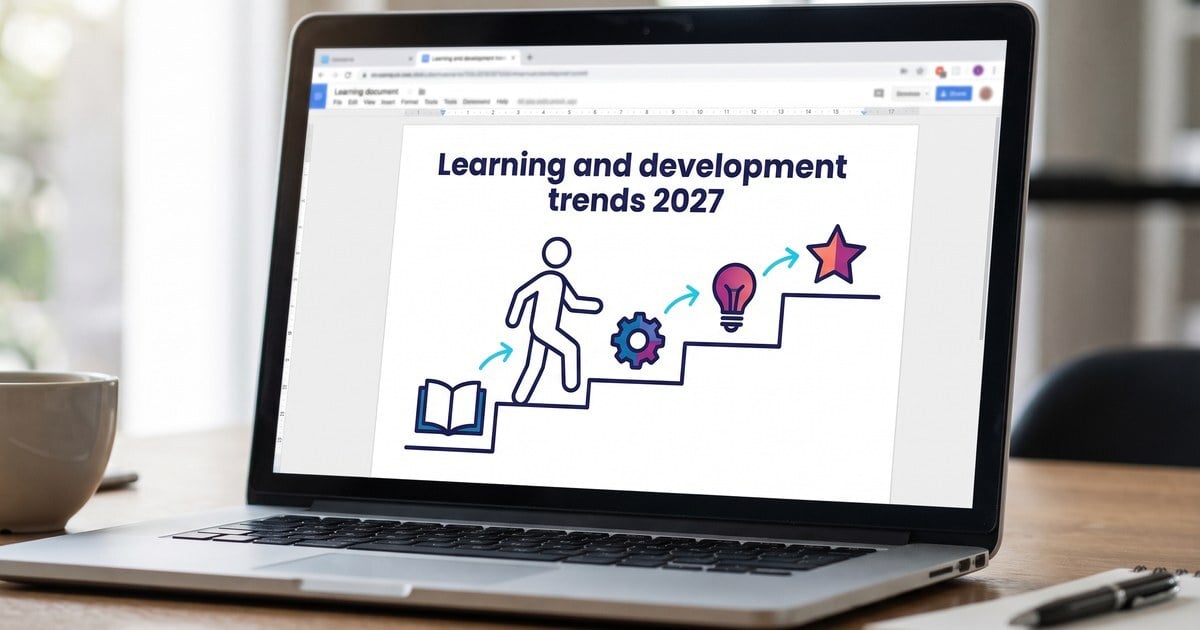
The biggest learning and development (L&D) trend for Australia and New Zealand in 2027 is the move from completion rates to capability evidence. Around it sit AI use outrunning AI training, skills-based planning, internal development over rehiring, managers as the learning channel, compliance moving down the agenda, onboarding judged on time to productivity, and rising budgets that must prove their return.
Last reviewed October 2026. Written for HR and L&D leaders in Australia and New Zealand setting learning priorities for 2027.
In short
- Completion rates stop counting as proof, and L&D teams that can show capability change will keep their budgets.
- Australians and New Zealanders are using AI at work faster than they are being trained for it.
- Skills-based planning moves into skills matrices that connect training plans to workforce plans.
- With Australian job mobility at 7.2%, developing the people you already have becomes the main talent lever.
- Managers become the main learning channel, because on-the-job learning is how most Australian employers train.
- Compliance training stays essential, but it no longer defines a good L&D function.
- Onboarding gets measured on how quickly new starters reach full productivity.
- Australian training budgets are rising, and the extra money brings harder questions about what it built.
Australian L&D heads into 2027 with more money and less evidence than it should have. Delivering training is the easy part; showing it built capability is the job, and it sits alongside the other HR trends for 2027. The share of employers planning to increase L&D spending climbed from 37% in 2024 to 58% in 2025, and 60% now expect skills investment to rise, according to the Australian HR Institute's (AHRI) Quarterly Australian Work Outlook for the March quarter 2026. AHRI had to calculate its own figure for employer training spend (about $1,122 per employee in 2025) because of "the absence of regular, nationally representative data on employer investment in training in Australia".
Most learning management systems (LMS) handle process risk well: assigning courses, chasing completions and keeping audit-ready records. What they miss is people insight risk, where training runs perfectly and still doesn't build the capability a role needs. Capability gaps aren't training gaps. They're the result of tools that track completion but ignore what people actually need to perform. A 2027 learning plan has to cover both risks.
1. Completion rates stop counting as proof
More people are finishing training. The World Economic Forum's Future of Jobs Report 2025 found the share of the workforce completing training as part of an L&D strategy rose to 50%, from 41% in the 2023 edition. Yet in Fosway Group's Digital Learning Realities 2026 survey of 334 mostly European L&D professionals, only 14% rated their learning strategy "very effective" at upskilling and reskilling. Teams using the learning module inside an HR suite were the least likely to call their platform fit for the modern workforce (17%, against 48% on a specialist learning system), a point to weigh when comparing an LMS with a human resources information system (HRIS) module.
Our take: A 100% completion rate tells you the process worked. It says nothing about whether anyone can do the job better. An LMS built to record attendance only shows half the picture. For 2027, tie each major program to a competency framework and agree what capability change you expect before the first cohort starts.
2. AI use is running ahead of AI training
The Hays Salary Guide FY26/27, drawing on more than 7,000 hiring managers and professionals across Australia and New Zealand, found 60% use AI regularly at work and 78% have had no formal training from their employer. Lack of training was the second-biggest barrier to AI adoption (45%), behind security and privacy (48%). Employers see it differently: in the AHRI December quarter 2025 Work Outlook, about three-quarters of organisations said employees were receiving AI training at least "to some extent". Both can be true if most of that training is informal, and informal training is hard to check.
Our take: AI makes course production cheap, and Fosway found 63% of L&D teams expect their investment in AI content authoring to grow, so 2027 will bring more learning content than any team can use. What holds AI capability back is knowing which people need which skills for which role, and a company-wide AI module doesn't answer that. Start with a training needs analysis by role.
3. Skills-based planning moves from the deck into the system
Asia-Pacific is ahead here. The 2026 LinkedIn Talent Report found 41% of Asia-Pacific organisations use skills-based workforce planning, against 22% in North America. The join-up is still weak, though. AHRI's March quarter 2026 survey found 79% of Australian organisations have a training plan and 65% have a strategic workforce plan, but only 20% say the two are integrated to a large extent.
Our take: "Skills-based" stays a slogan while the training plan sits in the LMS, the workforce plan sits in a slide deck and the skills data sits in managers' heads. A skills matrix that links all three makes it operational. For a starting number, run your roles through a skills gap analysis calculator.
4. Low job mobility makes internal development the main talent lever
Fewer Australians are moving. The Australian Bureau of Statistics (ABS) Job Mobility release for February 2026 put the job mobility rate at 7.2% for the year, down from 7.7%. AHRI found 59% of organisations planning to hire, the lowest recruitment intention since its survey began in May 2023. LinkedIn's 2026 report found providing learning opportunities is still organisations' number one retention strategy.
The formal pipeline is thinning too. National Centre for Vocational Education Research (NCVER) data published in June 2026 shows non-trade apprentice and trainee contracts in training fell 43.8% between 2021 and 2025. In New Zealand, Ministry of Education figures show workplace-based learners fell 12% in 2025 to 108,315.
Our take: When fewer people change jobs, most of the capability you'll have in 2027 is already on your payroll. AHRI found 26% of employers won't train staff because they might leave, which is a bet that people will stay and stay underskilled. Before your next external search for a hard-to-fill skill, use a reskill vs rehire calculator.
5. Managers become the learning channel
On-the-job learning is the most common way Australian employers deliver training (61%), according to AHRI's March quarter 2026 survey. Yet supervisors and team leaders are a target of L&D spending in only 37% of organisations, behind professional and technical specialists (41%) and frontline staff (39%).
Gallup's State of the Global Workplace 2026 found global manager engagement fell from 27% to 22% between 2024 and 2025. In Australia and New Zealand (ANZ), Gallup's regional summary puts managers at 27% engaged against 17% for individual contributors. Gallup's 2026 US research shows what managers are worth to learning: 78% of employees whose manager actively supports AI use are frequent users, against 44% without that support.
Our take: When on-the-job learning is the main way people learn, the manager is the delivery method, yet fewer organisations target supervisors with L&D spend than target specialists or frontline staff. ANZ managers still carry a clear engagement premium over their teams, while the global gap has narrowed to three points. Put manager capability at the top of the 2027 plan while it holds.
6. Compliance training stays essential, and stops being the strategy
For more than a decade, compliance held the top spot in Fosway's L&D priority rankings. In 2026 it fell to sixth (35%), well behind AI (67%) and upskilling and reskilling (58%). Australian employers show the same order: AHRI found compliance and regulation is the top training priority for 11% of organisations, behind technical and practical skills (23%).
Obligations don't shrink because priorities move, and in regulated roles a completion record also needs to sit alongside competency and credentialling evidence.
Our take: Compliance is process risk, and good tools already handle it. If compliance still eats most of your L&D team's hours, the tooling is setting your agenda. Automate assignments, reminders and audit trails with a proper compliance training platform, then give the time you get back to capability.
7. Onboarding gets judged on time to productivity
Entry-level work in Australia is changing. In AHRI's December quarter 2025 survey, 41% of organisations reported an increase in entry-level roles due to AI, against 19% reporting a decline. New starters are arriving into roles that AI is reshaping, so an induction written two years ago may describe a job that no longer looks the same.
Our take: Most onboarding ends when the checklist does, often well before the new starter can work unsupervised. Measure time to productivity by role, then build onboarding pathways around the capabilities that shorten it.
8. Budgets rise, and so does the demand for proof
Australian L&D budgets look healthier than Europe's. Fosway found one in four of its mostly European L&D teams had a budget cut in 2026, while AHRI found 60% of Australian employers expect skills investment to rise and just 2% expect it to fall. The spread is wide. Small employers (2 to 19 staff) spent about $549 per employee on training in 2025, against $1,547 for employers with 200 or more, and 15% of Australian organisations have no training budget at all.
Our take: Don't plan an Australian 2027 off European budget headlines. Rising budgets bring their own risk, because the second year of growth is when finance asks what the first year delivered. Build the return on investment (ROI) case early with a training ROI calculator and a clear method for proving LMS ROI against capability, not attendance.
L&D trends 2027 at a glance
| Trend | What changes in 2027 | What to do first |
|---|---|---|
| Completions stop counting as proof | Executives ask what capability changed | Tie programs to a competency framework |
| AI use outruns AI training | 78% report no formal AI training | Run a needs analysis by role |
| Skills-based planning gets real | Only 20% integrate their plans | Build one shared skills matrix |
| Internal development over rehiring | Fewer people changing jobs | Compare reskill and rehire costs |
| Managers as the learning channel | On-the-job learning leads (61%) | Fund manager capability first |
| Compliance drops down the agenda | Sixth priority for L&D teams | Automate it and free the hours |
| Onboarding judged on productivity | Entry-level roles reshaped by AI | Measure time to productivity |
| Budgets rise with scrutiny | 60% expect to spend more | Agree ROI measures up front |
Go beyond the completion report in 2027
Learning in 2027 will be easier to deliver and harder to defend. AI will produce the content and the LMS will log the completions. Your executive team will still want to know what people can do now that they couldn't do last year. Build that evidence into your 2027 HR plan from the start.
Go beyond the process by keeping compliance and onboarding automated and audit-ready. Understand your people by knowing what each role needs and where each team is short. Then make development decisions you can defend, with capability evidence behind the spend. Compono Develop is an LMS that tracks completion and builds capability, so both risks sit in one place. See how it works.
Track completion and build capability
An LMS that handles onboarding and compliance, then connects development to the capability gaps that hold performance back.
Talk to usFrequently asked questions
What are the biggest L&D trends for 2027?
The biggest L&D trends for 2027 are a move from completion rates to capability evidence, closing the gap between AI use and AI training, skills-based workforce planning, developing internal talent while job mobility stays low, investing in managers as the main learning channel, and measuring onboarding on time to productivity.
How much do Australian employers spend on training?
AHRI's March quarter 2026 Work Outlook estimated Australian employers spent about $1,122 per employee on training in 2025, with 38% of the workforce receiving workplace training. Spending varies by size: around $549 per employee for employers with 2 to 19 staff and $1,547 for those with 200 or more.
Is there a benchmark for e-learning completion rates?
No. There's no credible, published industry benchmark for corporate e-learning completion, so compare against your own baseline. Then also measure whether people can perform the capabilities the training was meant to build.
How do you measure whether training builds capability?
Define the capability before training starts, using a competency framework or skills matrix for the role. Assess people against it before and after, and ask managers to confirm the change shows up in the work. Completion data still matters for compliance, but capability evidence is what holds up with executives and finance.
Should we reskill or rehire in 2027?
With Australian job mobility falling in the year to February 2026 and recruitment intentions low, reskilling deserves the first look for skills close to existing roles. Rehiring still makes sense for capabilities nobody in the business is near. Compare the full cost of each before deciding.

Better hiring decisions, before the interview
Compono Hire helps you predict job-fit and team-fit using behavioural science, so you can shortlist with confidence.
Request a demoBuilt for mid-market hiring teams.

Practise your next tough conversation
Voice-first coaching that adapts to your personality. Get actionable steps you can take this week.
Start freeBuilt by Compono. Not therapy — practical behaviour change.