

Skip to the main content.
FOR GOVERNMENT

AssureArrow Left

Become the expert on delivering
valid and fair assessments for
your training and education.

Compono Assure


FOR BUSINESS

HireArrow Left

Engage Arrow Left

Develop Arrow Left

Automatically match to candidates who are a great fit for your team culture and who are intrinsically motivated to succeed.

Deeply understand your organisation with science-backed analytics on your culture, team design, and engagement.

Back your onboarding, compliance and skill development with industry-leading credentialling, competency and capability expertise.


The AI that actually understands you.

Hey Compono helps you understand your personality and how to turn it into your superpower.

First 1,000 users get 10 minutes free.
Just $15 a month after that — cancel anytime.

Hey Compono


5 min read

Predictive index results types: understanding the 17 profiles

Predictive index results types: understanding the 17 profiles
9:42

Understanding the nuances of human behaviour in the workplace has become the ultimate competitive advantage for Australian businesses in 2026. As we navigate a landscape where cultural fit and cognitive agility are as vital as technical skill, many HR leaders are turning to behavioural assessments to decode what makes their people tick. One of the most prominent frameworks used to achieve this is the Predictive Index (PI), which categorises individuals into specific behavioural profiles.

If you have recently sat a PI assessment or you are an HR manager looking at a dashboard full of data, you might be wondering what those labels actually mean. Why does it matter if your new marketing lead is a 'Maverick' rather than a 'Promoter'? And how do these insights translate to better performance on the warehouse floor or in the boardroom?

In this guide, we will break down the 17 predictive index results types, grouped by their primary drivers. We will explore how these profiles influence work styles, communication, and team synergy, helping you make more informed decisions for your organisation.

The four pillars of the predictive index

Before diving into the specific results types, it is essential to understand the four key behavioural drives that the Compono platform often integrates with when helping companies analyse their workforce. These drives—Dominance, Extraversion, Patience, and Formality—form the DNA of every PI profile.

Dominance measures the drive to exert influence on people or events. Extraversion tracks the drive for social interaction. Patience looks at the drive for consistency and stability, whilst Formality measures the drive to conform to rules and structure. The unique way these drives interact results in the 17 distinct profiles we see today.

By identifying similar drives early in the recruitment process through tools like Compono Hire, you can ensure that the person you are bringing into the business is naturally wired for the demands of the role. This reduces turnover and increases long-term job satisfaction.

The analytical profiles: data and discipline

The first group of predictive index results types focuses on the Analytical profiles. These individuals are generally driven by facts, data, and a high degree of accuracy. In the fast-paced Australian tech and finance sectors of 2026, these profiles are the backbone of quality control and strategic planning.

The Analyzer is the quintessential data-driven professional. They are intense, detail-oriented, and prefer to work with facts rather than intuition. If you need someone to find the needle in the haystack or ensure a complex project meets every single compliance standard, the Analyzer is your go-to.

The Controller is similar but with a stronger focus on results and self-discipline. They are proactive and prefer to take charge of a situation to ensure things are done correctly. Then we have the Venturer, who combines analytical thinking with a high degree of independence, making them excellent at navigating uncharted territory where data is scarce but decisions must be made.

Finally, the Specialist is the most cautious of the group. They are highly reliable and focus on doing one thing exceptionally well. They thrive in environments where the rules are clear and the expectations are consistent.

The social profiles: connection and collaboration

In 2026, the 'human' element of HR is more important than ever. The Social profiles are the 'people people' of the predictive index results types. They thrive on interaction, persuasion, and building relationships.

The Altruist is unselfish and supportive, always looking for ways to help the team. They are great at fostering a positive culture and ensuring everyone feels heard. The Captain, on the other hand, is a natural leader who uses their social skills to inspire and direct others toward a common goal. They are often found in executive roles where rallying the troops is a daily requirement.

The Collaborator is the ultimate team player. They are approachable, cooperative, and hate conflict. They work best in open-plan environments (or digital equivalents) where they can bounce ideas off others. Lastly, the Promoter is the cheerleader of the group. They are extraverted, charismatic, and excellent at 'selling' an idea or a vision to the rest of the company.

The stabilizing profiles: consistency and calm

Stability is often undervalued in high-growth environments, but without it, organisations crumble. The Stabilizing profiles provide the steady hand and the consistent output that keeps the lights on. These profiles prioritise patience and process over speed and socialising.

The Adapter is perhaps the most versatile of all 17 types. They don't have one dominant drive, allowing them to shift their behaviour to suit the situation. This makes them excellent 'all-rounders' in small businesses where people wear many hats.

The Craftsman is quiet, deliberate, and focused on the task at hand. They are the ones who will follow a process to the letter, ensuring that the final product is of the highest quality. The Guardian is similar but with a stronger focus on risk mitigation. They are the defenders of the status quo, ensuring that changes don't disrupt the flow of the business.

The Operator is the most patient of the group. They are reliable, relaxed, and very comfortable with routine. If you have a role that requires high-volume, repetitive tasks with a high degree of accuracy, an Operator will be far happier and more productive than a high-dominance profile.

The persistent profiles: drive and determination

When the going gets tough, you want the Persistent profiles in your corner. These individuals are characterised by their stamina and their refusal to give up on a goal. In the competitive Australian market of 2026, these are the people who push through barriers.

The Individualist is a creative problem-solver who isn't afraid to challenge the norm. They are independent and often come up with 'out of the box' solutions that others might miss. The Scholar is driven by a need to understand the 'why' behind everything. They are methodical and disciplined, often becoming the subject matter experts within a team.

The Maverick is perhaps the most famous of the PI profiles. They are innovative, influential, and bold. They don't just want to follow the rules; they want to change them. Whilst they can be challenging to manage, their ability to drive change is unparalleled. Using a tool like Compono Engage can help you keep Mavericks aligned with the company's broader goals whilst giving them the autonomy they crave.

Finally, the Producer is the workhorse. They are driven by a need for tangible results and will work tirelessly until a project is completed. They are the ones who stay late to ensure the deadline is met, not because they have to, but because they need to see the result.

How to use these results to build better teams

Knowing someone's profile is only half the battle. The real magic happens when you understand how these profiles interact. For example, putting a Maverick and a Guardian in a small room together might lead to fireworks—but it might also lead to the most balanced project plan you've ever seen, as the Maverick's innovation is tempered by the Guardian's risk assessment.

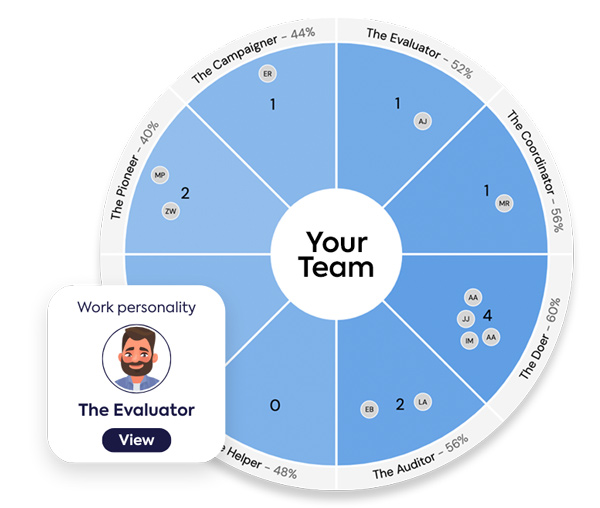
When you use the Compono platform to map out your team's work personalities, you can identify 'gaps' in your collective profile. If your entire leadership team consists of Captains and Promoters, you might be great at setting a vision but terrible at following through on the details. Adding an Analyzer or a Specialist could be the key to unlocking your team's full potential (Compono uses different terms and measurement, aligned to similar principles).

It is also important to remember that these profiles are not 'fixed' boxes that people live in forever. Whilst our natural drives tend to stay stable, we all learn to adapt our behaviour to meet the needs of our environment. Recognising where someone is 'stretching' themselves can help you prevent burnout and improve employee wellbeing.

Key takeaways for HR leaders in 2026

  • Data-driven hiring: Move beyond the CV and interview. Use behavioural profiles to understand how a candidate will actually work.
  • Team balance: Aim for a mix of profiles within teams to ensure a balance of innovation, social cohesion, and analytical rigour.
  • Personalised management: Tailor your leadership style to the profile of the individual. A Maverick needs autonomy, whilst a Specialist needs clarity and structure.
  • Continuous engagement: Use tools like Compono Engage to monitor team dynamics and ensure that everyone is working in a way that aligns with their natural strengths.

Understanding the 17 predictive index results types is a journey, not a destination. As we move through 2026, the companies that thrive will be those that treat their people as individuals with unique drives and motivations, rather than just cogs in a machine. By leveraging these insights, you can create a workplace that is not only more productive but also more fulfilling for every member of your team.

Ready to see how behavioural data can transform your recruitment and retention? You can book a demo with our team today to explore how the Compono suite approaches behavioural data and can help you build your best team yet.

Related

Building high-performing teams with work personality insights

Building high-performing teams with work personality insights

Ever looked at those dream teams that just seem to click, where everyone’s strengths complement each other perfectly, and wondered how they got it...

Read More
How to assess your team’s work personality to identify gaps

How to assess your team’s work personality to identify gaps

Ever wondered why some teams just click and others seem to struggle, even if every individual is talented? The secret often lies in understanding...

Read More
Understanding 'Work Personality': a smarter way to make hiring decisions

Understanding 'Work Personality': a smarter way to make hiring decisions

Ever feel like traditional hiring processes fall short in selecting the right fit for your team? Well, you’re not alone. The challenges of...

Read More