Skip to the main content.
FOR GOVERNMENT

AssureArrow Left

Become the expert on delivering
valid and fair assessments for
your training and education.

Compono Assure


FOR BUSINESS

HireArrow Left

Engage Arrow Left

Develop Arrow Left

Automatically match to candidates who are a great fit for your team culture and who are intrinsically motivated to succeed.

Deeply understand your organisation with science-backed analytics on your culture, team design, and engagement.

Back your onboarding, compliance and skill development with industry-leading credentialling, competency and capability expertise.


The AI that actually understands you.

Hey Compono helps you understand your personality and how to turn it into your superpower.

First 1,000 users get 10 minutes free.
Just $15 a month after that — cancel anytime.

Hey Compono


5 min read

PI behavioural assessment test guide: 2026 alternatives

PI behavioural assessment test guide: 2026 alternatives
10:17

Finding the right person for your team in 2026 feels a bit like trying to solve a Rubik’s cube while wearing oven mitts – it is complex, fiddly, and traditional methods often leave you feeling slightly disconnected from the actual prize. While the PI behavioural assessment test has been a staple in the HR toolkit for decades, the rapid shift toward hybrid work and AI-driven recruitment has changed the game, making many leaders wonder if there is a more holistic way to measure work personality.

We have all been there: you find a candidate who looks perfect on paper, but three months later, they are struggling to gel with the team or failing to adapt to your specific company culture. The problem is that a static snapshot of behaviour often fails to capture the dynamic reality of how a person actually works within a specific ecosystem. As we move through 2026, the demand for deeper, more integrated insights is driving a move away from standalone checklists toward comprehensive platforms that look at the whole person.

How the PI behavioural assessment test works in 2026

The Predictive Index, or PI behavioural assessment test, has built its reputation on a stimulus-response tool that asks candidates to select adjectives from two distinct lists. One list identifies how they perceive themselves, and the other identifies how they feel others expect them to behave. By measuring four key factors – dominance, extraversion, patience, and formality – it creates a profile of an individual’s natural PI behaviour and workplace tendencies.

An illustration of a diverse group of s represented as unique puzzle pieces that fit perfectly into a larger organisationa...

In the context of 2026, this methodology remains popular because it is fast and scientifically validated. However, it relies heavily on a self-reporting mechanism that can sometimes be influenced by a candidate’s desire to 'fit' a certain mould. While it provides a useful 'type' for an individual, it often lacks the granular data needed to predict how that personality will interact with existing team members or evolve over time as the business scales.

Most competitors will tell you about the 65 years of science behind these tests, and while that history is impressive, the modern workforce is no longer the same beast it was in the mid-20th century. Today, we need to know more than just if someone is 'patient' or 'dominant'; we need to understand their work personality in relation to the specific tasks and cultural dimensions they will face every day.

The limitations of traditional assessments in the modern workforce

One of the biggest hurdles with older behavioural models is that they often sit in a silo. You get a PDF report during the hiring phase, it gets filed away in a digital folder, and it is rarely looked at again until a performance issue arises. This 'one-and-done' approach to a personality test does not help you manage the ongoing health of your organisation or address the root causes of employee turnover.

Furthermore, the workforce in 2026 is increasingly distributed. Traditional behavioural traits like 'extraversion' manifest differently in a Zoom-heavy environment compared to a physical office. A candidate might be a social butterfly in person but struggle with the isolated nature of deep-focus remote work. Traditional tests that do not account for these environmental shifts can lead to misaligned hires who are technically capable but culturally exhausted.

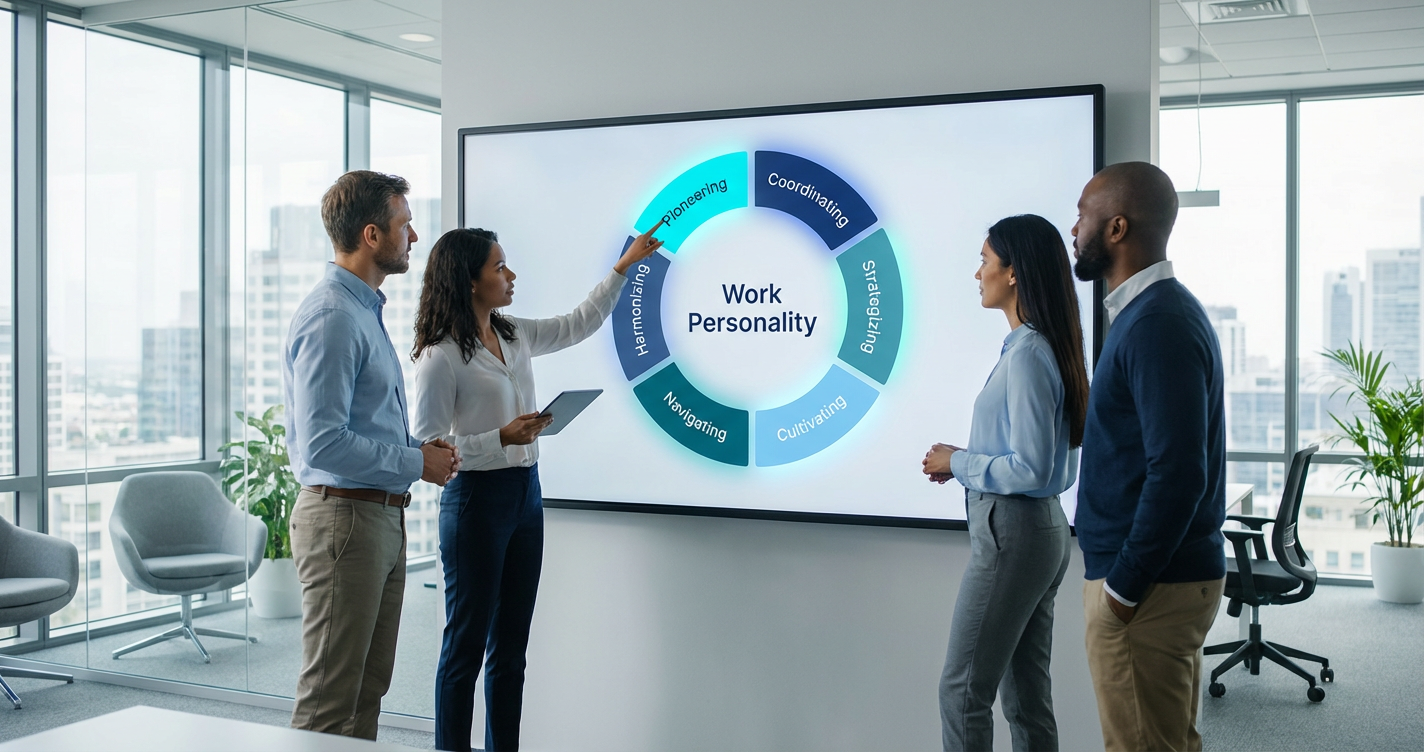
We have found that for mid-market leaders, the real value lies in seeing how these traits translate into actual work actions. At Compono, we take evidence-based organisational design seriously by mapping natural preferences to the eight key work activities that define high-performing teams: evaluating, coordinating, campaigning, pioneering, advising, helping, and doing.

A side-by-side comparison visualization. On one side, a static paper-style checklist (representing traditional PI). On the...
worktypes
The 8 work actions of high-performing teams

Introducing Compono Hire: a data-driven alternative for recruitment

If you are looking for a way to move beyond simple adjective checklists, Compono Hire offers a more integrated approach. Instead of just giving you a behavioural profile, it automatically ranks candidates based on three critical layers of fit: the job requirements, the team dynamics, and the overall company culture. It is about matching people to your DNA before you even open a resume.

By using predictive insights, you can stop relying on gut feel and start making decisions based on science. Our platform evaluates a candidate's work personality and motivations, showing you exactly how they will complement the existing strengths and blind spots of the team they are joining. This is a significant step up from the PI behavioural assessment test because it puts the data into immediate, actionable context for the specific role you are trying to fill.

Imagine being able to see, in real-time, how a new hire will shift the 'work wheel' of your department. If your current team is heavy on 'doers' but lacks 'pioneers', Compono Hire will highlight the candidates who bring that creative, out-of-the-box thinking you need to drive innovation. This level of team-matching is what separates a good hire from a great one in 2026.

Beyond the hire: why Compono Engage is the future of retention

Hiring the right person is only half the battle; keeping them engaged and productive is where the real ROI happens. This is where many traditional tools fall short. Once the PI behavioural assessment test is complete, the data often becomes static. In contrast, Compono Engage allows you to monitor the 'mood' of your organisation alongside its 'personality'.

By assessing culture and engagement together, you can identify the gaps between what your culture currently is and what your team thinks it should be to succeed. If your behavioural data tells you that you have a team of high-dominance individuals, but your engagement surveys show they feel 'suffocated' by centralised control, you have a clear roadmap for leadership intervention. You are not just guessing why morale is low; you are looking at the root cause of the misalignment.

This holistic view is essential for employee retention. When people feel that their natural work personality is aligned with the way the business actually operates, they are 84% more likely to be satisfied in their roles. Compono Engage turns behavioural data into a living breathing strategy for organisational health, rather than just a recruitment hurdle.

Comparative analysis: PI vs. Compono

When we weigh up the PI behavioural assessment test against the Compono ecosystem, the difference lies in integration and actionability. The PI test is a fantastic tool for understanding a person's 'wiring' in a vacuum. It is reliable, quick, and has decades of validity. However, it often acts as a point solution – a single piece of the puzzle that you have to fit into your strategy manually.

Compono, on the other hand, is built as a 'system of intelligence'. It does not just tell you who a person is; it tells you what they will do, how they will fit, and why they might leave. By combining Compono Hire and Compono Engage, you are creating a feedback loop that constantly refines your talent strategy. You use engagement data to build better hiring benchmarks, and you use hiring data to personalise onboarding and development.

In terms of candidate experience, Compono also offers a more modern feel. In 2026, top talent expects a seamless, digital-first experience. Our 'glow up' application process not only extracts CV data accurately but also provides candidates with immediate value by showing them their own work personality insights. This builds rapport and employer brand equity from the very first interaction.

Choosing the right tool for your 2026 talent strategy

At the end of the day, the 'best' test is the one that actually helps you build a better business. If you only need a quick behavioural snapshot to help with interview questions, the PI behavioural assessment test is a solid choice. But if you are a mid-market leader responsible for 60 to 1,000+ staff, you likely need more than just a snapshot. You need a co-pilot that helps you lead through the fog of rapid growth and changing work models.

By shifting to a platform that unifies hiring, engagement, and development, you remove the doubt that leads to mis-hires and toxic cultures. You start building teams that are high-performing by design, not by accident. You move from being a 'rule keeper' to being a strategic architect of your company's future.

If you are ready to see how your team really thinks and works, it might be time to look beyond the traditional checklist. The science of work has evolved, and your toolkit should too. Whether you are navigating a global talent shortage or trying to fix a disjointed culture, the answer lies in data that is connected, continuous, and deeply human.

Key takeaways

  • The PI behavioural assessment test measures four key traits but often lacks role-specific and cultural context.
  • Traditional assessments frequently sit in silos, whereas modern platforms like Compono integrate behavioural data across the entire employee lifecycle.
  • Compono Hire uses predictive matching to rank candidates against job, team, and culture DNA.
  • Compono Engage identifies cultural 'hotspots' and misalignments that cause turnover, providing a proactive roadmap for retention.
  • In 2026, a 'Hire-to-Retain' ecosystem is more effective than standalone personality tests for mid-market business success.

Where to from here?

Related

How to assess your team’s work personality to identify gaps

How to assess your team’s work personality to identify gaps

Ever wondered why some teams just click and others seem to struggle, even if every individual is talented? The secret often lies in understanding...

Read More
Understanding 'Work Personality': a smarter way to make hiring decisions

Understanding 'Work Personality': a smarter way to make hiring decisions

Ever feel like traditional hiring processes fall short in selecting the right fit for your team? Well, you’re not alone. The challenges of...

Read More
Building high-performing teams with work personality insights

Building high-performing teams with work personality insights

Ever looked at those dream teams that just seem to click, where everyone’s strengths complement each other perfectly, and wondered how they got it...

Read More