

.webp)

 Mathan Allington


The ATS to onboarding handover: complete guide for 2026
 Mathan Allington
To fix the broken ATS to onboarding handover. Discover the root causes of preboarding failures and how to connect your hiring and HR systems.
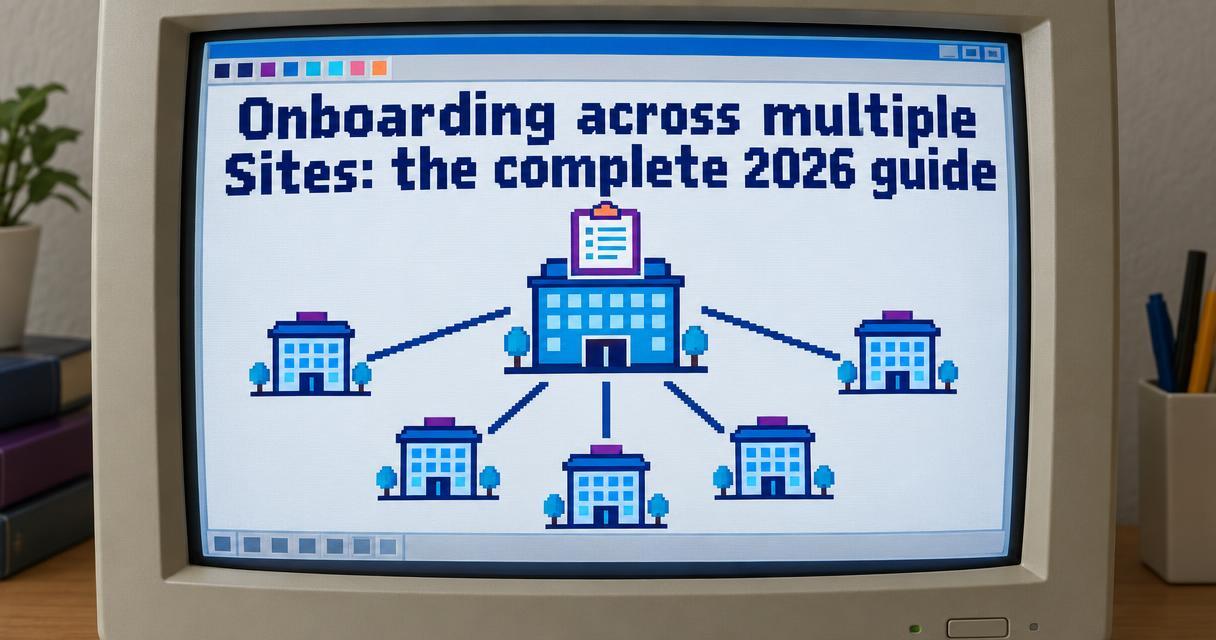
Onboarding across multiple sites requires a central framework for corporate compliance alongside local flexibility for site-specific operations.
Last reviewed October 2026
Key takeaways
- Head office must control core compliance and brand messaging to ensure consistency across the network.
- Local site managers need autonomy to handle practical orientation and team introductions.
- Automated workflows prevent paperwork bottlenecks and reduce the administrative burden on frontline managers.
- Role-based training paths ensure new hires only receive information relevant to their daily tasks.
- Success is measured by time to productivity and early retention rates rather than simple checklist completion.
Managing new hires in a single office is hard enough. When you distribute that process across ten, fifty or two hundred locations, the complexity multiplies. Head office wants strict adherence to brand standards and compliance. Site managers just want an extra pair of hands on the floor immediately. This tension often results in a disjointed experience for the new employee.
Data shows that 38% of organisations say employee onboarding is not meeting expectations. When you scale a broken process across a distributed network, the operational drag becomes massive. Paperwork gets lost in back offices. Critical safety training is skipped during busy shifts. Culture becomes entirely dependent on the mood of the local manager on day one.
Fixing this requires a structural shift. You need to separate the administrative burden from the human experience.
The primary failure point in distributed onboarding is the reliance on local managers to execute corporate administration. A store manager or site supervisor is usually measured on daily output, customer satisfaction and shift coverage. They are rarely measured on how well they explain the corporate history or process tax file declarations.
Research highlights this exact operational bottleneck. 41% of companies identify lack of manager time as their biggest onboarding barrier. When managers are stretched thin, onboarding becomes a rushed checklist rather than a structured integration into the business.
This creates a severe inconsistency in the employee experience. A new hire at your flagship city location might receive a thorough induction and a welcome lunch. A new hire at a regional site might get handed a uniform and told to shadow someone on the register. Both employees represent your brand, but only one has been set up to succeed.

You cannot script every minute of a new hire's first week. You can build a framework that guarantees the non-negotiable elements happen consistently. A successful multi-site strategy divides responsibilities clearly between the central support office and the local site.
We recommend establishing employee onboarding best practices that split the workload. Head office handles the universal requirements. The local site handles the practical reality of doing the job.
| Head Office Responsibility | Local Site Responsibility |
|---|---|
| Employment contracts and payroll setup | Site tour and facility access |
| Core brand values and company history | Team introductions and buddy assignment |
| Universal safety and compliance training | Site-specific hazard walkthroughs |
| IT provisioning and system access | Practical shadowing and shift routines |
This division of labour ensures compliance is locked down centrally while giving local managers the space to focus on human connection. The local manager does not need to explain the company's five-year vision. They need to show the new hire where the break room is and how the point-of-sale system works.
You cannot run a multi-site network on paper forms and email chains. Manual processes inevitably break down when scaled across different postcodes and timezones. Centralising your data is the only way to maintain visibility over who has started, what they have completed and where the bottlenecks are.
The shift to digital infrastructure delivers measurable returns. Automated onboarding can help new hires reach full productivity approximately two months faster. By moving the administrative heavy lifting into an employee onboarding portal, new hires can complete their paperwork, read the policies and watch the welcome videos before they even arrive for their first shift.
This pre-boarding phase is critical. When a new hire walks through the door on day one, they should be ready to meet their team and learn the job. They should not spend their first three hours sitting in a back office filling out superannuation forms.
Using a platform like Compono Develop allows head office to push standardised induction modules directly to the new hire's device. You can track completion rates globally while giving local managers a simple dashboard showing who is cleared to start work. We saw this exact approach transform operations in The Coffee Club's recipe for hiring success, where central visibility replaced scattered local processes.
A blanket approach to training wastes time. A barista does not need the same induction as a regional area manager. A warehouse forklift driver requires entirely different safety modules than a customer service representative.
Industry data supports this need for specific pathways. 74% of HR leaders say onboarding should be personalized by role. When standardising programs across multiple sites, you must build modular training paths that adapt to the specific job title.
Start by mapping the core competencies required for each role in your network. Group the universal modules together. Every employee needs the code of conduct and the basic safety overview. Then build role-specific branches. The shift supervisor branch includes inventory management and cash handling. The frontline staff branch focuses on customer interaction and product knowledge. This modular design means you only update a training module once and the change cascades across every relevant role in the network.
Operating across state or national borders introduces a massive compliance headache. Different regions have different requirements for workplace health and safety, food handling, responsible service of alcohol and manual handling. Relying on local managers to track these expiring qualifications is a major operational risk.
When choosing onboarding software for Australian businesses, you must prioritise systems that enforce compliance gates. A new hire should be physically blocked from being rostered for a shift until their mandatory regional certifications are verified and recorded.
This is where an audit-ready system becomes non-negotiable. If a regulator visits a site in Queensland, the local manager needs immediate access to the training records for every person on shift. A platform like Compono Assure handles this by centralising the evidence. It tracks exactly who completed what training, when they completed it and when it expires, removing the compliance burden from the site manager's shoulders.
Most organisations measure onboarding success by tracking checklist completion rates. Knowing that 98% of new hires signed the handbook tells you nothing about whether they are actually ready to do the job.
You need to measure outcomes rather than inputs. The data proves the value of getting this right. organisations with formal onboarding programs report 50% higher new-hire productivity. To track this across a multi-site network, you need to monitor three specific metrics.
First, track time to productivity. Define what a fully productive team member looks like for each role and measure how many days it takes a new hire to reach that benchmark. Second, monitor first-90-days turnover. If one specific site has a massive spike in early turnover compared to the rest of the network, you have a local leadership or culture problem, not a recruitment problem. Third, run automated pulse surveys at day 7, day 30 and day 90 to catch issues before the employee resigns.
Different industries face unique hurdles when distributing their onboarding programs. A strategy that works for a retail chain will fail in a healthcare setting.
Retail and hospitality networks deal with high volume and high turnover. Their onboarding must be rapid, mobile-first and highly practical. The focus is on getting the employee onto the floor safely and ensuring they understand the point-of-sale systems. Pre-boarding is essential here to keep day one focused on customer interaction.
Healthcare and aged care providers face entirely different pressures. The regulatory burden is immense. Onboarding across multiple clinics or care facilities requires rigorous credential checking, police clearances and specialised manual handling assessments. Speed is less important than absolute certainty regarding compliance and patient safety.
Logistics and manufacturing sites prioritise physical safety above all else. Onboarding in these environments requires site-specific hazard identification. A central video about warehouse safety is not enough. The local manager must conduct a physical walk-through of the specific machinery and traffic management plans at that exact location.
Scaling your workforce across multiple locations requires systems that balance central governance with local execution. We build tools that handle the compliance heavy lifting so your site managers can focus on welcoming their new team members.
You maintain culture by defining clear, non-negotiable behaviours centrally and allowing local sites to express those behaviours in their own way. Head office sets the values, but the local manager demonstrates them through their daily actions. Regular check-ins and cross-site communication channels also help remote employees feel connected to the broader organisation.
Ownership must be shared. The central HR or People team owns the system, the compliance tracking and the universal content. The local site manager owns the human experience, the practical training and the immediate team integration. Clear boundaries prevent tasks from falling through the cracks.
A proper onboarding program lasts at least 90 days. The administrative and orientation phase might take a week, but the integration into the team and the journey to full productivity takes months. Stopping the process after week one is the leading cause of early employee turnover.
You can use the same core content for universal policies like code of conduct, payroll setup and cybersecurity. You must customise the content for site-specific elements like emergency evacuation procedures, local leadership structures and specific equipment usage.
The biggest mistake is treating onboarding as a paperwork exercise and dumping the entire administrative burden onto busy frontline managers. When managers are forced to choose between serving customers and processing HR forms, the forms either get rushed or ignored entirely.
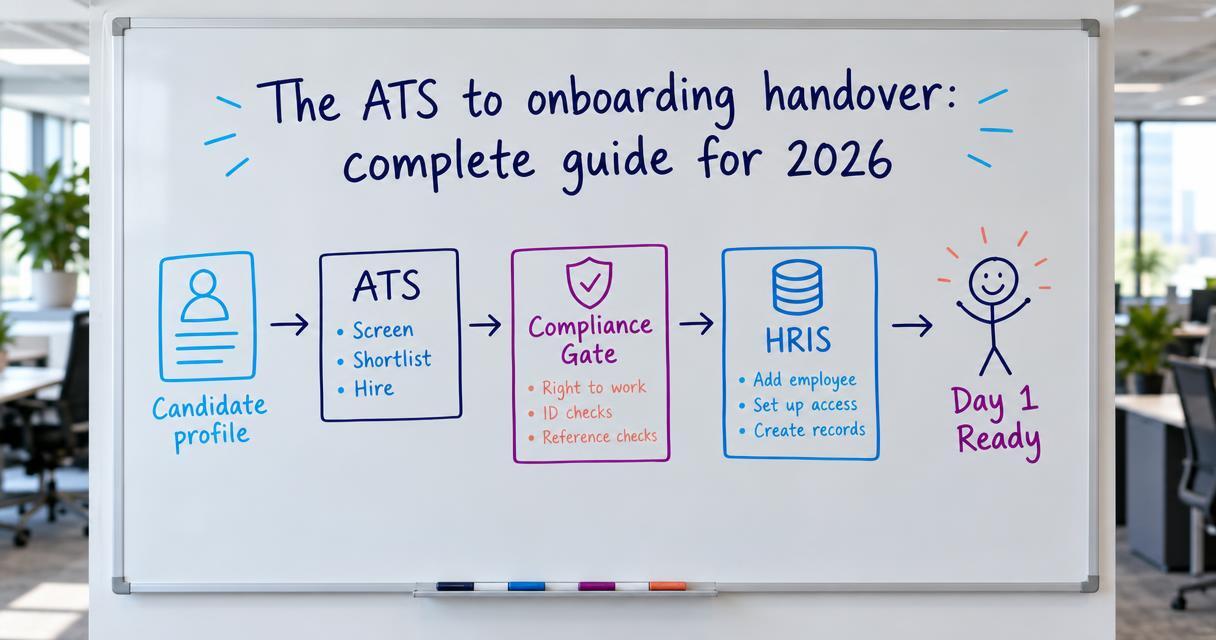
To fix the broken ATS to onboarding handover. Discover the root causes of preboarding failures and how to connect your hiring and HR systems.
An onboarding portal gives new starters one place for forms, policies, training and introductions. What a good one includes and why people ignore bad...

Onboarding software for Australian teams compared: which platforms handle TFN, super and Fair Work paperwork, what to look for, and how to choose in...