

.webp)

 Mathan Allington


How culture fit drives employee engagement in modern teams
 Mathan Allington
How culture fit and engagement feed each other, why matching values and work style lifts retention, and what to measure to see it happening.

Measuring company culture means going past the office vibe and the coffee-machine chat. It is about reading the invisible glue that ties your team to your business goals, so you can see whether everyday behaviour and decisions actually support performance rather than just measuring how happy people feel today.
Last reviewed July 2026.
For years we have relied on pulse surveys to tell us how our people are doing. Knowing whether your team is happy matters, but sentiment is really a measure of the mood of the office. It is a lagging indicator that tells you how people feel today, not why they feel that way or how their work environment is actually functioning.
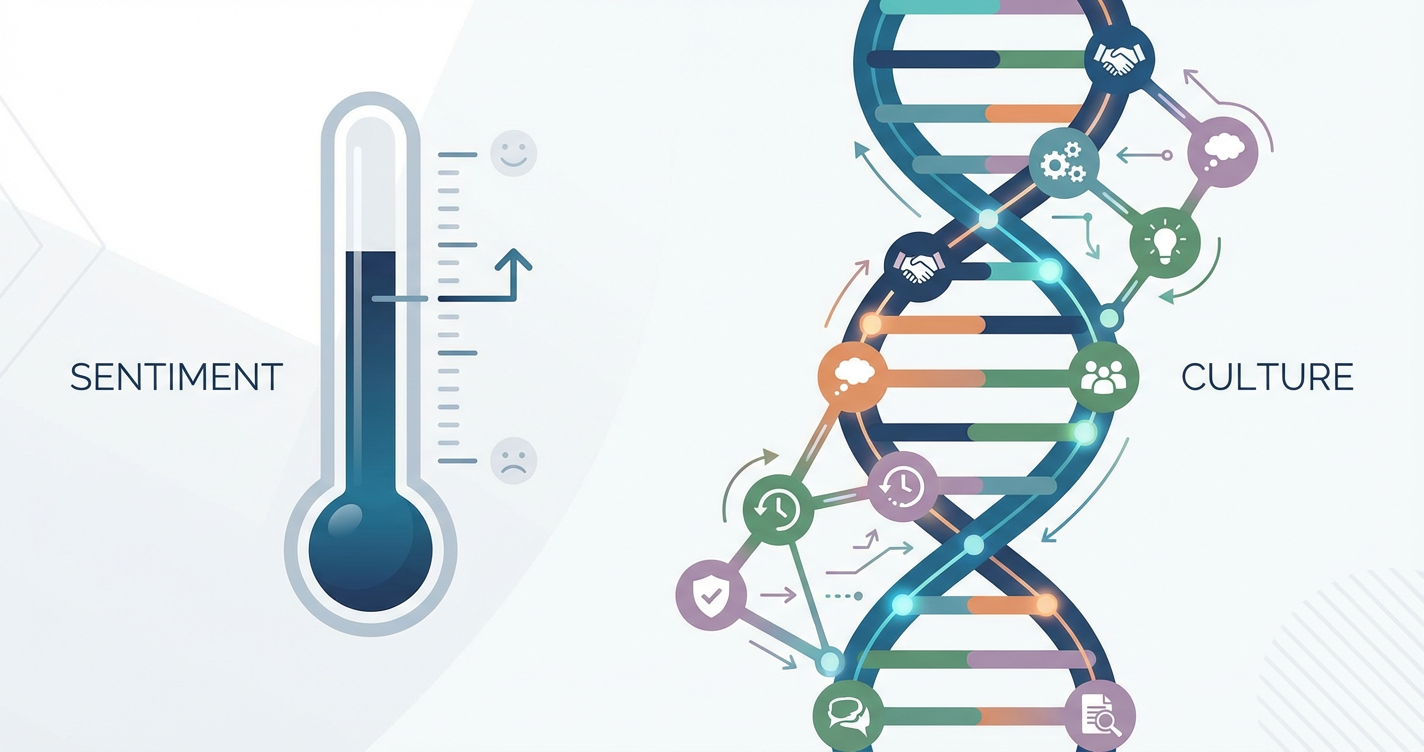
Think of it like a quick health check. A doctor can take your temperature and tell you that you have a fever, but without a blood test or an X-ray they cannot tell you what is causing the illness. In business, sentiment surveys show the symptoms while culture measurement reveals the underlying cause. To truly measure culture, you need to look at the systems, structures and values that shape daily behaviour.
When we confuse engagement with culture, we treat the symptoms rather than the cause. You might throw a pizza party to lift a low engagement score, only to find the real problem is a centralised control structure that suffocates new thinking. Move beyond sentiment and you get the clarity to make changes that actually last.
At Compono, we see culture as the personality of your organisation and engagement as its mood. Our research-driven model treats culture as an upstream driver. It sets the tone for how work gets done, which then shapes how engaged your employees feel. If the culture is out of step with the work people actually do, engagement drops.
High-performing teams use the Compono Engage methodology to map their current work environment against 12 validated dimensions. This is not about good or bad culture. It is about alignment. Is the way you do things around here helping you meet your strategic goals? If your business plan calls for rapid innovation but your culture is strictly process-driven, you have a performance gap that no amount of sentiment tracking will fix.
By reading culture and engagement together, you can find the hotspots where the work atmosphere holds teams back. This wider view surfaces the leading indicators of success. When you align your current culture with the state you want, your people find it easier to adopt the behaviours that lead to better results. HR shifts from policy enforcer to strategic architect.
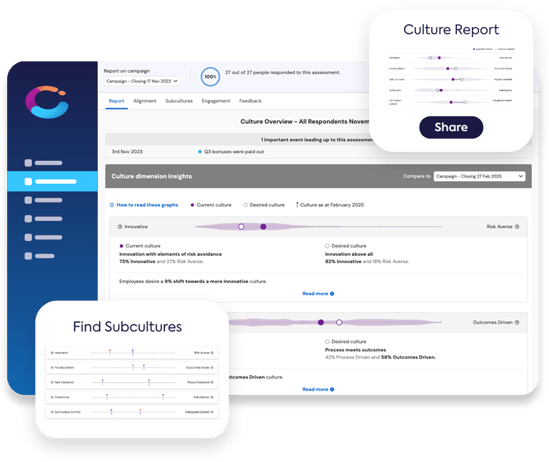
To get an accurate read on your organisation, break culture down into measurable parts. We use 12 distinct dimensions to describe how an organisation functions. They range from how decisions are made, from centralised to delegated control, to how teams interact, from cooperation to competition. Knowing where you sit on these scales gives you a blueprint of your company's make-up.
Consider the responsive versus planned dimension. In a fast-moving tech environment, responding quickly to customer needs might be an advantage. On a large infrastructure project, a planned culture that protects long-term goals is essential. Neither is inherently better, but one will suit your specific mission more than the other. Measuring these traits lets you be deliberate about the environment you build.
This level of detail is exactly what Compono Engage provides. Instead of guessing, you get data-backed insight into whether your hierarchy is too rigid or your team is prioritising internal effectiveness over customer satisfaction. You stop sleepwalking through your culture and start designing it with intent. Once you know the dimensions of your culture, you can hire for fit more accurately with tools like Compono Hire.
One of the biggest mistakes is assuming your culture is uniform across the business. In reality, each department often has its own subculture. The sales team might be highly competitive and outcomes-driven while engineering is more collaborative and process-oriented. These differences are natural, but they cause friction when they are not understood and managed.
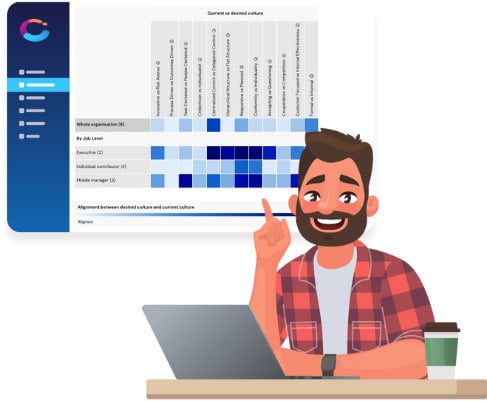
Measuring culture at team level lets you find hotspots of misalignment. Perhaps your marketing team feels they lack the freedom to be creative, even though leadership believes the company is highly inventive. That gap between actual and perceived culture is where disengagement breeds. Pinpoint these specific areas and you can target your effort where it is needed rather than applying a one-size-fits-all fix.
Filtering by department, location or tenure reveals the nuance. You might find that new hires see the culture very differently to people who have been with you for five years. This insight is vital for retention. If your true culture does not match the one you sold during recruitment, turnover will spike. Making sure your Compono Hire benchmarks match the reality on the ground is the first step to a stable, high-performing workforce.
Data is only useful if it leads to change. Once you have measured your culture and found the gaps, equip your leaders with insight they can act on. This is where HR moves from cost centre to strategic partner. You are not just reporting on problems, you are handing over the way to solve them.
If your assessment shows a lack of delegated control, the answer is not simply to trust people more. It might mean redesigning workflows, updating decision-making policies, or giving managers leadership training through a platform like Compono so they learn how to hand real ownership to their teams. The measurement provides the what, and your strategy provides the how.
The pace of business rewards being proactive. Waiting for an annual survey to tell you people are unhappy is too late. Continuous measurement of the work environment lets you track the effect of your change work in real time. It gives the board and the frontline a common language, making culture a tangible asset you can improve alongside financial or operational performance.

Map your work environment across 12 validated dimensions and see exactly where culture is helping or holding your teams back.
Talk to usCulture is how work gets done, the shared behaviours and structures that shape daily decisions. Engagement is how people feel about working here. Culture is the personality of the organisation and engagement is its mood, so you need to measure both to understand performance.
Pulse surveys capture sentiment, which is a lagging indicator of how people feel right now. They rarely explain why people feel that way or how the work environment functions. To measure culture you need to read the systems, structures and values that drive behaviour, not just the mood.
Compono measures culture across 12 validated dimensions, including how decisions are made (centralised versus delegated control), how teams interact (cooperation versus competition) and how the business responds to change (responsive versus planned). Knowing where you sit gives you a blueprint you can act on.
Start by finding the gaps between your current culture and the one your strategy needs. Then target specific changes, such as redesigning workflows, updating decision rights or training managers, and track the effect over time rather than waiting for an annual survey.

How culture fit and engagement feed each other, why matching values and work style lifts retention, and what to measure to see it happening.

How to measure workplace culture with surveys, behavioural data and work personality mapping, and turn the results into changes your team can see.

Industry culture benchmarks can flatter or mislead. What they show, what they hide, and how to measure culture against your strategy instead.