

.webp)

 Mathan Allington


A guide to evidence-based hiring for modern teams
 Mathan Allington
Evidence-based hiring uses data, assessments and structured interviews to cut bad hires and bias. A practical guide to doing it well, step by step.

When graduate applications all look the same, stop screening on experience signals. Pick the best graduates by defining a success profile from your own top performers, testing potential with work samples and behavioural interviews, ranking candidates on objective assessment data, and keeping your best prospects engaged until day one.
Last reviewed July 2026.
Your graduate intake closes and the ATS shows three hundred applications that read almost identically: a high credit average from a reputable Australian university, a stint of retail or hospitality work, and a genuine-sounding cover letter. GPA and university brand cannot separate them, and when we cannot find objective differences, we default to hiring people who look and sound like us. Here is the process that fixes that.
Graduates have not had the chance to build the experience signals recruiters usually rely on, so their CVs measure background, not capability. Academic success does not reliably translate to workplace success either. Relying on transcripts risks missing the hidden gems: candidates with the behavioural fit and cognitive agility to thrive in your specific environment, filtered out because they studied philosophy instead of commerce or worked part-time instead of taking an unpaid internship.
The fix is to shift the question from what a graduate has done to what they are capable of doing. Everything below follows from that shift.
Before assessing anyone, define what "right" looks like for your organisation. Analyse the current top performers who joined as graduates. What do they share? It is rarely their degree major. More often it is curiosity, resilience with difficult clients, or the ability to synthesise complex information quickly.
Build a success profile from those behaviours and cognitive traits, and loosen rigid degree requirements where you can. What matters most is learning agility, the ability to unlearn and relearn, because the technical skills a graduate brings today may be obsolete in three years. A philosophy major might have exactly the critical thinking your data team needs, and an old-fashioned keyword filter would never surface them.
Rehearsed answers to "Where do you see yourself in five years?" tell you nothing. To separate similar candidates you need to see them work:

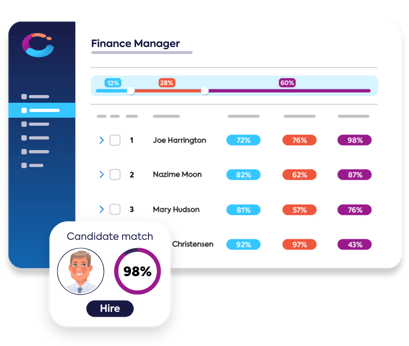
At intake scale, manual screening is impossible, and skimming three hundred PDFs is where bias creeps back in. A modern applicant tracking system (ATS) should rank candidates against your success profile, not just store documents.
This is what Compono Hire is built for. It goes beyond keyword matching with science-backed assessments that measure behavioural fit and cognitive ability, and it predicts culture fit. Your recruiters spend their time talking to the highest-potential people rather than wading through paperwork, and every shortlist decision has data behind it.
Speed matters too. Graduates expect a mobile-first application experience, and if your process is clunky or takes forty minutes, your best candidates drop out and accept elsewhere. Automate scheduling and status updates so the human time goes into relationships.
Prestige bias, favouring elite universities and unpaid-internship CVs, quietly excludes brilliant candidates from lower socioeconomic backgrounds. Counter it deliberately:
Strong graduates hold multiple offers, and how you treat them during recruitment is your culture on display. Personalise communication using what you learned in assessment: if someone performed exceptionally on a task, tell them. Between offer and start date, run keeping-warm touches such as regular check-ins, team lunch invitations and early access to learning materials, because reneging is most likely in that quiet gap.
The candidates you do not hire still matter. Someone not quite right this year may be perfect for a role in twelve months, and constructive feedback plus a respectful process keeps that pipeline warm while lowering your future time-to-hire.
A sink-or-swim start undoes everything above and drives turnover inside six months. Begin onboarding before day one with an introduction to the mission and the immediate team. Pair each graduate with a mentor who is not their direct manager, so they have a safe person for the silly questions. Give meaningful work with clear short-term goals from week one.
Then use your recruitment data to shape each development plan. A graduate with leadership potential who needs presentation practice should see that built into their first year. Compono Engage helps here, tracking sentiment so you know your new starters are motivated and aligned, not quietly drifting towards a second job search.
Hire ranks graduate candidates on behavioural fit and potential, with validated culture-fit prediction.
Talk to usTest capability directly instead of reading for experience. Work-sample tasks, situational judgement tests and behavioural questions about university projects or volunteer work all produce evidence of how a graduate actually operates, which predicts performance better than GPA.
Only as one signal among many. Academic results measure one kind of ability in one kind of environment. Learning agility, behavioural fit and performance on realistic work samples are stronger predictors of who will succeed in your organisation.
Blind the initial screen by hiding names, gender and university, score every candidate against the same rubric, use diverse interview panels, and shortlist on objective assessment data rather than CV impressions.
Stay present between offer and start date. Regular check-ins, team invitations and early access to learning materials keep the connection alive, and personalised communication makes your offer the one that feels real when a competing recruiter calls.

Evidence-based hiring uses data, assessments and structured interviews to cut bad hires and bias. A practical guide to doing it well, step by step.

Time to hire is usually lost between the steps, not inside them. Where the delays hide and what to change first so offers go out sooner.

The five steps of job analysis explained, from defining purpose to validating with your team, so every hire is built on evidence instead of guesswork.
 Compono