

.webp)

 Mathan Allington


Psychometric Testing for Recruitment: 2026 Guide & Alternatives
 Mathan Allington
The advantages and disadvantages of psychometric testing for recruitment in 2026, and how behavioural science is replacing pass or fail exams.
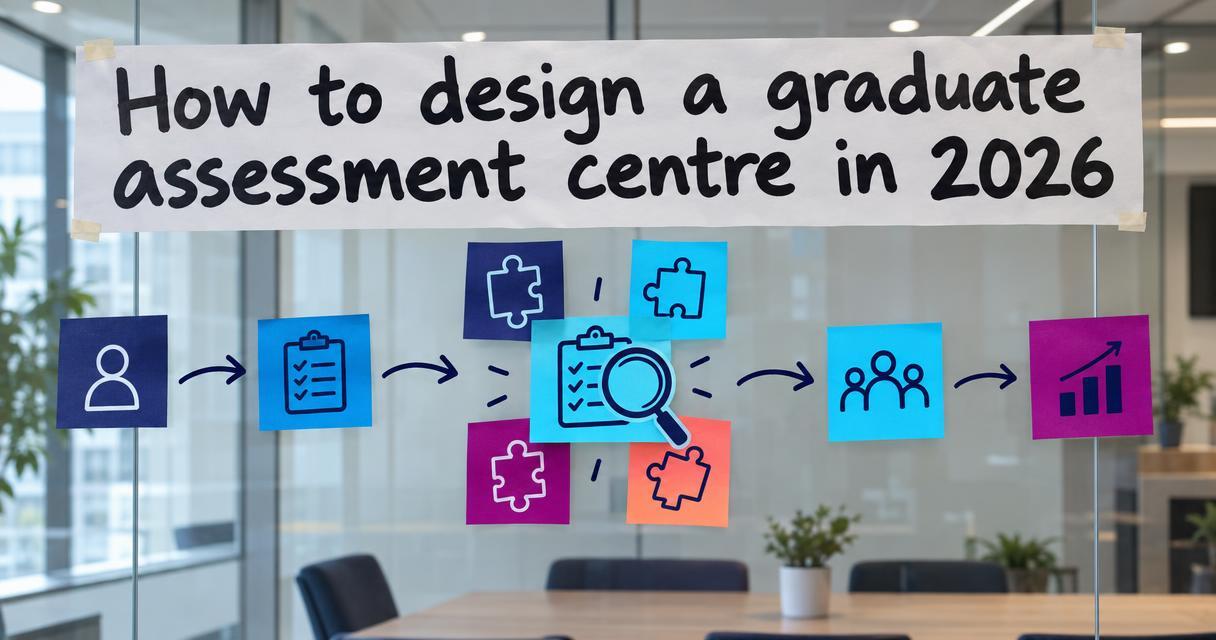
A graduate assessment centre is a structured evaluation process where employers combine multiple exercises and psychometric tests to measure candidate capability rather than relying on a single interview.
Last reviewed October 2026
When candidates have identical degrees and zero professional work history, traditional interviews fail to predict who will actually perform on the job. A well-designed assessment centre solves this by putting candidates into simulated work scenarios to observe their actual behaviour.
Key takeaways
- Structured assessment centres offer a predictive validity of 0.65 for job performance compared to just 0.20 for unstructured interviews.
- Group exercises remain the most common evaluation method because they expose how candidates handle peer changing and conflict.
- Replacing CV screening with behavioural and cognitive assessments reduces bias and increases long-term retention.
- Virtual assessment centres can match the effectiveness of in-person events if assessors use standardised scoring rubrics.
Graduate recruitment is fundamentally different from lateral hiring. You receive thousands of applications from candidates with nearly identical academic backgrounds. They have no track record of professional success to evaluate. You cannot ask behavioural interview questions about complex stakeholder management when the candidate has only worked casual retail shifts.
When you rely on standard interviews for graduates, you usually end up hiring the person who speaks the most confidently. Confidence is easy to fake in a forty-minute conversation. Competence is much harder to fake across a full day of simulated work tasks.
This is why 69% of UK employers used assessment centres for graduate recruitment in 2023, according to data from Hyring. Employers need a mechanism to see how a candidate thinks, collaborates, and solves problems in real time. They need objective data to make a hiring decision that will stick.
The primary goal of any hiring process is to predict future job performance. Traditional interviews are notoriously bad at this. Unconscious bias creeps in quickly. Interviewers favour candidates who share their background or communication style.
Assessment centres fix this by triangulating data. You measure the candidate across multiple exercises using multiple assessors. This approach drastically improves the accuracy of your hiring decisions. According to research cited by Hyring, a graduate assessment centre has a predictive-validity coefficient of 0.65 for job performance, compared with just 0.20 for unstructured interviews.
Better prediction leads directly to better business outcomes. Companies that use structured assessment centres reported 64% higher two-year retention among graduate hires than companies relying primarily on interviews, as noted by Gradivate. When you assess candidates accurately, they are more likely to succeed in the role and stay with your organisation.
A successful graduate assessment centre requires a mix of activities. Each exercise should target specific competencies from your hiring matrix. You want to see how candidates operate individually and as part of a team.
This is the foundation of the assessment centre. Around 92% of candidates encounter a group exercise during an assessment centre, according to AssessCandidates. The group task forces candidates to work together to solve a problem or reach a consensus under a strict time limit.
You are looking for collaboration and emotional intelligence. Many candidates assume they need to dominate the conversation to stand out. The best assessors look for the candidate who brings quiet members into the discussion, synthesises different viewpoints, and keeps the group focused on the objective.
Candidates are usually given a brief and asked to prepare a short presentation. Sometimes they receive the brief days in advance. Other times they get it on the day with thirty minutes to prepare. This exercise measures communication skills, information processing, and the ability to handle pressure during the Q&A session.
This simulates a typical morning in the job. The candidate receives an inbox full of emails, reports, and requests. They must prioritise the tasks, draft responses, and make quick decisions. It is a highly effective way to measure analytical thinking and time management.
When designing these tasks, it helps to review your graduate recruitment strategies to ensure the exercises reflect the actual daily reality of the role.
Observational exercises are powerful. They also introduce human error. Even trained assessors can misinterpret a candidate's behaviour. You need objective data to balance the subjective observations.
This is where formal testing comes in. Before candidates even reach the assessment centre, you should use a psychometric assessment to evaluate cognitive ability and work personality. This gives you a baseline understanding of how the candidate processes information and what their natural work preferences are.
During the assessment centre, you use this data to inform your observations. If a candidate scored highly on collaborative traits in their personality profile but appears quiet in the group exercise, your assessors can probe deeper during the one-on-one interview to understand their working style. Remember that assessment design is decision design. Every test you include must tie directly to a competency you need to measure.
The most perfectly designed group exercise is useless if your assessors do not know how to score it. Assessor training is the most frequently overlooked element of graduate recruitment.
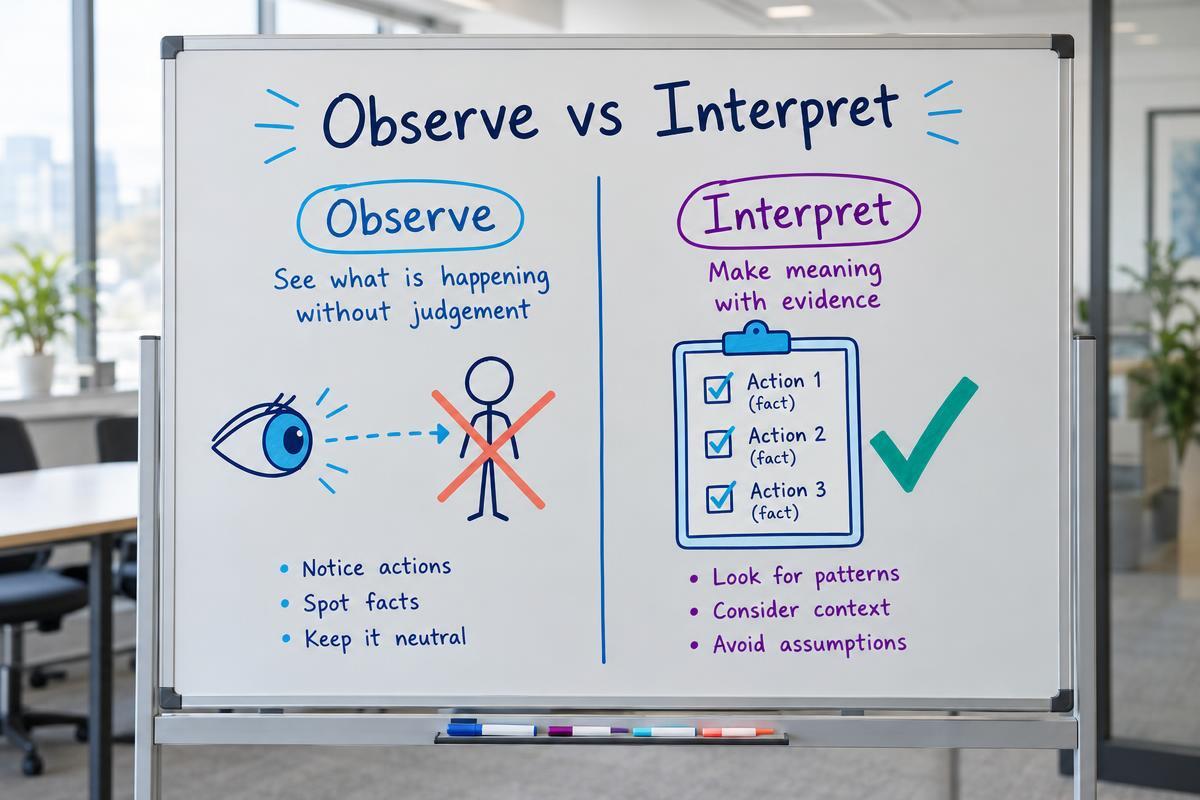
Assessors must understand the difference between observing behaviour and interpreting behaviour. Observing means noting that a candidate interrupted another speaker twice. Interpreting means labelling that candidate as aggressive. Assessors should only record observations during the exercise. The interpretation happens later during the wash-up session using a standardised scoring rubric.
You also need to train assessors to look past extroversion. The loudest person in the room is rarely the most competent. By focusing on specific behavioural indicators, your team can start engineering a smarter way to hire graduates that rewards actual capability over superficial polish.
Virtual assessment centres became the default a few years ago. Many organisations have kept them because they drastically reduce costs and improve accessibility for candidates from different geographic regions.
A virtual assessment centre requires different logistics. Group exercises happen in breakout rooms. Presentations require screen sharing. The core principles of measurement remain exactly the same. You still need multiple exercises, trained assessors, and a clear competency matrix.
The main challenge with virtual delivery is candidate engagement. Sitting on video calls for six hours is exhausting. If you run a virtual centre, build in frequent breaks. Keep the exercises short and highly structured to maintain energy levels.
The final step of the graduate assessment centre is the wash-up session. This is where all assessors gather to discuss the candidates and make final hiring decisions.
Do not let the most senior person in the room dictate the outcome. Every assessor should present their scores and the behavioural evidence they recorded. If there is a discrepancy between two assessors, they must debate the evidence, not their gut feelings. This structured debate is what makes the assessment centre so highly predictive of future performance.
Compono provides the tools you need to build a fair, objective, and highly predictive graduate recruitment process.
Candidates participate in a series of simulated work exercises, including group discussions, presentations, and individual interviews. Employers use these activities to observe how candidates behave, collaborate, and solve problems in real time.
Most graduate assessment centres last for a full working day, though some complex programs may span two days. Virtual assessment centres are often condensed into a half-day format to prevent video fatigue.
Assessors look for communication skills, teamwork, and emotional intelligence. They want to see candidates who can present their own ideas clearly while also listening to others, managing conflict, and keeping the group focused on the final objective.
Virtual assessment centres are highly effective when designed correctly. They measure the same core competencies using digital collaboration tools. They also offer the added benefit of testing how well candidates communicate and operate in a remote work environment.
Employers typically invite between six and twelve candidates per session. This size allows for effective group exercises while ensuring assessors can properly observe and score every individual participant.

The advantages and disadvantages of psychometric testing for recruitment in 2026, and how behavioural science is replacing pass or fail exams.

Looking for TestGorilla alternatives in 2026? Discover top assessment platforms that go beyond basic skills to evaluate true candidate fit and...

Cut application friction, stop ghosting, assess fairly and handle rejection well, with the specific changes candidates notice and tell others about.