

 Mathan Allington
How to run a talent review meeting that drives real
 Mathan Allington
To run a talent review meeting that reduces bias and builds succession plans. Get practical agendas, HR facilitation scripts, and legal guardrails.

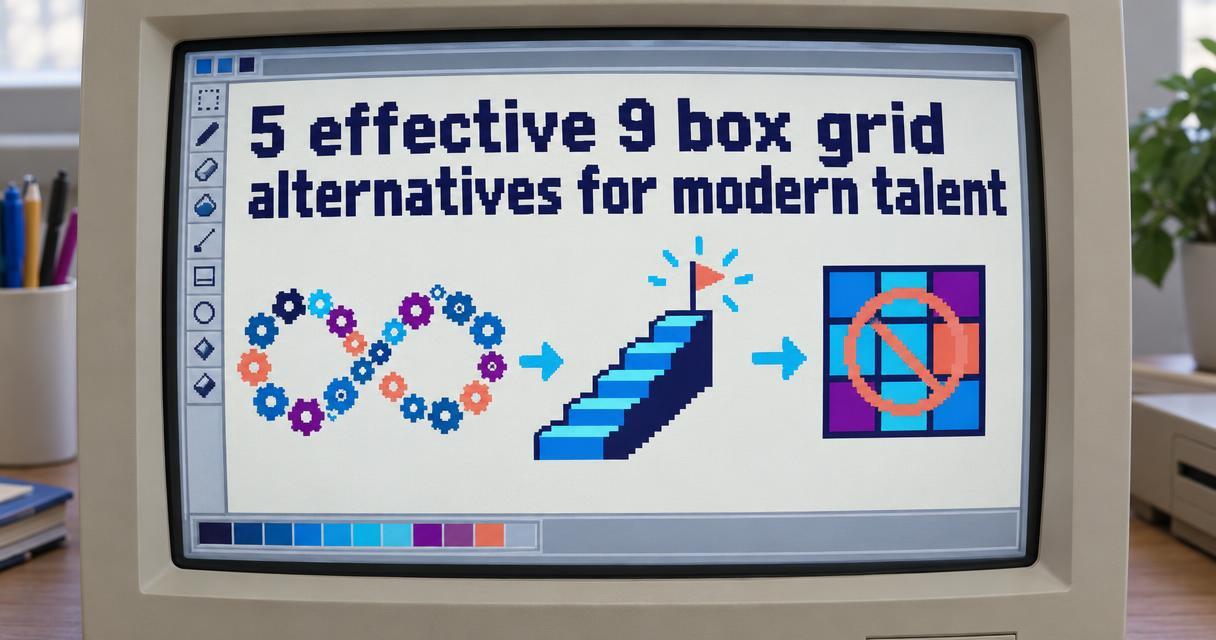
The most effective 9 box grid alternatives are skills matrices, continuous feedback models, and four-box impact grids that measure actual capability rather than subjective potential.
Last reviewed November 2026
Key takeaways
- Traditional nine-box grids rely on subjective potential ratings that often introduce bias into talent management decisions.
- Modern teams are replacing static annual reviews with skills matrices that map observable and provable capabilities.
- Continuous feedback frameworks deliver real-time performance insights and significantly reduce employee turnover.
- Agile four-box models focus on current impact and future growth trajectories rather than applying rigid, permanent labels.
- Transitioning to a new model requires separating performance measurement from compensation discussions to maintain psychological safety.
Many organisations still rely on the nine-box grid for succession planning and talent management. The process plots employees on two axes, usually past performance and future potential. On paper, it looks highly structured. It categorises staff into distinct boxes to help human resources teams decide who gets promoted, who needs development, and who might be underperforming.
This model fails because it manages process risk while entirely ignoring people insight risk. Traditional HR systems track the workflow of the annual review. They ensure managers fill in the forms and store the final grid. However, they ignore the risk of making critical talent decisions based on flawed assumptions about human behaviour. When you understand who people actually are, rather than just what a single manager thinks of them, you build much stronger teams.
It is important to understand the traditional nine-box grid fully before you try to replace it. Once you see the structural flaws in how it forces managers to label their people, the need for a modern alternative becomes obvious.
The biggest structural issue with the traditional grid is its heavy reliance on predicting future potential. Performance is observable, but potential is a guess. Assessing future capability is subjective and leaves ample room for unconscious bias to derail talent pipelines.
When managers sit in a calibration session, the loudest voice often dictates the outcome. According to research published by Culture Amp, "potential" ratings can create bias because future capability is subjective and difficult to assess consistently. A manager might rate an employee as low potential simply because that employee solves problems differently to how the manager would.
This subjectivity has documented consequences for diversity. A study from Seed People Consulting examined nearly 30,000 management-track employees, highlighting risks in using subjective potential assessments for talent decisions and identifying clear gender promotion gaps. When promotions rely on gut feeling, diverse talent often gets left behind in the middle boxes.
Labelling an employee as "low potential" creates a self-fulfilling prophecy. When employees learn that the organisation has decided their ceiling, they naturally disengage. The label stigmatises them. It destroys psychological safety and discourages them from taking risks or pursuing further development. Talent mapping should encourage growth, not cap it.
The traditional grid is usually an annual event. It provides a static snapshot of an employee at one single moment in time. Modern workplaces change rapidly. A static label fails to capture skill acquisition, changing project demands, or shifting team changing throughout the year. Teams need a live view of capability, not a historical document stored in a filing cabinet.
If the traditional model is flawed, you must replace it with systems that measure real capability. The best alternatives shift the focus from labelling people to tracking observable skills and encouraging continuous growth.
A skills matrix maps the specific capabilities required for a role against the actual skills an employee demonstrates. This approach removes the guesswork of potential entirely. You measure what someone can do right now and identify exactly what they need to learn next. A modern skills matrix goes far beyond a simple spreadsheet of boolean values, acting as a live database of organisational capability.
The global shift toward skills-based development is accelerating rapidly. Research from Workday shows that 55% of organisations worldwide had begun transitioning to a skills-based talent model by late 2024, while another 23% planned to start in 2025. Furthermore, data from SHRM indicates that 34% of organisations reported that they often or almost always use skills-first strategies in hiring and talent management.
Transitioning to this model requires the right technology. You can compare different skills management software options to see how modern tools track capabilities automatically as employees complete training or deliver projects.
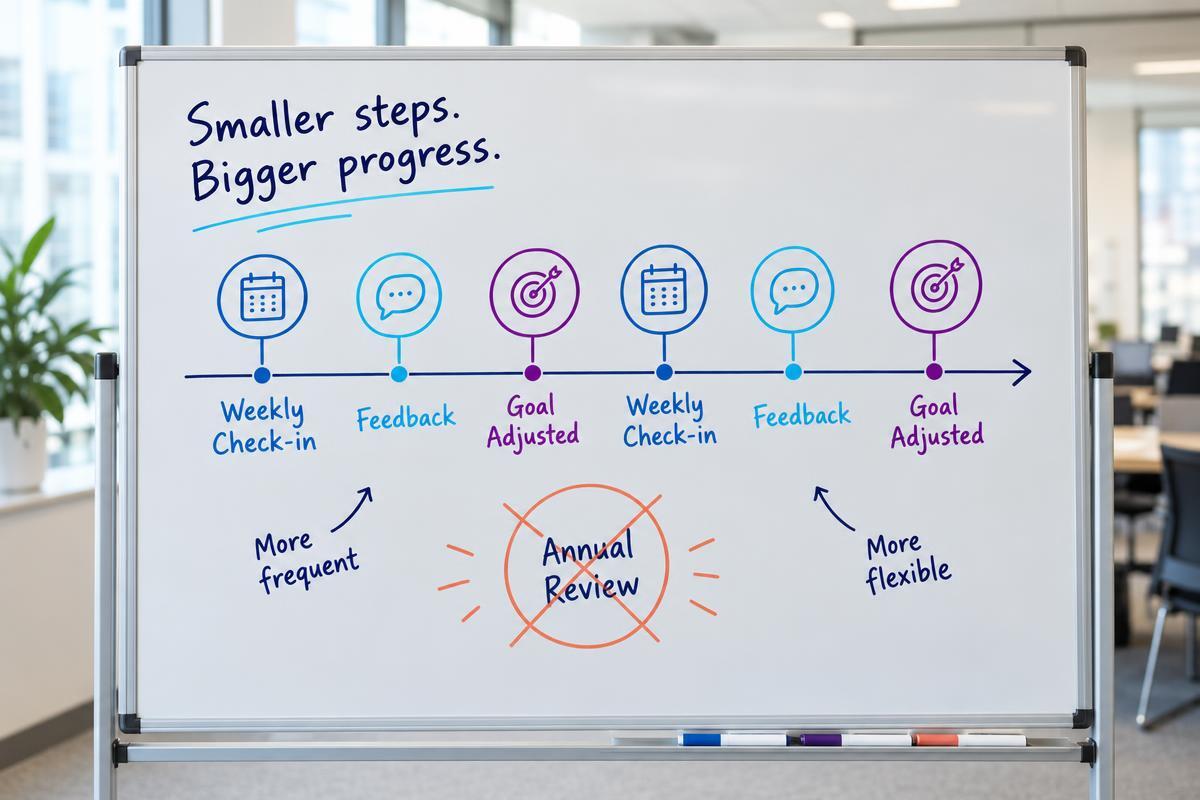
Annual reviews are too slow for modern agile teams. Continuous feedback models replace the yearly calibration meeting with regular, structured check-ins. Managers and employees discuss goals, roadblocks, and achievements weekly or monthly. This frequency completely changes the relationship between a manager and their team members.
The impact on engagement is measurable. Data from Hirex indicates that employees receiving feedback weekly or more often are reportedly three to four times more likely to feel engaged than employees receiving only annual reviews. This engagement directly impacts retention. The same Hirex report noted that organisations using frequent feedback and regular check-ins reported approximately 14.9% lower turnover than organisations relying on infrequent reviews. Starting performance management software that supports continuous listening is critical for this transition.
For executive teams that still need a visual framework for succession planning, the four-box model simplifies the grid. Instead of nine complex and overlapping categories, it plots current business impact against growth trajectory. The categories become much clearer.
This model focuses on what the employee is achieving right now and how they are trending, rather than assigning them a subjective ceiling. This framework aligns perfectly with looking beyond resumes and improving candidate evaluation accuracy during the initial hiring phase. You apply the same logical, evidence-based filtering to internal talent that you do to external candidates.
Objectives and Key Results (OKRs) provide another strong alternative to subjective potential ratings. Instead of evaluating a person's traits, you evaluate their outcomes. You set clear, measurable goals at the start of a quarter and track progress against them.
This method removes the bias associated with assessing personality. If an employee consistently hits their key results, their capability is proven. This data feeds directly into succession planning without requiring a manager to guess how that employee might perform in a hypothetical future scenario.
Rather than measuring static potential, learning capability frameworks measure how quickly someone adapts to new information. This is where modern learning systems prove their value. Compono Develop is a learning management system that handles capability and talent decisions. It feeds directly into your skills matrix by tracking actual skill acquisition rather than just course completion. This allows leaders to base promotions on proven adaptability rather than gut feeling.
Selecting the right alternative depends on your organisational maturity and your immediate business goals. Use this comparison to guide your strategy.
| Assessment Method | Primary Benefit | Main Limitation | Best Use Case |
|---|---|---|---|
| Skills Matrix | Provides objective, observable data on current capabilities. | Requires rigorous upkeep to ensure skills data remains accurate. | Technical teams and organisations transitioning to skills-based hiring. |
| Continuous Feedback | Drives high engagement and catches performance issues early. | Demands significant time commitment from line managers. | Agile teams with fast project turnarounds and high collaboration. |
| Four-Box Model | Simplifies succession planning and removes the "muddy middle". | Still relies slightly on manager judgment for "trajectory". | Executive leadership teams mapping long-term succession pipelines. |
| Goal-Centric (OKRs) | Focuses entirely on business outcomes rather than personality. | Can inadvertently discourage employees from taking creative risks. | Sales teams and highly outcome-driven operational departments. |
Moving away from a legacy assessment model is a major change management exercise. You cannot simply delete the old spreadsheet and expect managers to adopt a new mindset overnight. Follow these steps to ensure a smooth transition to capability-led talent management.
The first step is separating development conversations from pay reviews. When employees know a check-in determines their salary, they will not admit to capability gaps. They will hide their weaknesses. By separating these conversations, you create the psychological safety required for genuine continuous feedback.
Managers must learn to observe behaviour rather than judge potential. If an employee misses a deadline, the manager should document the missed deadline and the specific skills needed to fix the issue. They should not extrapolate that the employee lacks leadership potential. Training your leadership cohort on evidence-based observation is critical.
Manual spreadsheets cannot handle continuous feedback or live skills mapping. You need technology that centralises this data. Before selecting succession planning software, ensure it integrates with your learning management system so you can track actual capability improvements over time.
As you shift your models, keep an eye on operational metrics to ensure performance remains stable. A sudden change in management style can sometimes cause stress or confusion. Watch your absenteeism rates carefully. Using a Bradford Factor Tracker can help you identify unusual absence patterns that might indicate a team is struggling to adapt to the new continuous feedback cadence.
Compono Develop helps you track real capability and skill acquisition, giving you the objective data you need to map talent without relying on subjective guesswork.
The traditional grid is considered outdated because it relies heavily on subjective "potential" ratings. Managers are asked to guess an employee's future capability, which frequently introduces unconscious bias and stigmatises employees placed in lower boxes. Modern HR practices favour objective capability tracking instead.
A nine-box grid plots past performance against future potential across nine overlapping categories. A four-box model simplifies this by plotting current business impact against growth trajectory across just four categories. This makes the tool easier for managers to use and removes the ambiguous middle boxes.
Skills matrices replace the need for subjective performance reviews by mapping the exact capabilities required for a role against the observable skills an employee possesses. Instead of debating an employee's attitude, the manager and employee discuss clear, measurable competency gaps and plan training to close them.
While continuous feedback requires managers to meet with their teams more frequently, the meetings are typically short and focused. This ongoing cadence prevents small issues from escalating into major performance problems, ultimately saving managers the massive time investment required to fix broken projects or replace staff who resign due to poor communication.
You handle succession planning by looking at live capability data. By using a skills matrix and a reliable learning management system, you can identify exactly which employees have acquired the necessary skills for leadership roles. You promote based on proven adaptability and recorded skill acquisition rather than a manager's subjective rating of potential.
To run a talent review meeting that reduces bias and builds succession plans. Get practical agendas, HR facilitation scripts, and legal guardrails.
To assess employee potential accurately using objective capability data, psychometrics and structured frameworks. See how it works.
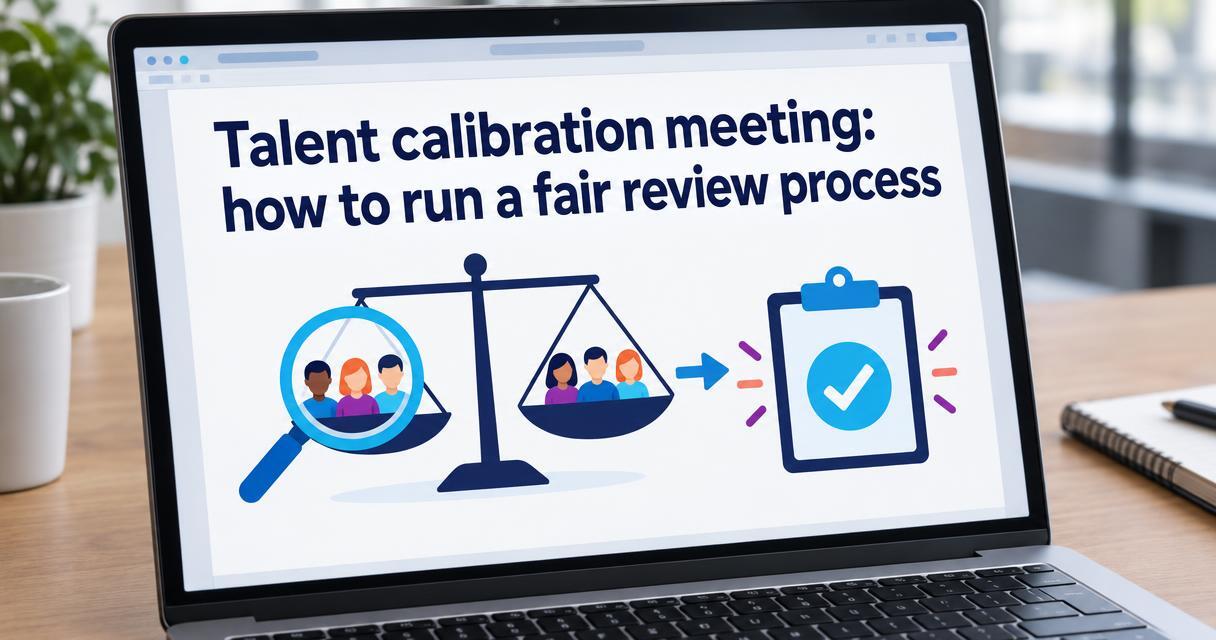
A talent calibration meeting aligns manager evaluations to ensure fair performance reviews. Learn how to run them, audit for bias and communicate...