

 Mathan Allington
To run a talent review meeting effectively, you need to combine objective performance data with structured behavioural insights, time-box the agenda to 90 minutes, and use a consistent calibration framework like the 9-box grid to separate current performance from future potential.
Last reviewed November 2026
Key takeaways
- Talent reviews fail when managers rely on gut feel instead of standardised performance and behavioural data.
- HR facilitators must use specific conversation scripts to challenge executive bias and prevent the halo effect.
- Legal guardrails require consistent documentation to protect against discrimination claims during calibration.
- Remote and hybrid talent reviews demand strict time-boxing and shared digital calibration tools to maintain focus.
- A successful meeting ends with actionable development plans rather than just updating a spreadsheet.
Why traditional talent reviews fall short
Many organisations struggle to understand how to run a talent review meeting that actually produces results. They often confuse these sessions with standard performance reviews. A performance review looks backward at what an employee achieved against their key performance indicators. A talent review looks forward to evaluate their future capability, their risk of leaving, and their readiness for succession.
When you combine these two different conversations, you invite process risk and people insight risk. Process risk occurs when HR teams spend all their time chasing managers to fill out spreadsheets. People insight risk occurs when you place someone in a leadership pipeline without understanding their true behavioural capabilities and work personality.
The stakes for getting this right are high. Only 22% of HR leaders report that their organisation has a formal succession plan, according to SHRM benchmarking research cited by Evalflow. Furthermore, 86% of organisational leaders say succession planning is urgent, but only 14% believe their organisations execute it effectively, as highlighted by Glean.
To close this gap, you need a structured approach to talent calibration. You need to move past subjective opinions and build a meeting framework that forces objective decisions.
Pre-meeting preparation and legal guardrails
A talent review meeting is won or lost in the two weeks before it happens. If managers walk into the room with empty templates or vague opinions, the meeting will devolve into a debate over personal favourites. Standardising your data collection is the first step toward a defensible process.
Standardising definitions of potential
You must give managers a clear rubric for assessing potential. Potential is not the same as performance. An employee might be a top performer in their current role but lack the learning agility to step up to a strategic leadership position. Define potential using observable behaviours. Ask managers to look for evidence of complex problem solving, resilience under pressure, and the ability to influence without formal authority.
You can simplify this process by using talent analytics software to gather capability data before the meeting begins. This ensures every manager evaluates their team using the exact same metrics.
Starting legal and compliance guardrails
Many HR leaders overlook the legal risks associated with talent calibration sessions. The notes and ratings produced during a talent review can become discoverable records in the event of an employment dispute or discrimination claim. You need strict guardrails to protect the organisation.
Train your managers to use objective and behaviour-based language in their pre-meeting notes. Terms like "too aggressive" or "lacks executive presence" are highly subjective and often carry unconscious bias. Instead, mandate language such as "needs to improve stakeholder communication during crisis events". Objective language protects the company and provides the employee with actionable feedback.
Consistency is your best defence. If an employee sees a sudden drop in their calibration rating without documented evidence or prior feedback, the legal risk increases. As noted by TechClass, 85% of employees say they would consider quitting after receiving an unfair performance review. This underscores the absolute necessity for consistent calibration in every talent discussion.
Attendance, roles and challenging manager bias
The success of your calibration session depends entirely on who is in the room and how they behave. Too many voices will derail the agenda. Too few voices will lead to an echo chamber. You need the right balance of business context and HR objectivity.
Who belongs in the room
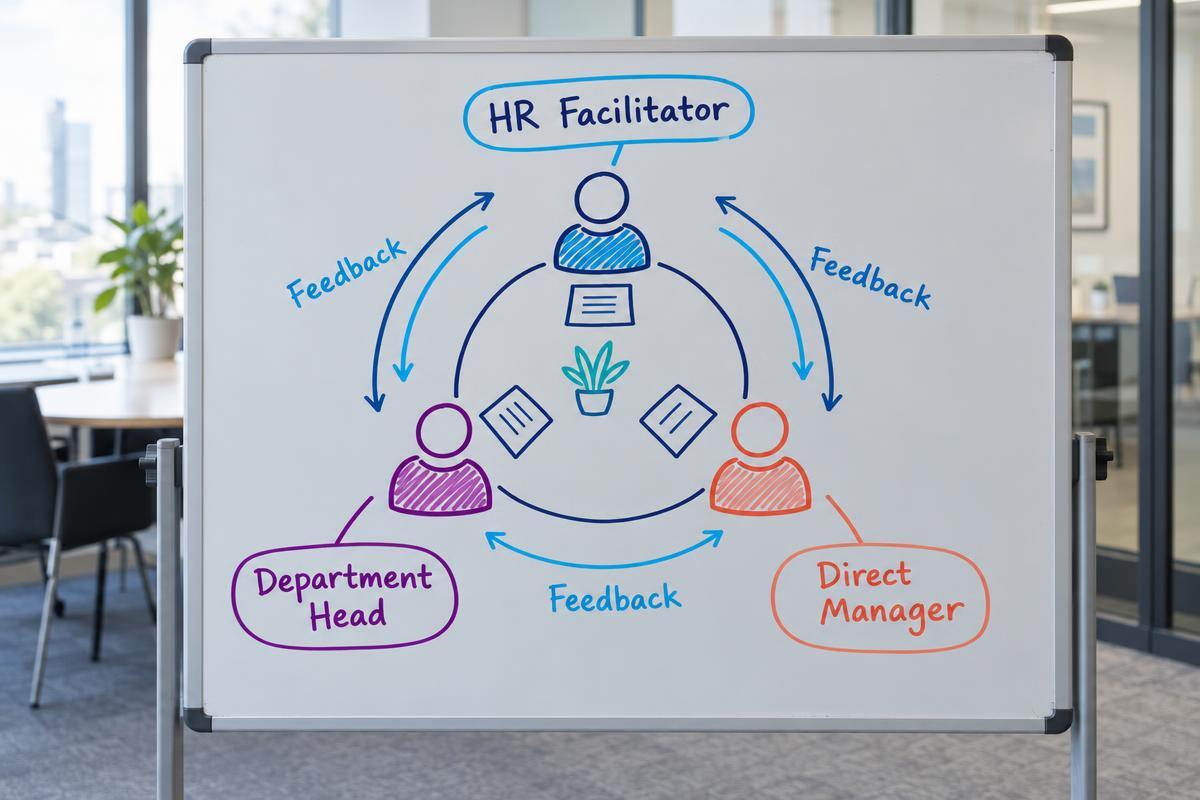
A standard talent review should include the department head, the direct managers of the employees being discussed, and an HR business partner acting as the facilitator. The department head provides the strategic vision for where the team is going. The direct managers provide the detailed evidence of employee capability. The facilitator ensures the process remains fair and strictly timed.
Facilitation scripts to challenge bias
The facilitator has the hardest job in the room. They must actively challenge senior leaders when bias creeps into the conversation. The halo effect occurs when a manager rates an employee highly across all categories simply because they excel at one specific task. The horns effect occurs when one recent mistake clouds a manager's entire view of an employee's potential.
To combat this, facilitators should use structured conversation scripts. When a manager gives an overly glowing review without evidence, the facilitator should ask: "Can you share a specific project from the last six months where they demonstrated this strategic capability?"
When a manager dismisses an employee based on a recent error, the facilitator should ask: "Are we rating their long-term potential, or are we penalising them for a single project outcome?"
When a manager advocates for a promotion simply because an employee has been there a long time, the facilitator should ask: "What new capabilities have they developed this year that show they are ready for the next level of complexity?"
These prompts force managers to ground their ratings in facts rather than feelings. This is critical because 26% of employees report receiving no feedback during the past year, highlighting the need to use talent reviews to identify actual feedback and development gaps, according to McKinsey & Company.
A practical 90-minute agenda template
Time management is the most common point of failure in talent reviews. If you allow open-ended discussions, you will spend an hour debating the first three employees and rush through the remaining twenty. A strict, time-boxed agenda is non-negotiable.
The step-by-step meeting structure
A standard 90-minute session should follow a rigid format to ensure equal time is given to critical talent decisions.
| Time allocation | Agenda item | Objective |
|---|---|---|
| 10 minutes | Ground rules and definitions | Align on the criteria for potential and remind the group of the legal guardrails regarding objective language. |
| 20 minutes | High-potential talent and succession | Identify the top performers ready for immediate advancement and verify the bench strength for critical roles. |
| 40 minutes | Calibration of edge cases | Debate the employees who sit on the borderline between two ratings. Do not spend time agreeing on obvious placements. |
| 20 minutes | Action planning and follow-up | Assign specific development plans, mentorship assignments, and communication strategies for every employee discussed. |
Strategies for remote and hybrid talent reviews
Running this agenda in a distributed work environment presents unique challenges. Side chats in messaging apps can undermine the transparency of the meeting. To run an effective remote talent review, you must establish specific digital ground rules.
First, mandate that all cameras remain on to ensure active participation. Second, use a shared digital whiteboard or a live dashboard so everyone can see the calibration grid changing in real time. Third, enforce a strict speaking order during the calibration phase to prevent senior voices from talking over junior managers. Finally, use a dedicated internal talent mobility platform to log decisions live, ensuring no data is lost when the video call ends.
Objective calibration and assessing performance versus potential
The core of the meeting is the calibration exercise. This is where you plot your team on a matrix to visualise your talent market. Most mid-market organisations use a framework that separates historical results from future capability.
Using calibration frameworks effectively
If you use a 9-box grid, you map performance on one axis and potential on the other. The goal is not to force a right bell curve. The goal is to identify your hidden talent, your reliable core contributors, and your flight risks.
You must instruct managers to focus their debate on the edge cases. Do not spend twenty minutes discussing your absolute best employee if everyone already agrees they are ready for promotion. Spend that time discussing the employee who delivers great results but leaves a trail of burnt-out colleagues in their wake. That is where the real people insight risk lies.
Integrating predictive analytics and skills data
Modern HR teams are moving beyond manual spreadsheets to capture this data. Predictive analytics can now highlight skills gaps before a manager even notices them. By reviewing data on learning agility and course completions, you can bring objective capability metrics into the calibration room.
This is where skills development software proves invaluable. When you can see exactly which competencies an employee has mastered over the last six months, you do not have to rely entirely on a manager's memory. The data provides a neutral baseline for the conversation.
Post-meeting follow-through and measuring success
A talent review that ends when the meeting ends is a waste of corporate time. The true value of the session lies in the development plans and succession decisions that follow. You must translate the grid placements into immediate action.
Action plans and talent governance
Every employee discussed must walk away with a tangible outcome. For high potentials, this might mean an assignment to a cross-functional project. For underperformers, it means a structured performance improvement plan. The HR facilitator must record who is responsible for delivering this feedback and set a deadline for the conversation.
You must also establish clear governance regarding what data is shared with the employee. Transparency is important, but sharing raw calibration scores without context can damage morale. Best practice dictates that you share the specific development goals and the feedback themes, rather than the literal grid placement.
Metrics to track ROI and long-term success
To prove the value of your talent review process to the executive team, you need to track specific return on investment metrics over time. The primary metric is succession bench strength. Only about one-third of critical roles are covered by succession plans, with coverage at 32% for CEO-reporting roles and 34% for the next management level, according to McKinsey & Company. Your goal is to increase that percentage year over year.
You should also track your internal mobility rate and the retention rate of your identified high-potential employees. Succession planning should be integrated into strategy, talent reviews, and annual evaluations rather than treated as a one-off event, as noted by Semler Brossy. Furthermore, 72% of organisations report that their full board reviews and updates CEO succession plans annually, offering a benchmark for recurring talent-review cadence according to iMocha.
When you run talent reviews with strict agendas, objective data and strong legal guardrails, you stop reacting to resignations and start actively designing your future workforce.
How Compono can help with talent decisions
Talent reviews are only as effective as the data you bring into the room. When you rely on memory and spreadsheets, bias takes over. Compono gives you clear visibility into your team's real capabilities and skills gaps, so you can base your succession and growth decisions on hard evidence rather than guesswork.
Frequently asked questions
What is the difference between a talent review and a performance review?
A performance review looks backward at an employee's output against their key performance indicators. A talent review looks forward to evaluate their potential, succession readiness and development needs for future roles.
Who should help a talent review meeting?
An HR leader or trained facilitator should run the meeting. Their primary role is to maintain the strict schedule, ensure consistent evaluation criteria and challenge manager biases during calibration discussions.
How often should you hold a talent review meeting?
Most mid-market organisations hold formal talent reviews once or twice a year. High-growth companies often shift to a quarterly cadence to keep pace with changing capability requirements and rapid internal mobility.
What data should managers prepare before a talent review?
Managers need to prepare recent performance scores, a draft calibration grid placement, retention risk assessments and specific examples of behaviours that demonstrate learning agility or leadership potential.
What should you tell employees after a talent review?
You should communicate the specific feedback themes, capability gaps and agreed development plans. It is generally not recommended to share raw calibration scores or grid placements, as they require significant context to interpret correctly.