


8 min read
People insight risk: what it is and why it grows in 2027
 Mathan Allington
October 26, 2026
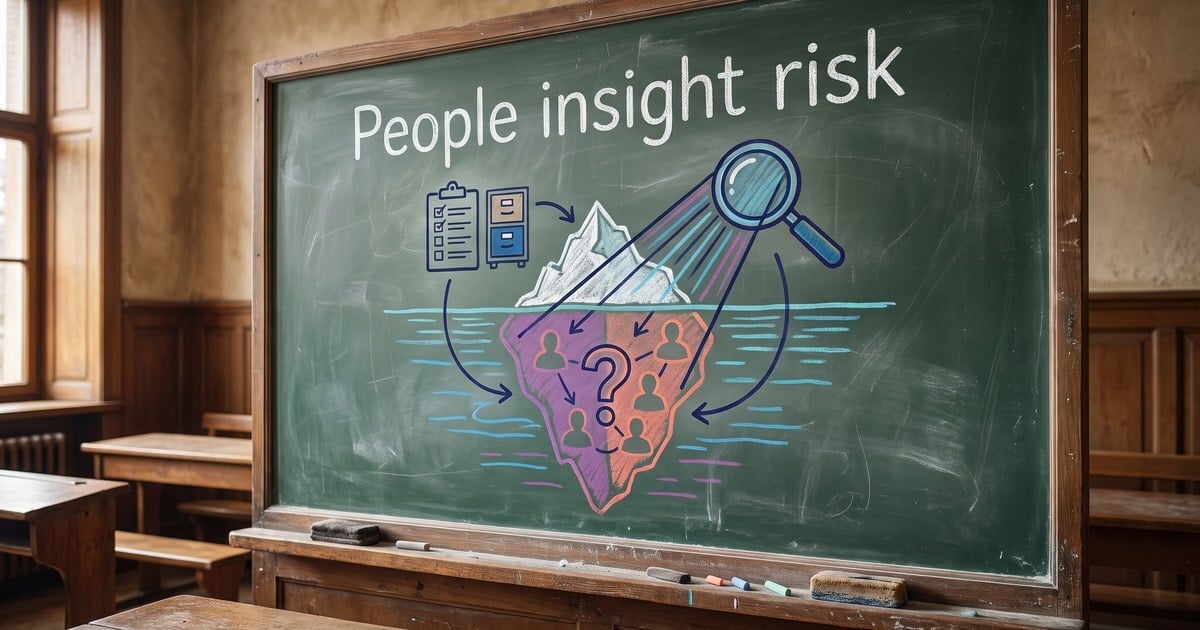
People insight risk is the risk of making the wrong people decisions, in hiring, culture, capability and retention, because your tools record the process but don't explain the people. Process risk is the other half: errors in admin, compliance, payroll and onboarding, which current HR tech handles well. In 2027, faster AI-assisted processes and new transparency rules make people insight risk bigger and harder to hide.
Last reviewed October 2026. Written for HR leaders in Australia and New Zealand who want people decisions they can defend in 2027.
In short
- AI in HR is mostly buying speed: in SHRM's 2026 study, 89% reported greater efficiency and 24% better identification of top candidates.
- Australian employers receive 21.5 applicants per vacancy but only 5.2 suitable ones, so matching is the hard part of hiring.
- Australian job mobility has fallen to 7.2%, so a wrong hire or a disengaged key person stays with you for longer.
- Global manager engagement fell from 31% in 2022 to 22% in 2025, and an engagement score alone can't tell you why.
- From 10 December 2026, organisations covered by the Privacy Act must disclose in their privacy policy when computer programs make or inform significant decisions about people.
- CV history and unstructured interviews predict job performance far less well than once assumed.
- You reduce people insight risk by keeping your process tools and adding evidence about how people work.
Most HR teams going into 2027 have plenty of data and far less clarity about what it means for the next hire or restructure. Compono's Two-Risk Framework gives that gap a name.
What is people insight risk?
People insight risk is the chance that a people decision goes wrong because you couldn't see what mattered when you made it. It's the candidate who looked right on paper and left within months, the strong performer who quietly disengaged, or the training program that ticked every compliance box and built no capability. The process ran perfectly each time, and HR still wears the blame.
Process risk is the half most HR technology was designed for: admin errors, missed compliance deadlines, payroll mistakes and onboarding steps that slip through. Applicant tracking systems (ATS), HR information systems (HRIS) and learning management systems (LMS) reduce it well. They record what happened, though, not why people behave the way they do.
Our HR risk management guide covers the full register, from compliance and safety to industrial relations. People insight risk is the item most registers leave out: the quality of the people decisions themselves.
Process risk vs people insight risk
| Area | What current tools handle | What they miss | The 2027 question to ask |
|---|---|---|---|
| Hire | Job posts, applicant tracking, scheduling, offers | Whether this person will do the work well in this team and culture | What evidence beyond the CV says this candidate fits? |
| Engage | Pulse surveys, sentiment trends, engagement scores | Why a team is disengaged and what would change it | Which ways of working sit underneath this score? |
| Develop | Course assignment, completions, compliance records | Whether training builds the capability the role needs | Which capability gap does this close, and how will we know? |
Most HR stacks answer the second column well and leave the last one to gut feel. See our comparison of process and insight tools for HR leaders.
Why people insight risk grows in 2027
Six forces are pushing people insight risk up next year. Each one makes it riskier to treat process data as though it explains people. For the wider picture, see our HR trends for 2027 in Australia and New Zealand.
1. AI speeds up the process without improving the decision
In SHRM's State of AI in HR 2026, a survey of 1,908 HR professionals, 89% cited greater efficiency and 36% lower hiring costs, while 24% cited better identification of top candidates. SHRM also found 56% of HR functions don't formally measure the success of their AI investments, and only 16% use ROI metrics.
AI lands first in screening and scheduling, where time saved is easy to see. Whether it improves who you hire is a harder question that few are measuring.
Our take: AI applied to an incomplete process mostly makes the same decisions faster. If your screening rules filtered on weak signals before, automation filters on them at scale. Before you add AI to any step in 2027, write down the decision it's meant to improve and how you'll check that it did.
2. More applicants, and still a shortage of suitable ones
Jobs and Skills Australia's Occupation Shortage Report for the March quarter 2026 found employers received 21.5 applicants per vacancy. Only 8.3 were qualified and 5.2 suitable, and the national fill rate still fell to 68.2%.
Volume was never the constraint. An ATS is good at moving 21 applications through stages, but it can't tell you which five will do well in your team and culture. The recruitment trends for 2027 show why matching matters more than volume.
Our take: When suitability is the bottleneck, a faster pipeline helps less than you'd hope. Define what good looks like in the role and team before the ad goes live, then screen for evidence that predicts it. The cost of a bad hire calculator shows what a miss costs, and Compono Hire is an ATS that also profiles candidates against your culture and your best people.
3. People are staying put, so wrong decisions last longer
The Australian Bureau of Statistics reports that 7.2% of employed people changed employer or business in the year to February 2026, down from 7.7% the year before and 9.6% in the year to February 2023.
Low mobility looks good on a retention dashboard. It also means a hire who doesn't fit stays longer, and a capable person who has quietly checked out keeps the seat, so the cost of a poor decision keeps running.
Our take: In a low-churn market, turnover rate is a weak warning signal. Pair it with measures of how people experience work, so you find the problems that aren't walking out the door. The cost of disengagement calculator puts a figure on the ones that stay.
4. Manager engagement is falling fastest
Gallup's State of the Global Workplace 2026 found global manager engagement fell from 31% in 2022 to 27% in 2024 and 22% in 2025, while non-managers moved from 20% to 19%. ANZ looks better for now: Gallup's 2026 regional summary puts ANZ managers at 27% engaged against 17% for individual contributors, a premium that has disappeared globally.
Managers make many of the hiring, development and retention calls. A survey shows their engagement dipping but not whether the cause is workload, unclear roles or a team whose ways of working pull against the manager's. Our engagement and culture trends for 2027 track the manager shift.
Our take: A falling manager score usually gets a leadership course. More often the fix is in the fit between how the manager works and how their team works, and no engagement score shows you that. That's the practical difference between engagement surveys and culture measurement. Compono Engage, our culture assessment and engagement software, measures both, so you see the dip and what's driving it.
5. Regulators want decisions you can explain
The Office of the Australian Information Commissioner (OAIC) confirms that from 10 December 2026, organisations covered by the Privacy Act must include information in their privacy policy when they've arranged for a computer program to make or inform decisions that could significantly affect an individual's rights or interests, including the kinds of personal information used. If you use automated screening or scoring in recruitment, review it with your privacy adviser now.
For Commonwealth agencies, the Australian Public Service Commission's principles for agency use of AI in recruitment state that "all recruitment and employment decisions must be explainable and defensible" and that "AI tools must not make the final decision in recruitment outcomes." Private employers aren't bound by them, but they show where expectations are heading.
Under the model WHS laws, Safe Work Australia explains, a business must eliminate psychosocial risks or, if that isn't reasonably practicable, minimise them so far as is reasonably practicable. Its list of common hazards includes lack of role clarity, poor support and poor change management, which are culture and climate conditions as much as safety ones.
Our take: A defensible decision shows the evidence and reasoning as well as the steps. A pipeline log proves the process happened, but it doesn't explain why one candidate was chosen. In 2027, keep the evidence behind people decisions as carefully as the process records. The psychosocial risk readiness calculator shows where you stand. This is general information, not legal advice, and New Zealand obligations differ.
6. The old hiring shortcuts were less predictive than assumed
The most-quoted table of how well selection methods predict job performance dates from Schmidt and Hunter in 1998. Sackett, Zhang, Berry and Lievens revised it in 2022 and set out the implications in Industrial and Organizational Psychology in 2023. Unstructured interviews fell from 0.38 to 0.19, with a lower 80% credibility value of -0.01, so in the weakest settings they predict no better than chance. Years of job experience sits at 0.07. Structured interviews came out on top at 0.42, and personality measured in a work context held up well: contextualised conscientiousness came in at 0.25 with almost no variation between studies.
Most process tools record the signals that slipped, like CV history and years of experience, without testing whether they predict anything.
Our take: Speeding up a weak predictor gives you weak decisions sooner. Use structured interviews, assess how people approach work, and treat experience as context rather than evidence.
How to reduce people insight risk in 2027
Keep your process tools, and add the evidence they don't hold. Compono's Engage interpretation method asks four questions of every result: what is happening, why it is happening, what it means for performance and what to do next. Data without context is reporting, and context without data is opinion. Most HR reporting stops at the first question. Good people analytics starts from the decision and works through all four.
Ask for specific evidence at each decision point:
- Hiring: What predicts success in this role and team? Ask for structured interview scores and a read on how the candidate approaches work.
- Engagement and retention: Which teams are slipping, and why? Ask for culture and climate results by team, since the organisation-wide average hides them.
- Development: Which capability gap does this training close for this person? A completion rate only proves attendance (see our L&D trends for 2027). Compono Develop is an LMS that maps learning to real performance gaps.
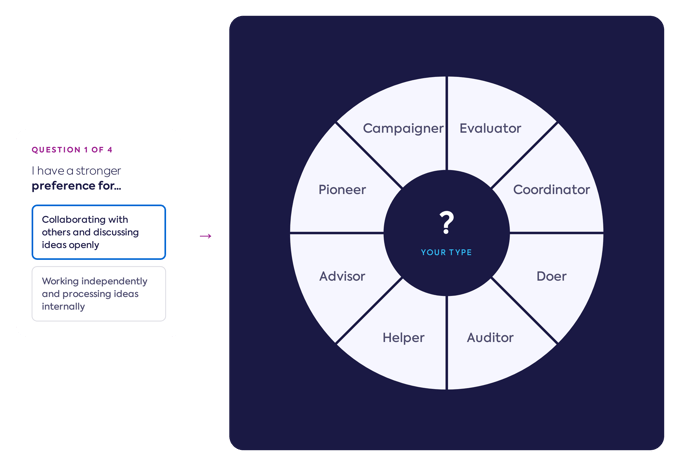
- Team and manager changes: Does this team's behavioural shape support the work it needs to do? Look at the team's Work Personality spread across the 8 ways of working (Doer, Auditor, Helper, Advisor, Pioneer, Campaigner, Evaluator and Coordinator) before you restructure or appoint a manager. Start with the free Work Personality assessment: 4 questions, about 2 minutes.
Read culture, climate and Work Personality together. Culture shows how work gets done, climate shows how people feel about it and how urgent a problem is, and Work Personality helps explain why the culture exists, because behaviour repeated over time becomes culture.
Go beyond the process in 2027
The tools that handle process risk are still worth keeping. The costliest mistakes in 2027 will come from people decisions made quickly, on thin evidence, with tools that show what happened but not why. An HR plan for 2027 that covers both risks is the place to start. Go beyond the process, understand your people and make decisions you can defend. Compono's workforce intelligence platform reduces both risks across hiring, culture and capability. See how it works.
See the people insight your process tools miss
Hire, Engage and Develop on one platform, built on organisational psychology, so your people decisions come with evidence you can defend.
Talk to usFrequently asked questions
What is people insight risk?
People insight risk is the risk of making the wrong people decisions, in hiring, engagement, development and retention, because your tools record process but can't explain how people work. It shows up as hires who don't fit and training that builds no real capability.
What is the difference between process risk and people insight risk?
Process risk covers errors in admin, compliance, payroll and onboarding, which current HR systems handle well. People insight risk is about the quality of the decision itself, such as whether you hired the right person or read a team correctly. A process can run perfectly and still produce the wrong decision.
Why will people insight risk matter more in 2027?
AI is speeding up HR processes faster than it's improving decisions, and Australian employers receive many applicants but few suitable ones. Low job mobility means poor decisions last longer, and manager engagement is falling globally. Australian privacy rules on automated decisions, commencing 10 December 2026, also push organisations to explain significant decisions about people.
How can HR reduce people insight risk?
Keep your process tools and add evidence about how people work. Before each decision, ask what is happening, why, what it means for performance and what to do next. Use structured interviews in hiring, and read culture, climate and Work Personality results together by team instead of relying on one engagement score.
Better hiring decisions, before the interview
Compono Hire helps you predict job-fit and team-fit using behavioural science, so you can shortlist with confidence.
Request a demoBuilt for mid-market hiring teams.
Practise your next tough conversation
Voice-first coaching that adapts to your personality. Get actionable steps you can take this week.
Start freeBuilt by Compono. Not therapy — practical behaviour change.