

.webp)

 Compono


1 min read
Team effectiveness assessment tools for high performance
 Mathan Allington
Team performance assessment tools measure three things: what each person on a team naturally does well, how the group works together day to day, and...

The most polished pitch deck in the world cannot hide a fractured leadership team forever, yet many investors continue to write cheques based on spreadsheets rather than the human dynamics that actually drive execution.
While financial and legal due diligence are standard practice, the human element—often the primary reason a high-potential startup fails—is frequently left to gut feel and intuition. We believe it is time to move beyond the bio and introduce rigorous people intelligence as a formal pillar of your investment strategy.
You have seen hundreds of them: the sleek slides, the hockey-stick growth projections, and the impeccable market opportunity assessments. Pitch decks are designed to persuade, and founders are increasingly adept at presenting a united front. However, a spreadsheet can only tell you what has happened or what is predicted to happen in a vacuum; it cannot tell you how a founding team will behave when the burn rate increases or a key product launch fails.

The reality is that financial data often masks underlying friction. When you invest in a company, you aren't just buying a business model; you are backing a group of individuals and their collective ability to solve problems. Traditional due diligence excels at finding holes in the balance sheet, but it rarely uncovers the hidden friction between a visionary CEO and an operationally-minded COO who have fundamentally different views on how to scale. This lack of leadership alignment is a silent killer of ROI.
We have found that many investors rely on a few dinners or casual chats to assess 'culture'. While these interactions are valuable, they are also prone to the 'halo effect'—where a founder’s charisma blinds an investor to potential execution gaps. To truly de-risk your portfolio, you need to look beneath the surface of the deck and quantify the soft risks that usually remain invisible until after the deal is closed.
In the world of mergers and acquisitions, the post-deal integration phase is where most value is lost. Research consistently shows that cultural misalignment is the leading cause of failed integrations. When two founding teams or executive suites are forced together, their natural work styles, communication habits, and decision-making processes often clash. If you don't understand these dynamics before the ink is dry, you are essentially gambling on the success of the integration.
Founder risk is not just about competence; it is about cohesion. A team of A-players can still fail if their work personalities are too similar, leading to groupthink, or too divergent, leading to constant deadlock. For example, a team composed entirely of 'Pioneers' might be brilliant at ideation but struggle with the 'Doing' required to hit milestones. Conversely, a team of 'Auditors' and 'Coordinators' might excel at process but lack the 'Campaigner' energy needed to sell the dream to future hires and customers.
At Compono, we have spent years researching high-performing teams to map how natural work preferences influence collective outcomes. By understanding the Compono Culture, Engagement and Performance Model, you can begin to see how the 'way things are done' in a startup directly impacts its ability to reach the goals laid out in that perfect pitch deck. This isn't about finding 'perfect' people; it's about finding the right mix of people who can work well together under pressure.
Traditional due diligence often stops at the resume. You see a founder with an MBA from a top school or a stint at a tech giant, and you tick the 'competence' box. But a bio doesn't reveal how a person deals with conflict, how they delegate control, or whether they are actually motivated by the day-to-day reality of the role they are in. Leadership alignment requires a deeper look at the intrinsic motivations of the founding team.
We often see 'brilliant jerks' who look fantastic on paper but destroy the very culture they are trying to build. Their negative impact on morale can lead to a revolving door of talent, which is an incredibly expensive problem for any business to solve. When you assess leadership alignment, you need to ask: Do the founders agree on the level of formal process required? Is their decision-making centralised or delegated? Are they focused on internal effectiveness or customer-centricity?
These are not just 'vibe' questions; they are structural questions that define the execution capability of the business. If the CEO wants an innovative, risk-taking culture while the CFO is inherently risk-averse and process-driven, the resulting friction will paralyse the organisation. Compono helps reveal these work personality traits early, allowing you to facilitate honest conversations between founders before they become a problem for your portfolio.
It is time to elevate 'People Intelligence' to a formal due diligence category, alongside financial and legal reviews. By using data-backed clarity, you can assess the execution risks of a founding team with the same rigour you apply to their cap table. This involves looking at team design as a primary ROI driver. If a team is missing a critical work type—for instance, they have no one naturally inclined to 'Evaluate' risk—you can identify that gap and plan for it as part of your investment terms.
Consider a turnaround scenario. When a company is struggling, the instinct is often to cut costs or pivot the product. However, if the root cause is a leadership team that has lost its cohesion, no amount of product pivoting will save the deal. In these cases, people intelligence allows you to clear the 'fog of war' and identify exactly where the work environment is holding the team back. It gives you the evidence needed to restructure the leadership team based on science rather than politics.
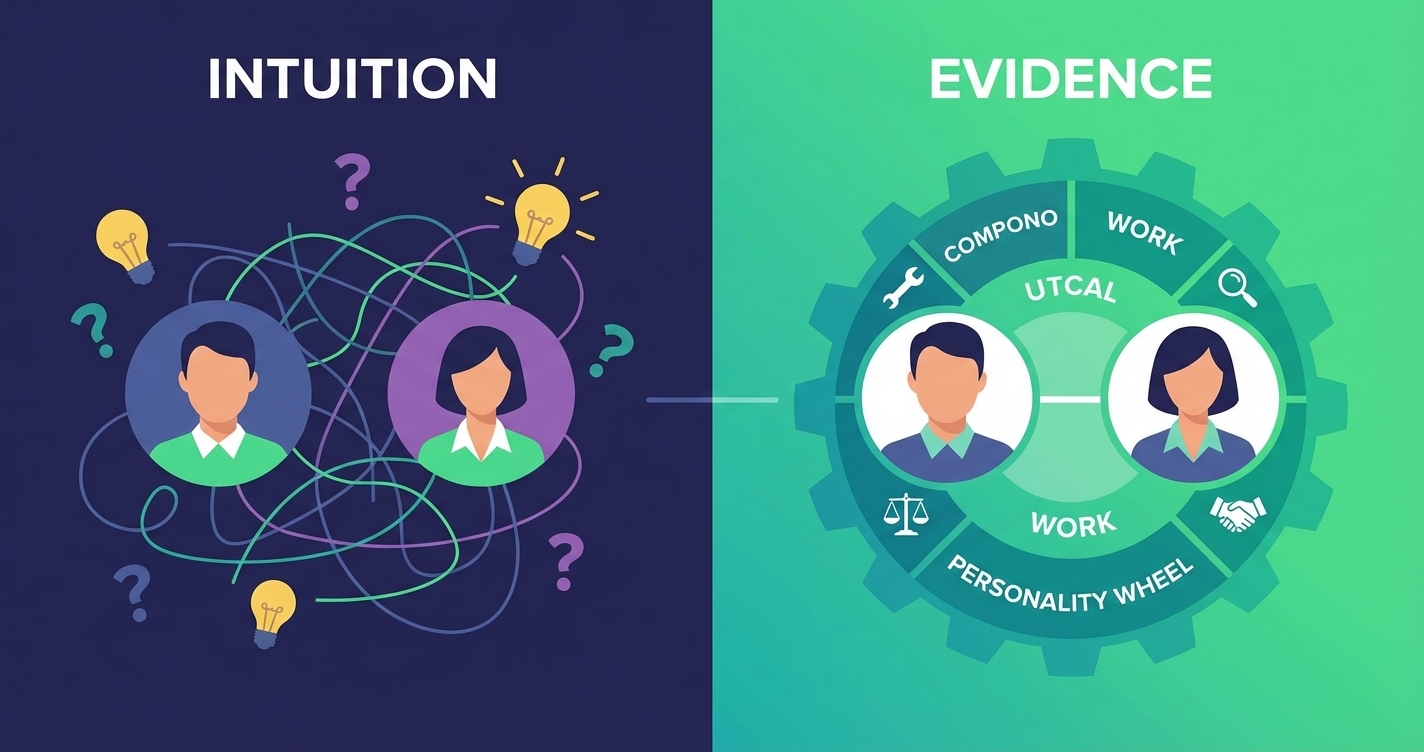
By integrating psychometric insights into your process, you move from intuition to evidence. You can see how a team's collective personality will influence their communication style and conflict resolution. For instance, knowing that two founders both have 'The Evaluator' work personality might tell you they will likely clash over who has the final say on strategic decisions. Providing this insight to them—and to you—is a powerful way to de-risk the investment from day one.

Managing an investment portfolio is an exercise in risk mitigation. You diversify your holdings, you monitor market trends, and you stay close to the numbers. But are you monitoring the cultural health of your portfolio companies? Cultural misalignment or leadership gaps often develop slowly over time as a company scales from 10 to 100 employees. If you aren't tracking these 'soft' metrics, you are missing the leading indicators of future financial trouble.
High-impact investors are now using people analytics to track the effectiveness of change initiatives within their companies. If a portfolio company is falling behind its growth targets, a culture assessment can reveal if the work atmosphere has become toxic or if job engagement has plummeted. This data allows you to act as a strategic coach to your founders, helping them build the teams they need to succeed. You can use Compono's platform to get a walkthrough of how to map these dynamics across your entire portfolio.
The goal is to build a repeatable playbook for human capital. When you can identify what 'good' looks like in your most successful companies, you can look for those same patterns in your next deal. You begin to recognise that the biggest risk in any deal is rarely the technology or the market—it is the people. By uncovering what pitch decks and spreadsheets can't, you safeguard your growth trajectory and ensure that your capital is backed by a team that can actually deliver.
The era of investing purely on the basis of financial metrics and charismatic presentations is ending. As the market becomes more competitive, the ability to identify and mitigate people risk will become the ultimate differentiator for successful investors and M&A specialists. Leadership alignment is not a luxury; it is a fundamental requirement for sustainable performance.
We invite you to stop guessing about the people behind the deal. Whether you are looking at a seed-stage startup or a complex global acquisition, the human factors will always be the primary driver of your success. By moving from intuition to evidence, you can turn human capital into your greatest competitive advantage. Remember, work isn't just something people do; it's a part of who they are. When you align who people are with what they do, you unlock potential that no spreadsheet could ever predict.

1 min read
Team performance assessment tools measure three things: what each person on a team naturally does well, how the group works together day to day, and...
1 min read
Why teams look for a Predictive Index alternative The Predictive Index behavioural assessment is one of the most validated instruments in the market,...
1 min read
Implementing a work personality test takes four steps: choose a test that is validated for workplace use, set clear objectives and prepare your team,...